Author: Stacey Hollebeek

  • Cheri Ackerman ’07

    Cheri Ackerman ’07

    ”Class with RVL was about making Jesus come alive to me— that He’s a real person who has real things to say to me. That I should expect to hear God speaking into my life.
    Connections Fall 2020 Alumni Profile

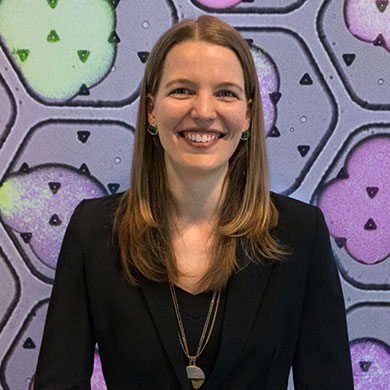
    Cheri Ackerman ’07 is refreshing living proof that faith, joy, science, and wonder are compatible. Maybe even that they belong together.

    You may have read about Dr. Cheri Ackerman ’07 in a few newspapers back in May of 2020, when her co-authored paper entitled “Massively multiplexed nucleic acid detection with Cas13” was published to much acclaim in Nature—the world’s leading multidisciplinary science journal, that is an honor for anyone to get published in, but especially as the first author listed. Her paper presented a new technology that can accurately and rapidly test over 1000 individuals at once for a virus like COVID-19—news that is especially exciting in the thick of quarantines and shutdowns.

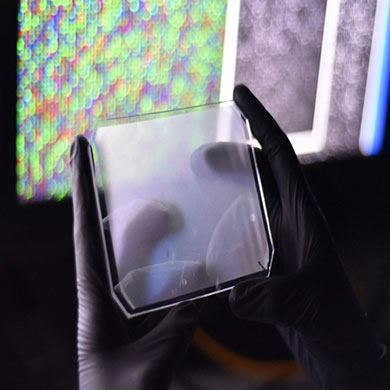
    The new diagnostic technology, called CARMEN (Combinatorial Arrayed Reactions for Multiplexed Evaluation of Nucleic acids), can also test one individual’s blood sample for over 160 different viruses all at once, using a “kChip,” a clear and flexible microfluidic “chip” about the size of a small CD case, so patients could find out exactly and quickly which viruses are making them sick.

    It’s biotechnology that Cheri helped create as a postdoctoral fellow at the Broad Institute of MIT and Harvard for the last couple of years. It’s obviously useful medical research that she and her team were excited to do, and its incredible value has only skyrocketed since the global COVID-19 pandemic started.

    “I was honed for that [postdoc] position—I was really good at it. It was super fun, and by God’s grace I was really successful,” Cheri said matter-of-factly, then running through her educational history after Holland Christian: double majors in Spanish and biochemistry at Calvin University, her PhD in chemical biology from the University of California-Berkeley, completed with a full ride Hertz Fellowship. Then postdoctoral work with the Broad Institute of MIT and Harvard.

    But believe it or not—there’s even more exciting news now. Because what do you do with your very smart self after you finish your postdoc? Most people in her position would go into academia, seeking an elite, tenured, though potentially lonely professorship somewhere. Instead, Cheri stayed in Boston to start Concerto Biosciences, a startup where she now works as CEO, and is learning on the fly how to market to potential investors—with zero business experience covered in her previous 27+ years of education.

    “I have no idea how to do this, but honestly, it’s really energizing,” she said laughing. “In praying about it, I felt God saying, ‘You are made for either [academia or Concerto]. Success is not guaranteed in either one, but I will be with you whatever you do. Neither is outside my wish for you.”

    Plus she really likes the team of four that she started the company with, and saw how clearly they would be working in this together. They’re “so smart, talented, so motivated!” she said. “Their willingness to trust me as well—that you are the right person to carry this vision forward, to lead us and shape us, create our team culture—is a very powerful and rare thing!”

    Concerto is a biotech company that uses the same kChip from CARMEN and applies it to probiotics, or microbiome therapeutics, looking to discover new therapies for diseases by using various random mixes of bacteria. They’re planning to start with eczema, a disease that infects over 200 million globally, and costs over $5 billion to the American economy.

    “There’s this vague notion that probiotics are good for you, but the science is still growing,” Cheri explained. “The world is an exciting place—we know that there’s more to learn in this field. Just like in science, this is a hypothesis that we’re trying to test, but in business—you have a hypothesis about who wants your product. We’re trying to address all the risks with as little money as possible.”

    She never really imagined back in middle school or high school she would be doing what she’s doing now. “In high school I was pretty set on being a doctor. When I was in middle school there was a Tsunami in Bangladesh, and I remember feeling so stuck. Old enough to want to make a difference, but not old enough to be able to make a difference. But business? No!” she smiled.

    It’s that winsome mix of seeing her amazing brain as a gift from the Lord given to serve others, along with the humility to appreciate how others have shaped her, and her sheer delight in God’s elegantly designed world that make Cheri a poster child for Christian education—besides a fascinating person to talk to. You believe her that this Concerto upstart is not only possible, but you follow her delight in getting to be the person uncovering God’s intricate designs and handing it to us for healing.

    Oh, and add a sense of humor, to laugh even at herself.

    “In high school I was really smart, and bad at being really smart,” she laughed. “I was too serious—people just want to have fun in high school, and I didn’t get that back in high school—I was like can we just talk about science, math, and ideas?”
    ”There’s this vague notion that probiotics are good for you, but the science is still growing. The world is an exciting place…

    ”The Christian life was not meant to be walked alone—we’re in this together—our faith is a shared faith…
    That being said, Cheri definitely gives credit to past teachers, tracing back present day loves to HC days. At Calvin, Cheri majored in both Spanish and biochemistry, and claims the Spanish stems from first grade at HC, when Miss Scholten was her teacher: “She was amazing. She taught us all of the colors and numbers in Spanish. I really fell in love with the Spanish language starting already at age six thanks to her.”

    The 8th grade Isle Royale trip that she took with Mr. Dewey was “life changing,” and the first time she ever backpacked—now a favorite pastime, with traipsing unhindered for days throughout the Sierras one of her favorite things to do.

    And sophomore biology with Julie (Bredeweg) O’Brien “changed my life—it was super formative for me!” she said, remembering how learning one day that DNA changes to RNA, which changes to protein blew her world. Plus, “there’s a woman crushing it in science—who understood really cool things about the world and taught them to us.”

    Then there were AP English with Mark Hiskes, and Discipleship Class and Israel trip with Ray VanderLaan: “Both were really good about exploring who do you want to be in this world, what do you want to be building and putting your energy into in this life. Who are you building for, why those things.”

    But really, she appreciated any HC teachers “willing to engage the full force of my brain, who were not intimidated by my brain, not frustrated when I got done too early, but thought ‘Let her take it to the next level,’ and encouraged that exploration,” she said.

    Cheri also appreciates the intentional spiritual teachings she had at HC, and that have played out valuably throughout her life so far. The Discipleship class with RVL was “really about making Jesus come alive to me— that He’s a real person who has real things to say to me about who I am, what I do in the world. That I should expect to hear God speaking into my life.

    “That call to have your faith touch every part of your life is really strong at HC,” Cheri added, while recognizing first hand it’s not always easy for Christians to thrive solo in the variety of academic situations she’s been in. “There’s something about Christians holding Christians up in these more adversarial situations,” she said. “The Christian life was not meant to be walked alone—we’re in this together—our faith is a shared faith and a new context puts new pressure on your faith, so having a community around you is incredibly important to walk through that with you.”

    In Cheri’s day-to-day life now, she’s hitting the streets— virtually and literally—for Concerto investors, selling not only a product, but a creation that can improve people’s lives, and is trusting God will see her through. That He created her and made her who she is for this very time, and for this very purpose.

    For further information on Cheri’s research from this spring, read her Nature publication at nature.com/articles/s41586-020-2279-8, or watch her Calvin interview on the topic at calvin.edu/news/archive/calvin-alumresponds-to-the-pandemic-with-innovative-diagnostics.
  • Rebecca Deng ’04

    Rebecca Deng ’04

    Spring 2020 Connections Alumni Profile

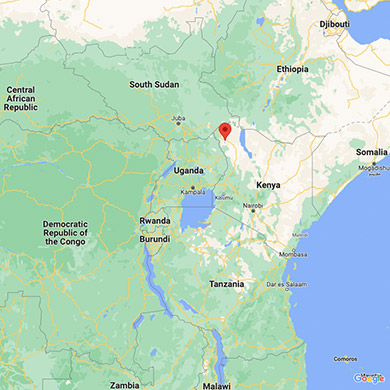
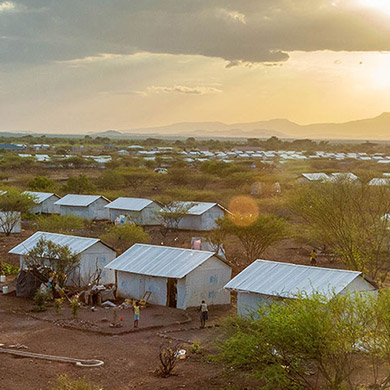
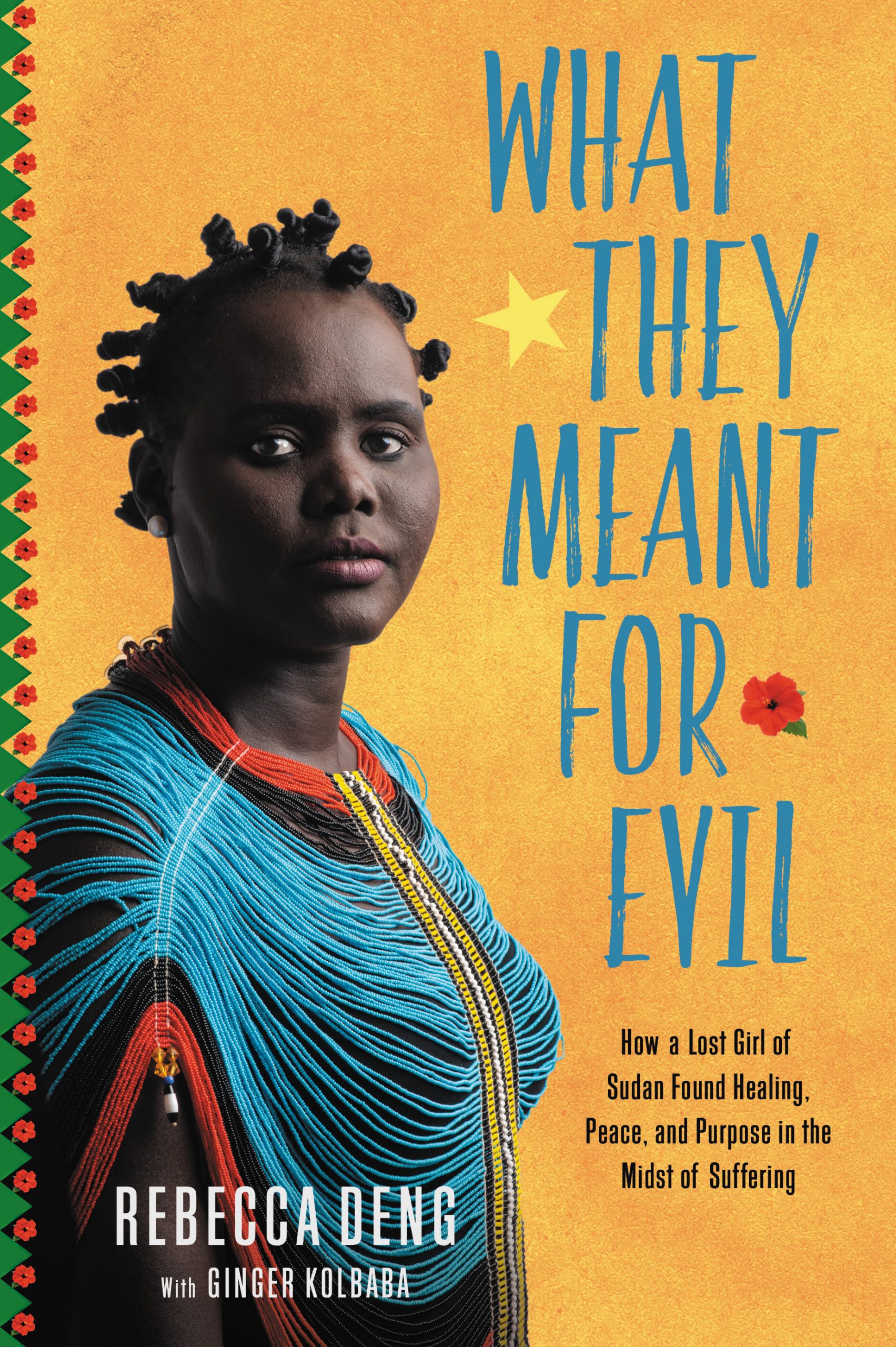
    Last fall, Rebecca Deng ’04, who happens to be a remarkable story teller, published her biography, What They Meant for Evil: How a Lost Girl of Sudan Found Healing, Peace, and Purpose in the Midst of Suffering. In her book describing how she was orphaned through the Sudanese War, and lived most of her childhood in the Kakuma Refugee Camp, Rebecca focuses on how it is possible to endure all she did, and afterwards to live a life of healing and meaning, thanks to so many who helped her out in so many ways. But most of all thanks to the graciousness of a God that she was irresistibly and mysteriously drawn to, even from a young age. And in the middle of a refugee camp.

    Rebecca moved to Holland, Michigan when she was 15 and straight out of the Kakuma Refugee Camp in northern Kenya. She had lived there for the previous eight years, after fleeing southern Sudan at age six with her uncles and aunts and cousins in the Bor Massacre of 1991.

    You can read that whole fascinating story in her book.

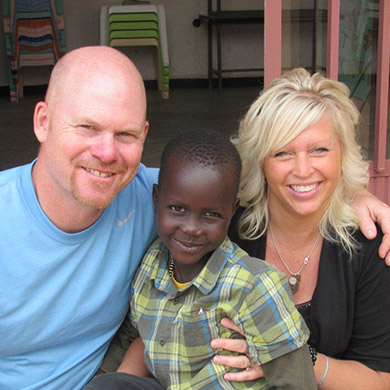
    One of only a handful of female Sudanese orphans brought to the United States in the year 2000, when it was “the Lost Boys” who were getting the media attention, Rebecca was taken in as a foster child here in Holland by Rachel and Lennis Baggech. The then-recently married Baggeches had just returned from Kenya themselves, moving to Holland for work. Always interested in humanitarian aid and missions, they wandered into Bethany Christian Services (BCS), and were asked by BCS if they would take in foster kids from the Sudanese refugee camp. They first said yes, found out they were pregnant with their first child, were told by scores of people it would be crazy to take in foster teens with a first baby, backed out, but when it felt so wrong, stepped back in, taking two teenage girls.

    “It was a hard yet beautiful time of adjustment. Some days we’d laugh so hard we cried, and some days we just cried, but I  wouldn’t trade anything for it,” Rachel Baggech still says. “You make one decision and it unravels a whole different path for you. But I’m a Christ follower and not a culture follower—the thing that binds all of us is Christ, finding the commonality of our faith.”

    Not that things were easy by any means. Rebecca didn’t have the words or the emotional wherewithal at that time to share her feelings. She came in November, of all months, to Holland, Michigan from a hot sunny desert, and had never before seen snow. And had lived a life of trauma for basically the past 10 years.

    But she also “didn’t have to worry about people breaking and entering. I had breakfast, lunch and dinner! I could feed my physical body, and dreams ahead!” Rebecca said, remembering fondly the breakfast of Kenyan-style porridge Lennis Baggech made for her that first morning.

    HCHS was basically Rebecca’s first real schooling, she said. And both she and her foster sister Teresa were HCHS’s first real English Language Learners (ELL) students at that time. “They didn’t know what to do with me,” she admitted. “At HC I was in formal school for the first time in my life, and I had the English of a second grader!”

    ”Suffering is not sexy, but there is no amount of brokenness that can’t be overcome…there is room for healing and transformation—though for it to take place, you need a village around you!

    But it worked, eventually, though not always perfectly. But it worked well enough for Rebecca to write a book almost 20 years and two higher degrees later.

    “Being at HC was what I needed when I came—it was the best place for me,” Rebecca said. “It was a high school where I had my own space to learn about who I am as a person—as an ESL student, as a person of color in [a white] environment. The one thing that was really helpful was the kindness that I needed and that stood out—from both teachers and students.”

    Choir with Mr. Bird was a favorite class, an easy way to learn English: “There’s something about singing—if I see a word and sing it, it just flows. Singing is good for learning a new language!” she said. “Plus, it’s an orchestra of different voices—you’re free to express yourself, but you are working together! We can be a choir and celebrate different tones!”

    She loved other classes too, especially Bible with RVL. But it was a story, a book about another African refugee who eventually graduated from Harvard, (Of Beetles and Angels: A Boy’s Remarkable Journey from a Refugee Camp to Harvard by Mawi Asgedom) that her HCHS English teachers, Kathy VanTol and Deb Bandstra, shared with her, that was a turning point. It helped launch Rebecca Deng out of how she saw herself at the time into future possibilities.

    Because she realized even then, that if she just looked at herself on the outside, she didn’t necessarily look like what people would judge as successful: “You are a girl, a black girl in a school [of mainly white students], a teenage mother, an ESL student…therefore you are not going to do well. Those are the voices that diminish hope in people,” Rebecca said.

    But “once I made it through [the book], I thought, that’s me! I can do that—finish college, maybe I can do grad school. That’s the empowerment of different voices and diversity in literature, because everyone wants to see themselves in stories, in successful stories,” she added.

    Because things got really complicated the summer after her first year at HCHS, when she and the Baggeches realized that Rebecca was pregnant, from being raped the day before flying to America. Complicated, more difficult, but certainly not impossible.

    With the help of the Baggeches—who had gone suddenly from double income no kids to two teenage girls and two babies in diapers—along with her HC support system of teachers and circle of friends, Rebecca graduated from Holland Christian four years later. And then graduated from Calvin College another four years later.

    It was when she was working for the American Bible Institute, married to her Calvin sweetheart (another great chapter of her book), and not sleeping the last month of her pregnancy with their now four-year-old son, while absorbing the news of hurting children at the US border that she started writing her memories down. She realized she was protected, had a house, safety, yet struggled with introducing her son to a world that wasn’t welcoming or friendly, where so many young children struggled.

    So she started writing her book on her iPhone, in the middle of the night, when she couldn’t sleep.

    ”God only says you are beautiful, you are a treasure, you can do this. I am a God of abundance, I can provide.

    “There was something that jerked the memories, made me think about childhood things I had put away, and those memories came out,” she said.

    The colors and the smells she remembered the most vividly, but anything she thought she remembered, but wasn’t sure about, she verified via phone with her uncles and aunts and cousins, now spread throughout Sudan and the world, their home villages obliterated in the war. “Is this true?” she would ask, “and they were like yes or no—especially the uncle’s wife that was running with me during the war.”

    She realizes she was “one of those kids that pay attention to a lot of things, and think about them more.” Rebecca recalls one instance back in the refugee camp when other refugee kids bullied her, saying since she was the only one left in her family, she must have hurt them.

    She cried the whole day, wondering if she really had hurt her family.

    But then she distinctly remembers praying to God, something she had learned from the group of Christian women in Kakuma who had taken her in, mothered her, and taught her about life, her body, worship, and the Living God, “God, please, give me Your truth and only Your truth, so I can tell the difference.” And she then remembers feeling His peace, realizing how wrong those kids were.

    Part of Rebecca was reluctant to share her story even this many years later, with so much trauma to relive in the process. But her hope throughout the writing and publishing was that “If I share it, it might help somebody that is going through a dark time, that actually you can do it. Suffering is not sexy, but there is no amount of brokenness that can’t be overcome,” she continued. “If [a traumatic event] didn’t kill physically, then there is room for healing and transformation—though for it to take place, you need a village around you!”

    Since her book’s publication, Rebecca, her husband and children have stayed settled in Holland for the time being, as she promotes the book and fills speaking engagements.

    And when those belittling, mocking voices periodically return, reminding her of her childhood trauma, of what she may look like on the outside to others, she has learned to hear her heavenly Father’s  voice instead: “No this is not from God—he only says you are beautiful, you are a treasure, you can do this. I am a God of abundance, I can provide.”

  • Steve Zwiep ’71

    Steve Zwiep ’71

    ”…this is why my parents wanted me to have a Christian education, that it’s God’s world, and He is in everything we do. And it’s so true.

    Connections Winter 2020 Alumni Profile

    We’ve been in the education business long enough to realize that sometimes it’s the “naughty” kids who end up the most committed church elders, best community leaders, most successful business people, high quality parents. Not always, but a good bit of the time.

    Steve Zwiep ’71 admits he was one of those naughty kids back at HC—and his friends and teachers would probably agree—and acknowledges that he didn’t always appreciate his Christian education then.

    But that was long before he sent his own three kids through HC, and now watches his grandchildren start there.

    “At the time I didn’t really appreciate it—it wasn’t until afterwards when I got out that I realized this is why my parents sent me to a Christian school, why they wanted me to have a Christian education, that it’s God’s world, and He is in everything we do. And it’s so true,” Steve admitted.

    “There was a sign in front [of school] that said ‘Soli deo gloria.’ That had a lot of meaning, and has stuck with me all my life—not that I have done everything for the glory of God, but it is a guiding direction in my life,” he added.

    Raised in his Holland home just 150 feet out the back door from his grandpa’s greenhouse, Zwiep’s Greenhouse, Steve started working for his dad and grandpa when he was 12, coming home after school and on Saturdays to do the odd “gopher type jobs” for a grand $.25 an hour. Then his dad purchased the greenhouse from his grandpa, Steve and his brothers became managers, and learned the gig through reading and experience, as well as MSU seminars.

    Brought up in greenhouses, increasingly addicted to plant growing, Steve majored in biology at Calvin then-College, where he met his wife, Sue, and together started a family eventually with three children, two sons and a daughter, all HC grads.

    “The interesting thing about growing is that it gets in your blood. And it’s very rewarding,” Steve said. He’s had a variety of college majors work summer jobs at the City of Holland’s parks who so enjoyed the work they almost switched majors.

    Ever since 2006, Steve has worked as the City of Holland’s Parks Supervisor, watching over, caring for, growing, planting, raking, fertilizing and everything else you do for Holland’s 22 parks, from the smallest 1/2 acre Morton Park to the 160 acre VanRaalte Farm, together totaling over 400 acres. “We have a large park system for the size town we have,” he shared. “It goes to quality of life. It allows people to escape from the busyness of life, just to sit, to relax and let the beauty of the flowers and place come over you.”

    “It’s important,” he went on. “No one comes to ooh and aah over our streets, our police department, our fire department—though of course we need those things, but it’s like the icing on the cake.”

    “Even in the winter people park [at Kollen Park] and just sit and gaze over the frozen water. Green spaces are very calming and restorative for people—just look at the Psalms!”

    Each year since 2011, Steve has helped Holland win numerous awards through the national community improvement program “America in Bloom,” where communities are judged on seven different criteria, such as flowers, landscaped areas, urban forest, environmental effects, community vitality. This year Holland was awarded “Best Community Celebration” for its population category. “It’s just fun,” Steve said. “It’s an improvement program—it shows us how we can improve our city in these areas.” In 2017, Holland even entered an international competition, “Communities in Bloom” with the same criteria, and won several categories for its population group that year as well, and may enter it again in 2020.

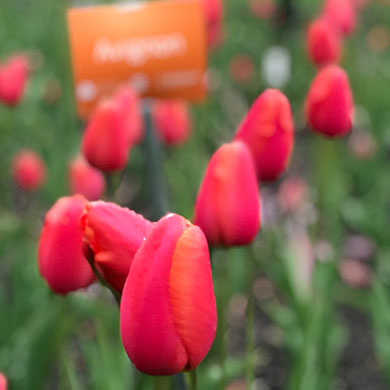
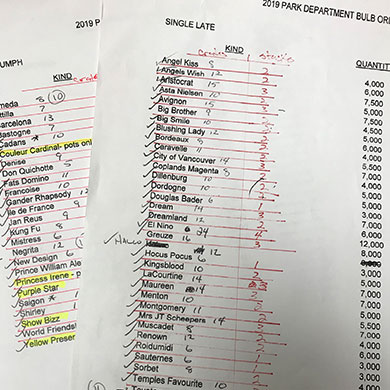
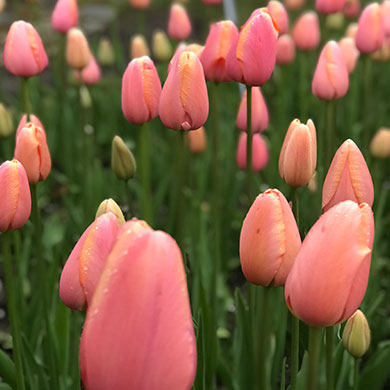
    But his biggest event, obviously, is Tulip Time, and he’s been choosing the tulip colors and types, with some input from others, including his recently hired greenhouse specialist, for the last 12-13 years. The 2+ mile parade route and downtown area get new tulip bulbs every year, and although most tulip bulbs last longer than one season, “you get a better stand” with new bulbs, he said. “If you leave them in the ground, the bulbs split, and the stems aren’t as strong, but blooms are smaller,” so out they come every summer. And in go new ones—all 189,000 of them in 90 different varieties. By hand—and foot, since they use a thigh-high bulb planter to plant them.

    Steve orders all the bulbs at the end of May, or beginning of June already for the next spring. The City puts out a bid, and ever since 2016, they’ve gone with Unex, a bulb company based in the Netherlands. For just one year, back in fateful 2016, when the city went with what was the cheapest bid that year, rather than Unex, the tulips sported brown spots, deformed twisted leaves, and short stems—all signs of a fungus called Botrytis, or tulip fire. Definitely not a year to repeat.

    ”We just put them in the ground; we can’t control the weather, so I don’t worry about that. God controls the weather. When the tulips come up, the tulips come up.

    ”It doesn’t matter what your calling is, but if you find God’s calling in your life, and you go after that, God’s going to make you satisfied in that calling.

    But that wasn’t quite as bad of a year as the 2012 “Stemfest.” “We won’t talk about that,” Steve chuckled. “The last week in March had 80+ degree days for five days in a row. Tulips were blooming in the end of March. I never saw that before.”

    In the end, all they could do was make a parody of it, still running all the parades and celebrations, just as “Stemfest,” instead of Tulip Time. “I think the 2012 Tulip Time t-shirt is actually a collector’s item,” he laughed.

    It may seem like a lot of stress on one guy’s shoulders, but “We just put them in the ground; we can’t control the weather, so I don’t worry about that,” he admitted. “God controls the weather. When the tulips come up, the tulips come up.”

    Another year, back in 2015, Holland was awarded the best tulip celebration in the world. And not because of total tulip numbers. Places like Istanbul, Turkey, actually have way more tulips—30 million of 125 species—planted throughout the city. And there are cities in China, Australia, and Japan that all hold tulip celebrations as well, often with more tulips than Holland. But Holland holds the largest tulip festival that sets the one week of tulip celebration ahead of time and sticks with it, no matter when the tulips bloom. The other tulip communities set a general month for the tulip celebration, wait for the tulips to bloom sometime in that month, then spread the word whenever they’re blooming.

    “We have the largest economic impact of all these countries,” Steve said. “We don’t know when the tulips are blooming. But even if the tulips are over and done blooming, we still have the festival, and have a good time.”

    Together Windmill Gardens, who orders 120-130 different varieties, and the City of Holland order 450,000 tulip bulbs from the Netherlands. It’s the largest single order of tulip bulbs by a city in the Western Hemisphere, other than Ottawa, Canada. (Since Ottawa receives 500,000 tulips every year in gratitude from the Netherlands for housing and protecting the Dutch royal family during WWII.) Steve and his team plant the tulip bulbs at the end of October into November, since they “need the cold period, to get rooted, take up the nutrients, and get a good stand.”

    A good life, filled with rewarding work that Steve feels blessed to enjoy.

    “In Ecclesiastes, he talks about your work, that your work is a calling of God, and that God satisfies you in your calling,” Steve said. “It doesn’t matter what your calling is, but if you find God’s calling in your life, and you go after that, God’s going to make you satisfied in that calling.”

    “My whole work life has been so satisfying, and for that I’m grateful to God.”

  • Austin Homkes ’10

    Austin Homkes ’10

    Spring 2019 Connections Alumni Profile

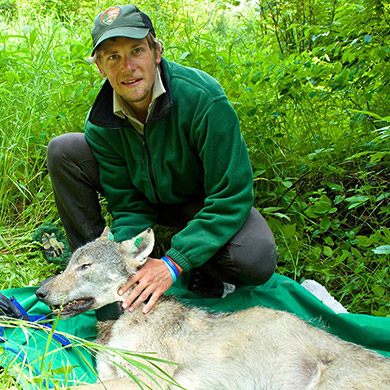
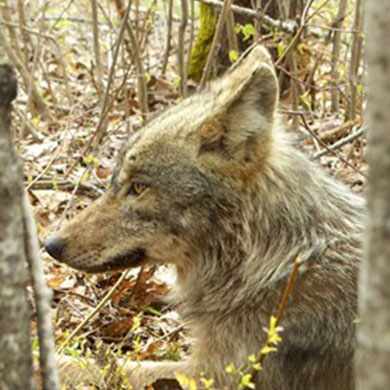
    Austin Homkes ’10 was enjoying just another day at work when he spontaneously let out a short wolf howl. To his surprise, six wolf pups emerged out of the brush and ran around him with an eager air of investigation. Once satisfied, the pups returned to their denning area in the brush. Intrigued, Homkes lingered and an adult wolf appeared, joined quickly by the energetic pups. Homkes stayed until the mother wolf left, then let out a goodbye howl as he walked away. At once, all six pups responded with howls of their own.

    By now, you probably figured out that Austin Homkes does not have a “normal” job. Austin’s official job title is “Wildlife Science Technician” at Voyageurs National Park in northern Minnesota, and his workday is primarily devoted to the Voyageurs Wolf Project. The Wolf Project is a research collaboration between the National Park Service and the University of Minnesota staffed by Austin and another PhD student (both Hope College grads) and requires a great variety of skills, stamina, and expertise all utilized to better understand wolf behavior and pack health.

    Voyageurs National Park is connected to the better known Boundary Waters Canoe Area Wilderness and the Quetico Provincial Park in Canada, composing a vast swath of lake country. Encompassing hundreds of small lakes with rocky shorelines and surrounded by dense coniferous and deciduous forests, Voyageurs National Park is one of only a few preserves that allow motor boats. “While the silence of ‘canoe only’ wilderness areas are certainly special, being able to get deep into the park in an afternoon is a huge advantage, especially for visitors who only have a few days,” said Austin, explaining why they allow motor boats.

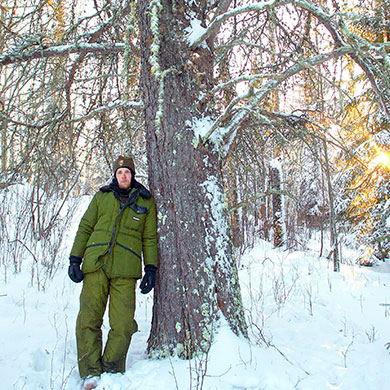
    Once deep in the park, visitors have the opportunity to see old growth forests and trees rarely available anywhere else. In fact, Austin is credited with having found the largest Jack Pine in America on one of his  excursions deep in the park. But that is another story. And this work is about wolves.

    ”…wild things and places have an intrinsic value simply by existing. In other words, wild things have value to humans simply by being wild.

    In the late spring between April and May, the work consists mostly of collaring wolves with GPS collars that give researchers updates on the wolves’ locations every 20 minutes. From May through the end of October (or when the lakes freeze), Austin and his colleague follow and track the wolves looking specifically for locations where two or more wolves are in a small area within those 20 minute updates. These groupings can indicate a bedding area or a kill site revealing important information about behavior and the pack. Kill sites are particularly important to the researchers as the summer dense forests of Voyageurs reveal very little.

    Knowing where those sites are through GPS allows Austin precise data to find and then examine dens, prey, wolf numbers, and even find wolf pups. But that work is hardly easy. And that is part of the allure.

    “What I like most about my job is that I get to spend almost all my time hiking in the woods in deep wilderness and see the intimate places and habits of a very private animal,” Austin said. “It is not uncommon for me to spend 50 hours a week in the woods, off trail, hiking 10 to 15 miles a day. In doing this, I really get to know the land, know the wolves, and develop a deeper knowledge of nature that can only be acquired by thousands of hours in the woods.”

    ”HCS prepared me for this work by instilling in me a sense of professionalism, a desire for excellence, and a character of integrity and honesty.

    The downside? Bugs. And rain. “After many hours in the woods, day after day, the weather and the bugs can wear on the mind and body,” he admitted. Fortunately, he can unwind at his home just north of the park with his wife and dog, about 25 minutes from the nearest town, International Falls, Minnesota.

    As the seasons change, so does some of the work. Austin and his colleague still chase wolf packs in the winter, but use snowmobiles instead of boats and boots, and split their time between collecting data and analyzing it. He said, “This is very important information for understanding the health of a pack. We need to know how many wolves there are to catch and collar in each pack and how many adult wolves will be supporting the pups in the spring. We also set up a lot of remote trail cameras for the same purpose. We end up finding a lot of winter deer kills in the process, from which we collect information relating to the locations of the kill and the condition of the deer that was killed.”

    Winters in northern Minnesota last a long time and can be especially frigid with full weeks below 0 degrees and routine -20 degree mornings.

    But the hard work is also what makes it both rewarding and valuable. “The work my team and I do is important because I believe that wild things and places have an intrinsic value simply by existing. In other words, wild things have value to humans simply by being wild,” explained Homkes.

    He further noted that a thriving wolf population requires a large and pristine wilderness either unaffected by human activity or carefully stewarded to allow for the right environment. Given the current human population and its projected growth, the second option is becoming more the norm.

    And careful stewardship of any kind whether it be environmental, financial, spiritual and even wolves requires expertise. “It sounds harsh,” said Homkes, “but the real world doesn’t mess around with mediocrity. You actually have to be good at what you are trying to do, you actually have to bring value to the table wherever you try to plant yourself.”

    Austin credits HCS in part for that dedication to excellence: “The specialized skills came later, but the solid foundation began at HCS. HCS prepared me for this work by instilling in me a sense of professionalism, a desire for excellence, and a character of integrity and honesty.”

    Austin went on to praise the communications skills in writing and speaking that he learned at HCS, as well as the desire to do well and learn as much as possible—not just the minimum—besides a solid understanding of the sciences (with a shout out to Mr. Dewey, a former HCMS science teacher) that he received at HCS as major takeaways from his K-12 education.

    Even more than that, he found not just an occupation utilizing his skills, but a vocation: “As Christians we are called to be stewards of creation. I view wildlife research and management as a big part of the call. Followers of Christ are called to be a light wherever they are called to be, and that’s what I strive to be as a wolf researcher.”

    ”Followers of Christ are called to be a light wherever they are called to be, and that’s what I strive to be as a wolf researcher.

    His advice to current Holland Christian students? Keep trying different things. Be open. Take risks to uncover unknown interests. “While you’re still young, try as many things as you can, before you make it to a point in life where you start having to make choices of what you want to do with your life. Be willing to work for free. It starts with experiences, trying things out, finding out what you like,” he advises.

    And that may just lead you deep into the northern hardwood forests, giving out wolf calls to be joined by pups eager to discover who was making all the noise. Or anywhere in the world, serving the Lord and committed to being the best light possible.

    We really didn’t have enough room to give you all the cool nitty gritty details about Austin’s work, so if you’d like to read more about his research with the Voyageurs Wolf Project, it’s been hitting a lot of national news lately. Check out PBS’s program “American Spring Live,” or a June National Geographic article “The secret lives of fish-eating, beaver-ambushing wolves of Minnesota.” Another great recent article, “The secret summer lives of Voyageurs Park Wolves” was in the Duluth News Tribune, or visit the “Voyageurs Wolf Project” Facebook page.

  • The Meyaards ’89

    The Meyaards ’89

    Winter 2019 Connections Alumni Profile

    It was hot. Like crazy second story Africa hot, and with no air conditioning of course. Julie (Timmerman) Meyaard ’89 had never been gone from her six children at home in Zeeland this long, had never been overseas, much less to Africa, had never adopted anybody before.

    And it was not going well.

    Julie and her husband Steve Meyaard ’89 were supposed to fly back home today, but the American Embassy was missing the second page of a two-page document and would not allow their freshly adopted four-year-old daughter Myla into America, so it made no sense to put her on a plane out of Ethiopia. While everyone else in their group loaded up and headed to the airport, the Meyaards’ adoption coordinator thought they should try one last-ditch effort to get the embassy to release Myla. So they literally ran over to the office, up the stairs.

    And the woman behind the counter was not cooperating. At. All. She was refusing to hand over the paperwork, while Julie stood there, tears streaming down her face, swearing she was never coming back to Ethiopia, was never going to leave her home town again, argued with God why was this so difficult, when it seemed like they were faithfully following His plan? His opened doors? To adopt this girl brought to them unexpectedly from Ethiopia, to add to their six children already back home?

    Unaware of the drama at the counter, Myla stood in the waiting area bouncing a superball someone had given her, singing some of the only words she knew in English: “Our God is so great, so strong and so mighty, there’s nothing our God cannot do. Our God is so great…”

    ”Our God is so great, so strong and so mighty, there’s nothing our God cannot do. Our God is so great…

    Suddenly a man walked in from a door behind the counter, saw Julie crying, asked the woman in charge what was going on. She explained the missing paper, and he asked her, “Well, why can’t you do it?” “Because I am not losing my job over these people,” she answered. He looked at Julie, at Steve, at Myla happily bouncing her ball and singing, and said, “I will,” stamped “Approved” and sent the Meyaards off to catch their plane. Calling back over their shoulders while they ran, “What was your name again? Thank you! God bless you!”

    Back in their old HCHS days, there’s no way Steve ’89 and Julie (Timmerman) Meyaard ’89 ever planned in the study hall that they met in, to have the 11 children they currently joyfully claim, age 24 down to 3 ½ . Once they actually thought about kids, they fully intended—like so many of the rest of us—to enjoy their 3-4 oldest biological children, live happily ever after in their 4 bedroom 1 ½-bath-house, and be finished.

    “But looking back, we can see how much bigger and better His dreams for us were,” Julie says earnestly, before relating one amazing story after another how they unexpectedly added not just Myla, but four more adopted kids to their six biological kids, following God’s surprising lead every step of the way.

    ”Desmond taught us that joy. With Desmond, we realized that we almost missed this opportunity to have this ray of sunshine, this love for people that he has!

    “And I don’t think I said yes to any of them, I never actually ever said yes,” added Steve. “I was always just like, well, why not? Why shouldn’t we?”

    First came their four oldest biological children, twins Dalton ’13 and Jaden ’13, Casey ’14, and Charles ’16, and then came along the pleasant surprise of Court ’22, now a freshman at HC. At that point, being adopted herself, Julie thought that she would really like to adopt a girl, wanting a sister for their only daughter, Jaden, and another daughter for herself. So before Court was even born, they started the adoption process, hoping to bring a daughter from Guatemala, which made sense living in Zeeland with its new Spanish immersion programs, and round their family out to six kids, “and we would be complete” she said.

    While waiting through the super slow Guatemalan adoption process, Julie gave birth to their son Caleb, now a sixth grader at ZCS. And then they all watched the Guatemalan government close the door to international adoption.

    “We had already invested all this money, but thought maybe God was trying to tell us ‘You’re good, enjoy your six kids, take care of them, you don’t need two girls,’” Julie said.

    But a couple of years later, when Caleb was two, the adoption agency called out of the blue, just when the Meyaards had learned to be content knowing that their money invested into the potential Guatemalan adoption was being used to house and feed other needy Guatemalan mothers and children. Suddenly the adoption agency was offering to transfer a portion of their adoption investment toward adoption from another country—either Vietnam or Ethiopia.

    Meanwhile, VP of Operations for Quality Machine and Automation by day, Steve had traveled to Beautiful Gate in Lesotho on a mission trip with a buddy of his, Mike Verkaik, and their Pastor Tim at Haven CRC in Zeeland, and fell in love with all that is Africa.

    “I would say that was when my husband became a true Christ-follower,” Julie said. Sure, he was raised a Christian, went to church, believed in Christ, “and yet are you living it out, and letting go? But after that trip, his heart was exploding (while I wasn’t there!) and he was right away on board; ‘Let’s switch!’ he said to me.”

    But Julie wasn’t there yet, wasn’t ready to bring an African girl to Zeeland, telling God, “I can do Guatemala, but God, I don’t know about Africa. A black child in Zeeland?”

    So they prayed.

    And then this seemingly random article comes out from Holland Christian in the Holland Sentinel, declaring something along the lines that “God’s fabric is more colorful,” describing HC’s efforts already back then to diversify its student population.

    “The timing was incredible!” Julie says, adding that is how they decided to send their oldest children, then just ready for high school, to Holland Christian. But it’s also how they agreed to switch to an Ethiopian adoption, and two weeks later received a picture of a darling four-year-old girl, dressed in a purple sweatshirt, with an “absolute sparkle in her eye” and “there wasn’t a question, never really even a discussion—and all the kids were absolutely on board.”

    ”We could not have asked for something more perfect! God knew when this all started, I will have a place for your kids. That house is such a gift!

    But after returning triumphantly from Ethiopia with Myla, things still weren’t exactly easy.  “Everything was different than we had signed up for,” said Julie. “I thought if this was God’s plan, why was it so hard?”

    Myla’s transition was difficult, the most difficult of their five adopted children, Julie said, though Myla was really excited to have a dad. She had been used to being an only child, to getting her way, was strong-willed, and now she was suddenly the youngest child of seven.

    But now, 10 years later? “She’s one of the first ones I call for help,” Julie said. “She’s one of the most capable.” Eventually life began to feel complete, almost normal with seven children, and with absolutely zero thoughts of adopting more.

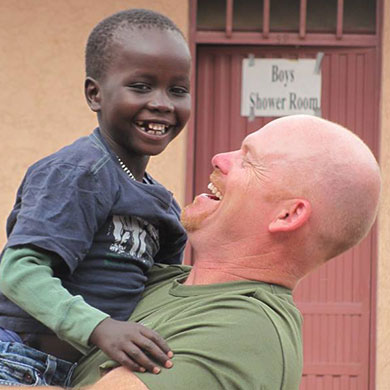
    But then, to make another miraculous, God-interceding story short, along came Desmond, an unexpected gift from northern rural Ethiopia, more Sudanese than Ethiopian. But also pure joy, sheer noise and energy, and so worth the boat Steve sold to pay for his adoption. “Desmond taught us that joy,” Julie said. “With Desmond, we realized that we almost missed this opportunity to have this ray of sunshine, this love for people that he has!”

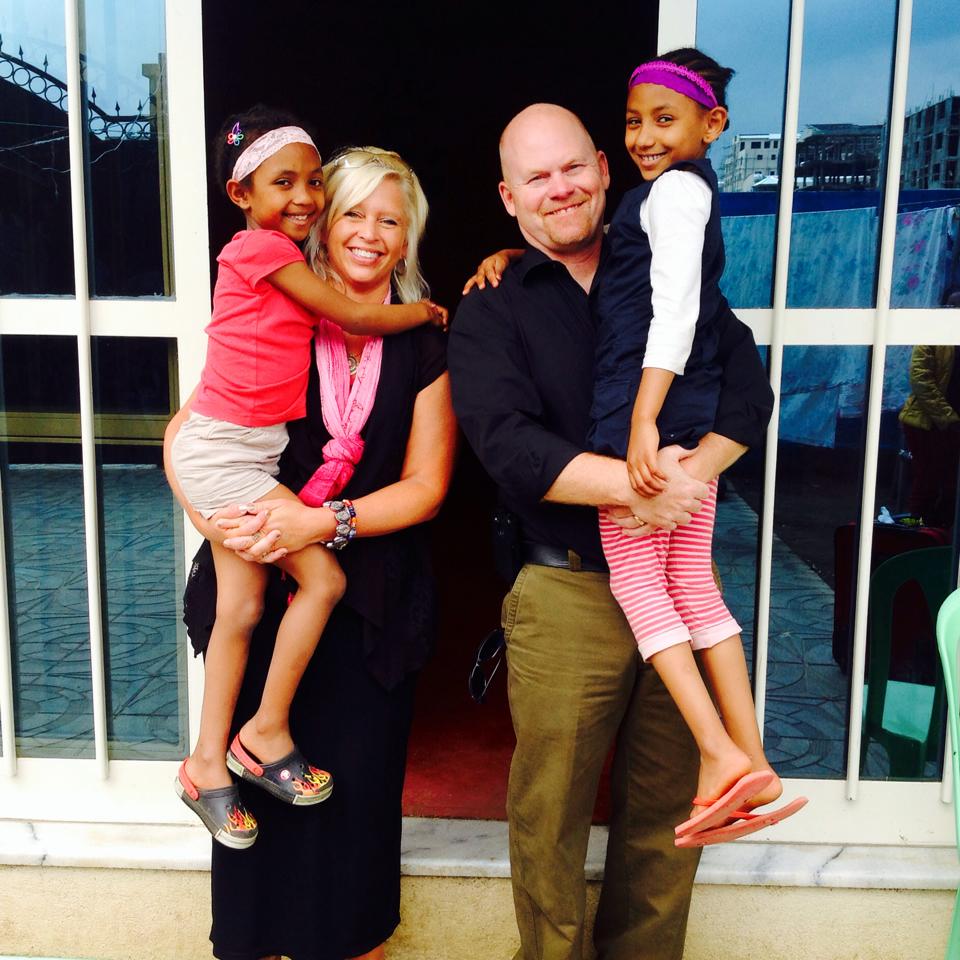
    And so there were eight. “We thought we were done—but we had let so much go by at that point, that we knew but if something is asked of us, we will keep our eyes open!” Julie said. So along came the offer of two sisters to adopt, again from Ethiopia.

    “This was where I had more reservations,” said Steve. “We had emptied out our 401K at this point, we were still in our old house with 1 ½ bathrooms. We had sold a car, a boat, applied for grants and previously got nothing. We would have to fundraise every dime of this one, about $38,000. We were financially responsible for two 18, 19 year olds starting college…”

    But Julie was already on board for this one: “We’re not going to make them wait, just because we aren’t financially ready for them,” she insisted.

    So they were in the process of planning a dessert fundraiser, and on a random suggestion, contacted Joseph’s DreamCoat, a Texas family organization that funds adoptions, and hoped for maybe $3-4K from them. Maybe enough to make the first payment?

    Instead they were told by the head of the organization that they were going to completely fund both adoptions, after they had checked with the Meyaards’ pastor, “Are these guys for real?!” So now they just had to figure out where they would put all those kids—how do you do 12 morning routines with only a bathroom and a half?

    “Can I just tell you that bathrooms are life changing?! At our old house, we had lines for the bathroom, kids just peeing off the deck,” Julie laughed.

    ”I told Steve, I’m not taking a baby! We’ve got chickens and kids and chaos–this is no home for a baby. I’m so done, so over the baby stage!

    They had been holding on to a chunk of land for several years, planning to build their dream house on it someday, but now sold their house, and moved all 12 of them into Steve’s parents’ house in anticipation of building.

    But then decided they just couldn’t do it. “I decided I don’t care what my countertops looked like, when two years earlier that had been my dream! The thought of going through the building process, and the financial burden of it all” was just too much, Julie said.

    So they looked at houses one last time, exhausted even more possibilities than they already had, fully knowing that finding an affordable house in the Zeeland area to fit 13 people was no small task.

    But miraculously (in the truest sense of the word!) they found one: “A house is just a house, but it was so handpicked for our family—huge kitchen, big bedrooms, five bathrooms, a laundry room that was huge—more than we could ever have imagined, 10 acres with a pool. We could not have asked for something more perfect! God knew when this all started, I will have a place for your kids. That house is such a gift!”

    And their two new daughters? Both girls were very malnourished, thin and extremely small for their registered, but unlikely, ages of 7 and 9. And, again, did not have an easy start in their new home:

    “It was rough. Rosina was madder than a hornet! She has a big personality, had been through a lot, and did not want to be loved. We wondered did we finally push it too far? Did we take on too much? But she has come so far! She is such a sweet, fun, sarcastic kid!” Julie said.

    At ten kids, an even dozen for their family, the Meyaards felt complete. For real this time. But they wanted to help promote the “Safe Family” ministry of Bethany Christian Services, a passion of Julie’s through their church, Haven CRC in Zeeland. Since they wanted to be able to help others become safe families—families who could do short term child care for under-resourced families in crisis, hopefully preventing Child Protective Services from entering the picture—the Meyaards decided to walk through the certification process themselves, only so that they could better help other families walk through the process.

    And you can guess the drill by now. Yup. Another kid showed up.

    ”A good Christian education gives you a worldview that looks at family differently than the typical American nuclear family. We were blessed to have been taught that Jesus calls us to live a life that matters, and doesn’t always make sense to the rest of the world.

    They were in the middle of Court’s birthday party, when they received a call from Bethany, saying they had a little baby, and were wondering if the Meyaards could take the baby for just a couple of weeks.

    “I told Steve, ‘I’m not taking a baby! Tell her NO! We’ve got chickens and kids and chaos—this is no home for a baby. I’m so done, so over the baby stage!” Julie recalled.

    But Bethany promised it was just for a couple of weeks, and Steve convinced Julie that “We can do anything for two weeks!” So in came child #11, and Julie now says, “We fell in love, our kids fell in love, it got complicated really fast, but it was incredible to see our girls heal through Eva. When she came into our house, it was suddenly not all about them, and they knew how to do this, since they had taken care of babies with their child care center. They instantly attached to her!”

    But that time things weren’t easy, either. What was supposed to be only two weeks became a year, with Eva in and out of their house. She came back to them on the kids’ first day of summer break, and Julie was overstressed, exhausted, thinking “What is wrong with me? I need to learn to say no! I don’t have a crib, formula, diapers, and she came back to us with dirty clothes, and all the kids were home for summer…Eva’s screaming, I’m trying to wash her clothes, and I finally called Myla in for help.”

    As Myla, then in Mr. Bouman’s class at Zeeland Christian, was busy folding Eva’s baby clothes, she suddenly recognized the clothes: These were the clothes that her class from school had given to a young pregnant mother that they had “adopted” to pray and care for. Had as a class filled a dresser for, with all the necessary first new baby clothes and paraphernalia.

    “And now she’s in my house?!” exclaimed Julie. “And I said, ‘God, why do you always do this?!’ When we are just about at our lowest, and most sinful, He is like, ‘No, I’m going to turn your attitude!’”

    “And everybody loves Eva! She’s taught us that God’s called us to love in the moment—would you still do this, if you knew you weren’t going to be able to hold on to her? Because there’s no signed paperwork, we’re still not guaranteed we’ll get to keep her,” Julie said. “Though we’re trying!”

    But how do they make the daily details work? Of life with 11 children? A Christian education for every one?

    “We use my crockpot a ton, eat lots of tacos, and eat buffet style. Do a lot of Aldi shopping…” Julie said matter-of-factly. “We’re definitely better with our resources! Things get passed around and utilized, and food seldom goes to waste. It goes through the kids, then the dogs, then the chickens. You learn as your family grows what works, what doesn’t. They grow up different and faster and learn things from their older siblings!”

    Not the life Steve and Julie imagined for themselves back in high school, yet one they are grateful for, flourishing in.

    “I would say that Holland Christian planted the seeds that made us aware of living for more than just the ‘American Dream,’” Julie said. “It also helped us develop Christian friendships that helped encourage us to step out of the boat when the time was right. A good Christian education gives you a worldview that looks at family differently than the typical American nuclear family. We were blessed to have been taught that Jesus calls us to live a life that matters, and doesn’t always make sense to the rest of the world.”

  • Holland Police Officers

    Holland Police Officers

    Winter 2018 Connections Alumni Profile

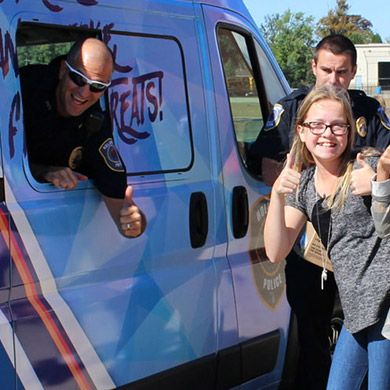
    Just maybe there’s a surprise in middle school life better than a free ice cream truck showing up your last afternoon class on a glorious October Friday. But not many.

    Then make it courtesy of your local Holland Police Department (HPD), and the officer handing out the free ice cream happens to have graduated from your school, oh, about two decades before. Totally cool.

    Maybe not what you’d expect from your local police? But that’s one thing the Holland Police Department seems to be particularly  good at—surprising and breaking stereotypes, both consciously and unconsciously.

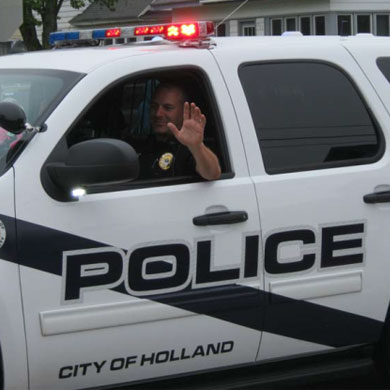
    “It’s important in this day and age to be making positive contacts,” said HPD Officer Dan Keuning ’96, the one handing out free ice cream cones. “If you get ice cream out of that truck, you don’t forget it. And it provides us that opportunity to have positive contact in a non-confrontational way, to show that we are the good guys.”

    Only the fourth police department in the nation to do so as one element of community policing, the HPD launched their free ice cream truck, the “Polar Patrol,” this June after receiving donations from area businesses, including the vehicle, vehicle graphics, and of course, lots of ice cream.

    “We were hoping to be the first in the state,” Keuning grinned competitively, “but we were second. One other department beat us to it while we were in the application process.”

    ”It provides us that opportunity to have positive contact in a non-confrontational way, to show that we are the good guys.

    “We want people to see us as a person, so they’ll get a better idea of what we’re doing,” added Capt. Keith Mulder ’88. “Those who don’t have any officers they know personally, fill in their own blanks.”

    Curiously, over a quarter of the 60-member Holland Police Department graduated from Holland Christian Schools—twice as many as any other high school represented in the department. Furthermore, there seem to be few Christian schools across the nation with as much pride and affection for, or connection to, their local police department as HCS seems to have for the HPD.

    Many of the HC-alum in the HPD draw parallels between their Christian faith and their compassion shown daily for those they come into contact with, recognizing that compassion was instilled in them through their parents at home, their churches, as well as through their Christian education.

    “I remember doing those service hours back in high school. ‘Servitude’ I think we called it then? But here we are still serving—it got ingrained in us a little bit,” said Mulder.

    ”Treating people well is something I would say we learned from Holland Christian—you’re more compassionate because of your faith.

    “Not everyone has the upbringing that most HC students have—with the school support and the home support,” said Officer Joy Nelson ’96, currently a booking officer who receives arrested individuals into the Holland jail. “People I’m booking say all the time, ‘Thank you for being so nice.’ Treating people well is something I would say we learned from Holland Christian—you’re more compassionate because of your faith.”

    Plus, did you ever think of your police officers actually praying for you? Nelson added, “It’s not unusual to hear officers say to people they just arrested that they’ll pray for them, and people are pretty thankful for that.

    “By the time they get here, they realize they messed up, that they made a poor choice, but you can still treat them with respect, offer forgiveness to people if they ask for it,” Nelson said. “As a Christian it’s good being able to sympathize with them a little—plus it’s not always not HC people going through here!”

    One of the reasons many of the HC grads went into the HPD is because they “love the area” and “want to help people,” to be a positive contributor to their community.

    “The faith community here is a lot different,” said Officer Joe Slenk ’96, K-9 officer. “How we treat people and interact with them. Something’s different about this place to outsiders. One of our visitors to the department the other day said, ‘Every time I come here, it’s just different.’ I believe it’s totally faith related—how we treat people and interact with them.”

    When the national media floods with police shootings and beatings, showcasing police in a negative light, treats and cards of support show up in the HPD break room, delivered from local community members. Especially just after September 11.

    “People around here truly do support the police, and that helps,” Nelson said. “I can’t imagine working where there are riots that are so anti-police—it would be hard to have so many people be angry just because of your career. We definitely feel the support!”

    And it’s not like they don’t see everything that bigger American communities and police forces deal with, just maybe not as much of it. “People have no idea about the ton of crazy stuff we run into!” said Mulder. “You never know what’s coming next, but that’s what keeps the spark, the excitement—there’s always something different.”

    “We live in a very broken world, and it takes a unique skill set to work with that every day,” said Captain Rick Walters ’86. “What we do is so different from every other vocation.”

    Most of HPD who are HC alumni don’t draw a direct connection between their HCS experience and their career choice, but agree that their training in compassion and integrity, their Christian awareness of brokenness and desire to help in the midst of it, led them in part to their career, as well as connections through their Holland Christian associated community.

    “I’ve always been a hands-on guy,” said Cadet Spencer Slenk ’15, who “always wanted to go into law enforcement.” But he also credits his eighth grade HCMS Shadow Day for pointing him in the right direction, as well as his friendship with Keith Mulder’s son Nate Mulder ’15, who invited him to assist with the scenario-based Police Academy training when he was a junior in high school.

    ”The faith community here is a lot different–how we treat people and interact with them. Something’s different about this place to outsiders.

    A lot of them became interested in police work through Joe Slenk’s dad, Dave Slenk ’68, who first worked for the Michigan State Police, then spent the last 15 years of his career at HCHS as the Director of Student Safety, a fundraised position that was dropped when he retired after 15 years.

    Most of them have four year college degrees from places like Calvin, Hope, Grand Valley. Several, like Walters, who started out as an accounting major at Calvin, realized a couple of years in that their first career choice just wasn’t going to work for them, that they would prefer a career with a little more unpredictability.

    So it’s not like they all planned this back in high school together, to all work together for the HPD. It just somehow serendipitously happened.

    “I work closely with four people I graduated the same year from high school with—four very different people with different friend groups back in high school,” Captain Mulder said. “I never would have thought back then that I would be working with these people. But you start to see different things in people that in high school you just weren’t aware of. We get along great now, and work very well together.”

  • Robb VanderZwaag ’92

    Robb VanderZwaag ’92

    Fall 2017 Connections Alumni Profile

    Typically in this space here we tell you about Holland Christian alumni who are off doing amazing things in exciting destinations of the world elsewhere—like improving education in Honduras (Spring 2017), or saving AIDS orphans in Lesotho (Spring 2016). Exciting and important work for the Lord.

    But we also recognize how many of you HC grads stay local and impact our place here for the better. Quietly remain “average” West Michigan Joes who help make our community pretty great. Do God’s work here, maybe get married, maybe raise kids, run successful businesses to pay the bills, go to church. You show up when needed, pray for us when we beg you to, donate items we didn’t even realize we needed until you give them, cheer our kids at sporting events.

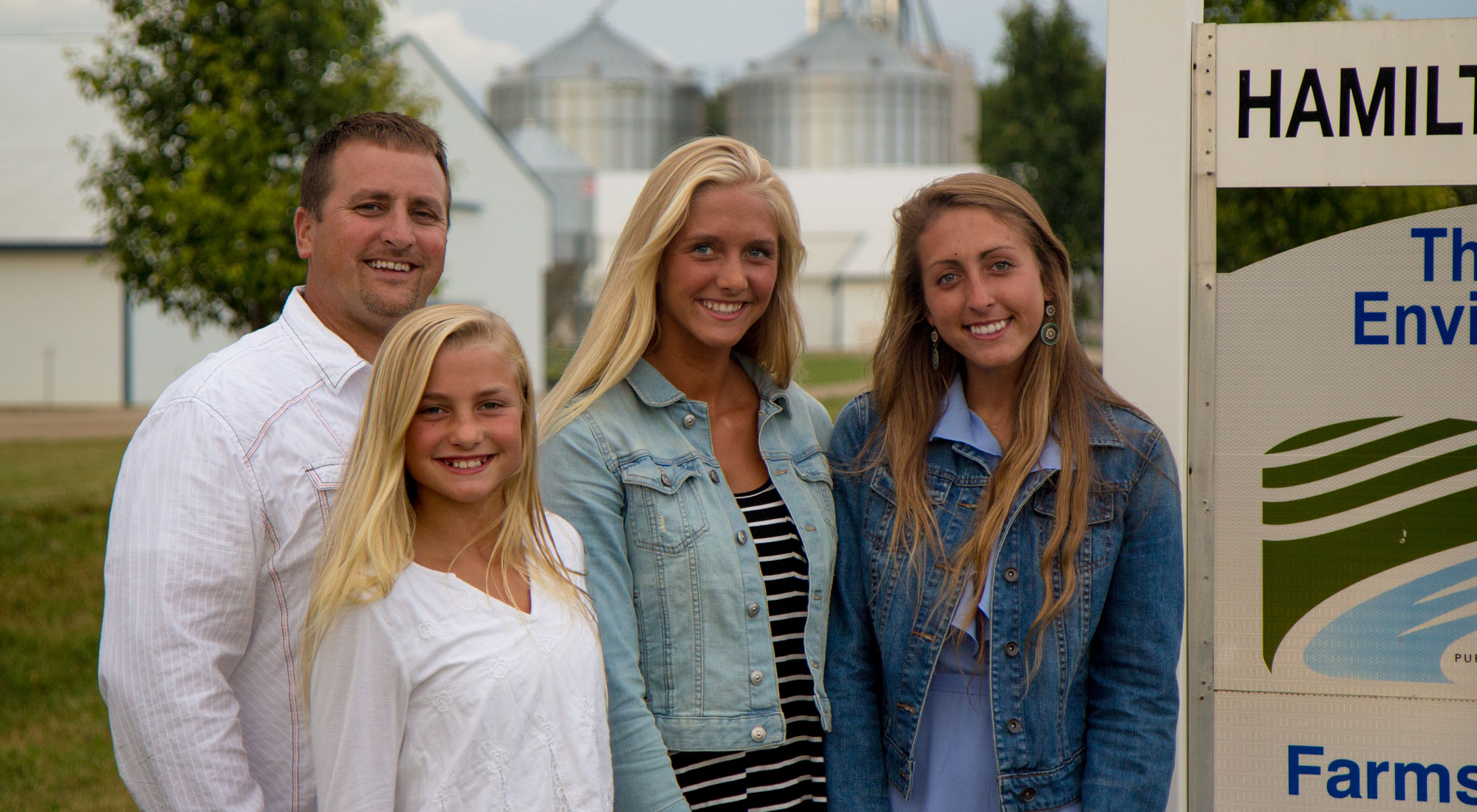
    There are a lot of you like this, but one such stand out is Robb VanderZwaag ’92, the owner of Hamilton Pullets, in, you guessed it, Hamilton, Michigan. A pullet, to preempt those of you reaching for your phone’s Google search engine, is a young hen, a guaranteed female egg-layer under six months old. Robb has close to one million of them, ranging from one day to four months old, all comfortably and cleanly housed in the most up-to-date chicken barns possible.

    Basically out of his barns come chickens that eventually lay eggs for super markets and restaurants like McDonalds all over America. And if you drive up to buy a few pullets for your own back yard, he’ll sell you those, too, gladly—because his pullets have been vaccinated for things like salmonella to keep your kids healthy. Since all of these chickens need to eat, Robb also owns a feed mill, MD Farm Supply, with his brother Jon VanderZwaag ’98 and Doug Dreyer ’78, where they mix up over a thousand tons of feed for his farm and other local farms every week.

    ”You don’t have to do big things, but just by your way of life, be someone who takes care of others. You can be just as impactful as a farmer, as a bank president or a college professor.

    Talking to the man is like talking to a self-made audible walking chicken encyclopedia. Everything from chicken economics (Why are eggs so cheap right now? Only $.35 a dozen?) to chicken trends (What’s the difference between free range, cage free, and Eggland’s best?) and chicken biology (Why do they sell brown eggs in Europe, but white eggs in America?). Inside the barns, the air is always a balmy 70 degrees, supported by blowing fans and generators. They don’t stink, since all the chicken droppings fall onto a moving conveyor belt below, where they are fan dried and then shipped off as powdered fertilizer. Zero waste, zero smell. But biosecure, because they don’t want a disease to run through the whole flock.

    All this, and no college degree.

    “I’m a firm believer in the fact that a four-year college degree isn’t for everyone,” Robb says, explaining his one-and-a-half unfinished years at Davenport College. “Status means nothing—it’s what you do with life that’s more important. Making sure you’re treating people right, and living in a way that is God-honoring so that other people look at you and say, ‘They are different!’ You don’t have to do big things, but just by your way of life, be someone who takes care of others. You can be just as impactful as a farmer, as a bank president or a college professor. We need a good blend of both.”

    ”I’m a firm believer in the fact that a four-year college degree isn’t for everyone.

    It all started when Robb did not make the Holland Christian basketball team his freshman year—funny how God has a plan different, and so much more far-sighted than ours? Suddenly he had more time on his hands, and began working for a chicken farm on Holland’s north side, enjoying having the extra spending money. The farm also had its own feed mill and Christmas trees, and was soon running out of space in its north side location.

    So, once he graduated HCS in 1992, Robb was the one to be shipped south, moving all the way to Hamilton, to run the new start-up location there. A young bachelor living on his own, he didn’t cook a whole lot, but ate out often at the Trestle Stop Restaurant in Hamilton, where the really cute daughter of the owners would wait on his table. Add in a few years of dating once Lisa Lampen ’94 graduated from Holland Christian in 1994, a wedding in 1997, and three darling baby girls followed.

    Meanwhile, the farm took off, too, grew like crazy, and in 2000, when the original owner, a 1978 HC grad, wanted to give Robb the chance to advance, he sold him the farm in Hamilton, thereby creating Hamilton Pullets. For the first several years, Robb was it—the only guy running the show, and worked like crazy just to keep up. Slowly, though, he added employees as he could, eventually rising to his current payroll of 22.

    Life seemed happily ever after.

    Lisa, busy with their three girls, helped her parents as needed at the restaurant, but was also following her life passions— singing on their church, Central Wesleyan’s, praise team, helping with children’s ministries and with Bible Study Fellowship, besides busy caring for orphans whenever and wherever she could. She even flew down to visit and volunteer at an orphanage in Mexico in 2007.

    “She was an awesome person—the best you can get,” Robb says of his wife. “Her number one goal in life was to be able to help others.”

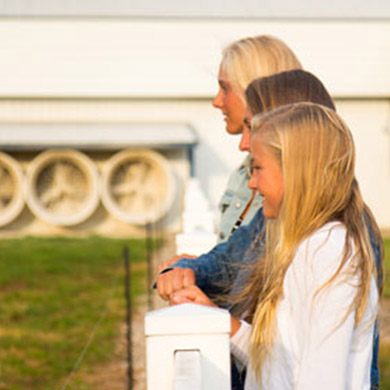
    The girls, Brylynn ’15, Mady ’18, and Tryna ’23, were nine, seven, and two years old in the summer of 2007, when the VanderZwaags started the process of adopting a nine-year-old boy, Irwin, from Mexico.

    But before the adoption could be finalized, Lisa learned she had breast cancer—and on Brylynn’s birthday to boot.

    You can’t pack all that pain into a paragraph—of innumerable trips to the Mayo Clinic in Minnesota for one treatment tried after another, repeated arrangements for the girls to be cared for while they were gone, Robb trying to be there for Lisa and still run the business. If there was any comfort, it was that they didn’t do it alone.

    “We had so many different friends fly us out of Holland airport,” Robb says, listing one HC family after another. “There’s a reason these girls are at this school—there was such a huge support system here. There still is.” For seven years Lisa and Robb managed to fend off the cancer. “She just kept plugging away, in and out of bed. With no complaining, ever…” he trails off.

    ”It’s amazing once you’ve been through it—you become so much more aware of others going through it.

    But then came spring of 2014. Lisa realized the treatments were no longer working, that she was just getting worse, and she decided she just wasn’t going to fight it anymore.

    “How do you tell your kids that ‘Mom is not going to do this anymore?’” Robb says. “The kids were just used to her having cancer; I don’t think Tryna ever really saw Lisa with hair.”

    Lisa died in May of 2014. Her funeral filled Central Wesleyan, and Robb had people coming out of the woodwork telling him how Lisa had blessed their lives in ways he had not known the 17 years he had been married to her.

    “My biggest fear was that my girls would lose what their mom had instilled into them. How do we make sure our girls keep that same giving and loving spirit?”

    ”Paying for Christian education can sometimes be a struggle, but it’s been one of the best decisions we’ve made.

    So Robb and his daughters together started Lisa’s Legacy, a nonprofit committed to charitable giving, “so our girls could look for people struggling, and help them. It’s amazing once you’ve been through it—you become so much more aware of others going through it,” he says.

    Robb and his girls took money donated at Lisa’s funeral, invested it, and pull it out when they see a good cause they want to give to. When Robb worried that the girls were getting lost in themselves, not paying enough attention to others with needs, he contacted a couple of HC teachers, asking them to look out for not only his daughters, but also for worthwhile needs they could donate to. Sometimes it’s a couple chick incubators for the elementary schools, or for another family who is walking through cancer and needs some distraction relief, maybe a family who can’t make tuition payments.

    And so these girls of Lisa’s are learning to give generously just like their mother—who was excited at one time to see the pullet business grow only so that they would have the means to help more people.

    “When your wife dies of cancer, you get a very good perspective of what’s important in life,” Robb ends. “You know, paying for Christian education can sometimes be a struggle, but it’s been one of the best decisions we’ve made. Lisa always said, ‘Don’t worry about the [money]—it will just come. I don’t know how, but it will be there.’ She always said it was because we have faith. And we were once told, ‘If you do business and live life with generosity and integrity, you will be taken care of,’” he says matter-of-factly with a shrug. “And so far it’s been true.”