Author: Stacey Hollebeek

  • Top TRIP Tips

    Top TRIP Tips

    Fall 2023 Connections

    Our best estimate is that out of over 1000 HC families, only about 20% use TRIP as a way to put extra money into their tuition accounts. TRIP, an acronym for “Tuition Reduction Incentive Program,” is a fundraising program that uses gift cards, whether purchased online or via a paper order form through Holland Christian Schools to shop at major food, retail, and online stores. A variety of stores sell HC their gift cards at a discount, and then HC sells the cards at face value to participants, crediting their tuition account with the difference; sometimes that difference could be 3%, and sometimes it could be all the way up to 20%, like Biggby’s gift cards are, with everything in between.

    ”TRIP has changed so much, and has gotten a lot more user-friendly. TRIP is magic—it’s just magic!

    The thing is, anyone in the community can participate, and not just current HC families: we’ve got grandparents, relatives, friends, and potential HC families, or couples with no children yet—all who use TRIP to make regular purchases, then send their TRIP earnings to the account of a presently enrolled family of their choice, save it for their own future family, or even donate it to Holland Christian’s Tuition Grant Fund. And if it’s been a few years since you attempted to use TRIP, you might want to give it another go—it’s gotten so much more convenient.

    “TRIP has changed so much, and has gotten a lot more user-friendly,” said Kim Hekman ‘02, HC’s TRIP Coordinator. “It’s become so much more available instantly and on a phone that it takes a lot of planning out of it. And Raise Right is continuing to make the user experience much better. TRIP is magic—it’s just magic!”

    The biggest complaint we hear from parents is that TRIP is too complicated to use. And to be honest, a few of us thought so at first too. But we’re here to show how easy it can be to use if you break it down into regular life activities. So we’re giving you four easy ways to use TRIP in your everyday life right here:

    Number 1: Trash

    Kim Hekman recommends starting small, with one easily managed purchase, like maybe your trash pick up (if you don’t live in the City of Holland). The bonus is that you need to think about it only every third month or so, and it’s for a worthwhile amount: Arrowaste offers 12% towards your tuition, while Republic offers 11%.

    After you receive your trash/recycling bill in the mail, purchase the TRIP certificates for that trash company through the Wednesday morning TRIP tables that are at Rose Park or the High School, or by using the blue weekly order form (also online at hollandchristian. org/admissions/financial-aid/trip/), then pay your full bill by mailing in the TRIP certificates instead of a personal check. If you—or a grandparent, for example— happen to pay a business’s trash through HC TRIP as well, you can really increase your monthly TRIP income.

    The next easiest category is probably gas, since we all need gas, right? Whether you pump gas most frequently at Quality, BP, Speedway, Meijer, Mobil, or even Sam’s Club, you can earn TRIP money from each gas fill-up by purchasing gas gift cards at the TRIP table. If you want, you can reload some of the gas gift cards online right before you get gas, like with Walmart’s gift cards to pump gas at Sam’s Club.

    Or, if you have teenage drivers, physical gas gift cards are an easy way to provide gas for your teens, and you can keep the denominations smaller if they’re likely to lose the cards. If you like to make road trips, Kim recommends looking ahead at the national chain gas stations likely to be on your route, and purchasing a variety of those national chain gas cards ahead of time.


    Number 2: Gas pump
    Number 3: Groceries

    A third easy category for using TRIP is food, since we all need to grocery shop, so why not do it while also saving a percentage off of your tuition?

    How you use TRIP for groceries depends on where you like to grocery shop: There are physical Family Fare and Meijer gift cards available each week, some reloadable online, as well as Walmart and Amazon. If you’re a committed Aldi shopper, you can use the Instacart app, and have your groceries either delivered to your house, or gathered and waiting for you to pick up at Aldi. You can even purchase the annual Aldi Instacart fee through TRIP by using the Raise Right app, or use a prepaid Visa card that has no activation fee. In order to use TRIP through the very easy Raise Right app, you’ll need a school code from the TRIP coordinators that we are not allowed to publish online (too many robots out there!) Just email them at trip@hollandchristian.org for this code, and they’ll get it to you ASAP, though it’s helpful if you can give it a day or two.

    Your best next TRIP step is to get yourself to a Wednesday morning TRIP table at either Rose Park or HCHS, between 7:30-9am, and ask for help from either Kristi Lokker or Kim Hekman. Often the other moms (or dads or grandparents) who are also purchasing TRIP certificates will have great suggestions for how they use it as well. You can also visit our TRIP page at dev.hollandchristian.org/trip or email trip@hollandchristian.org.

    Stay tuned to our HCS social media—we plan to post TRIP suggestions on our Facebook and Instagram pages, and we’d love to hear back from you on the ways your family is using TRIP!


    Number 4: lightbulb
  • Business & Industry Drive

    Business & Industry Drive

    On October 25, the last Wednesday of October, we send out 50-60 volunteers including alumni, high school students, and HC staff, all carrying freshly made HC cinnamon rolls. They visit a host of area businesses in pairs, drop off cinnamon rolls, and often collect donations right on the spot.

    If you or your business would like to be involved, or if you would be willing to spend a few hours on October 25 visiting area businesses on behalf of Holland Christian Schools, please contact Leanne Halma at 616.820.2811 or lhalma@hollandchristian.org.

  • Cheerleading Clinic!

    Cheerleading Clinic!

    Maybe you saw them all lined up at last year’s Homecoming Game cheering their hearts out. Or maybe your daughter loved it so much last year, that she wants to do it again! HC cheerleading alumni are holding an HC Girls Cheer Clinic for any preschool-6th grade girls interested in cheerleading at the 2023 Homecoming Game on Friday, September 15! The clinic on Saturday, September 9 (9-11:30am), costs $25 through August 30 and will involve learning a dance and cheers taught by alumni cheerleaders. The girls will then cheer during the 2nd quarter into halftime of the Homecoming Football Game on September 15.

    For the Saturday Cheer Clinic, the girls will need clothes they can move in, shoes they can be active in, and a water bottle. We will have T-shirts similar to last year’s for each girl at the clinic on Saturday, September 9 so they can wear them to cheer in the Friday, September 15, Homecoming game. Please register by August 30 so we can order the correct number of T-shirts for the girls. We cannot guarantee T-shirts after August 30, and the cheer clinic price increases to $30 on September 1.

    Register here for the HC Girls Cheer Clinic. 

    • Saturday, September 9: 9am-11:30am @ the HS Gym
    • Friday, September 15: Time TBD @ the HS Gym
    • Homecoming Game on September 15: 7pm @ the HS Stadium
  • Jerry Vreeman ’68

    Jerry Vreeman ’68

    Spring 2022 Connections Alumni Profile

    Jerry Vreeman ’68 can tell you gripping stories of all-night interrogations with government officials in India, or of Christians being beaten by the Hindu Indian government after being seen with him. Of meetings with Christian Rwandan leaders breaking down hate barriers, or of Indian widows whose lives are rescued by sponsored cows. And he tells them all just as fluidly as he tells his stories of marching in Tulip Time with HC’s 140 student band as HCHS’s drum major, or of being called out of class for whole school days to pick up landscaping for the then-new high school building. Or the time he was one of two male cheerleaders when the 1968 boys basketball team took second in state, then celebrated the next day with a 50+-car student parade to Hudsonville and back —and of the accidents that happened along the way.

    He can also tell you delightful stories how he met his lovely wife Cori, whom he’s been married to for the last 49 years, of his six children, and seven grandchildren. A Dordt College and Calvin Sem grad, he can tell stories of the churches he’s preached at and the youth groups he led all over West Michigan and the greater Chicago area. How as both a child and an adult he and his family helped lead worship multiple summers at the Christian Reformed Conference grounds. Interestingly, even though he’s worked over the last 50-some years with big Christian evangelism names like Luis Palau, Billy Graham, James Dobson, and Max McClean broadcasting and directing their live performances, and he could probably tell you about that too, those stories don’t come out as much.

    These days, you’re more likely to find Jerry traveling on a motorcycle through India or on a bus bumping through the backroads of Africa. It’s a role he relishes as the full time current executive director of L.I.O.N. Outreach International. Which, by the way, stands for “Leadership In Obscurity Network,” an organization he helped start back in 2010, when he was almost 60 and wondering what was next. There’s a story for that, too.

    ”We live in a time when information and resources for training and equipping are available to almost anyone anywhere through technology, transportation, and abundant print or audio visual materials. Yet, leaders in obscurity often feel more disconnected, lonely, insignificant, or abandoned than at any other era.

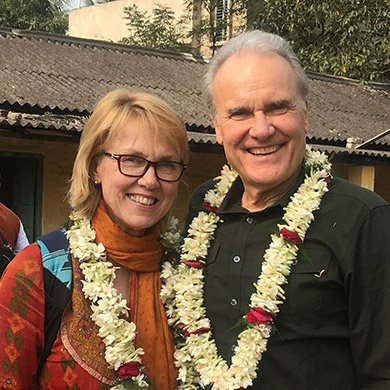
    Jerry and Corrie Vreeman smiling at the camera

    It all kinda started originally back when he was a junior at Holland Christan, though, working part-time as a radio announcer for Holland’s WJBL radio station. In between caring for her 10 children, his mother, (a Mrs. Michigan winner, and Mrs. America pageant finalist!) ran the daily WJBL am radio program “In Your Neighbor’s Kitchen” from their home, so he “grew up twisting dials and knobs on a radio/audio mixer,” he said. While at Dordt, he helped launch their KDCR radio station, then at Calvin Sem helped start CRC-TV at the request of Back to God Hour. Then eight years later he helped create Multimedia Ministries International (MMI) in the Chicago area “in order to credibly and effectively present the historic Christian faith through media” What followed were several decades of media ministry, working with big name evangelists all over the country from his Chicago area homebase, while raising six children with Cori, who taught piano lessons from their home, helping steady the family income.

    And there are more than enough riveting stories to fill this issue of Connections with stories only about L.I.O.N. and its current worldwide impact. As with so many God-lead endeavors, it really started unexpectedly when Jerry, at the age most adults look toward retirement, was trying to figure out what was next, while working for a church plant in NW Indiana, but “wrestling spiritually with a change in our ministry focus,” he said.

    He and Cori look back now and see God’s creative and convoluted planning: In 2002, their fifth child, Amy, was invited by Jerry’s college roommate, Dr. Rick Kruis, to attend Rehoboth Christian School for her sophomore year, and to live with the Kruises in nearby Gallup, NM, to “experience the adventure of living there with them” Jerry said. She loved it so much she asked to go back to Rehoboth for her senior year.

    ”It’s more empowering to them that the missionary is not there with them, but is an outside coach, mentor, motivator.

    At the same time, he had been “challenged by two spiritual mentors to consider taking a leave from media ministry and serve in person the kinds of people Jesus called ‘the least of these,’” Jerry said. So he and Cori moved to Rehoboth, NM, with their youngest daughters, Amy and Carmen, thinking that “serving the Navajo and Zuni communities would be our faithful response to the nudging of God’s spirit.”

    Instead, while at Rehoboth he happened to run into a Holland Christian classmate, Randy Disselkoen ’68, whom he hadn’t seen in years, and who just happened to be visiting Rehoboth on business.

    “As we shared our wrestling to serve underserved people, Randy invited me to join him on a trip to India, to meet and possibly serve his friend, Mano, in India,” Jerry explained. “We now know that was a ‘God thing!’”

    After that first trip, Jerry started traveling back and forth to India 4-6 times a year through Mano’s organization, FPTL from their new home in Colorado Springs. Jerry’s network of contacts and work in India was growing, and he had no intention of creating another non-profit organization. “I simply felt called to serve other leaders both here in the United States and in other developing countries,” he said. And “I felt a growing desire to focus primarily on leaders in obscurity in many different professions and walks of life.” So he started L.I.O.N. not to provide funding for these leaders and their important work as much as to help them network within the global Christian community, to encourage and enable them in their work.

    “We live in a time when information and resources for training and equipping are available to almost anyone anywhere through technology, transportation, and abundant print or audio visual materials,” he said. “Yet, leaders in obscurity often feel more disconnected, lonely, insignificant, or abandoned than at any other era.”

    Used to visiting the White House, or talking Jesus with Billy Graham before he broadcast him live to thousands, Jerry found new excitement in serving these Christ followers who were unknown, scattered, obscure, but doing important work for God’s kingdom in their own communities.

    Ever since childhood “I had been thrust into more of a public eye and leadership, with national exposure, hanging with celebrities, that this is who I am, you just do it,” Jerry reflected. “But to be turned around and to be poured into the least of these, and end up being invested in the other side of the world, spending time in Rwanda, hearing life stories of going through 100 days of one million Rwandans murdered, more than half by their neighbors with machetes…” he trailed off. Then finished, “How can we come alongside and encourage and equip and empower them? How to love one another? The gospel has always been birthed in those horrendous situations…” and yet, he added, amazed that “how by God’s grace—I wonder that God would choose me for this kind of work…”

    It’s now 12 years since it started, and L.I.O.N. currently networks with literally thousands of Christian leaders all throughout rural India and Africa, supporting them primarily through “the four Es”: encouraging them, equipping and empowering them, while also engaging them in whatever work they are already doing in their home locales. Not the old way of bringing in the white missionary to preach truth, but instead using normal people in normal everyday work to be Christ to the people around them—and help them do it even better.

    ”As I serve struggling leaders and families around the world today, I am so amazed by and grateful for the sacrifices made by several generations before me to lay the foundations and grow Holland Christian Schools.

    “They’re making a difference, turning communities upside down,” Jerry said. “It’s more empowering to them that the missionary is not there with them, but is an outside coach, mentor, motivator. That is far more empowering; plus they’re networking with leaders in Nepal, in Punjab, Kashmir…” his list trails on.

    Looking back, Jerry is grateful for his years as a student at Holland Christian, is thankful for how he was prepared by Holland Christian for leadership at a national and global level, for the variety of opportunities Holland Christian gave him, and especially for the community that wrapped itself around him: “As I serve struggling leaders and families around the world today, I am so amazed by and grateful for the sacrifices made by several generations before me to lay the foundations and grow Holland Christian schools,” he said. “I am so grateful to have specific memories of teachers, administrators, and school-associated parents outside of my own who cared about me and invested time to encourage me, or—more importantly sometimes—held me accountable.”

    But like any true Christian evangelist, he doesn’t stop there: “I’d love to challenge anyone at Holland Christian that their gifts, their talents are what is needed globally— to open yourself up to being used just as you are, to live out the kingdom principles in their lives.”

  • Megan Feenstra Wall ’98

    Megan Feenstra Wall ’98

    January 2023 Connections Alumni Profile

    Megan Feenstra Wall ’98 doesn’t remember exactly when she decided to be an architect.

    Maybe it started when she was a little girl pondering church ceilings—as she did through most church services of her childhood at North Street CRC, or Eastmanville CRC, imagining the whole thing flipped upside down, and how fun it would be to slide down the giant beams.

    Or it could have been when she loved art and found math easy at Holland Christian High School, so that Mr. Tuls wouldn’t even bother to check her math assignments. And Mrs. Luce, the art teacher then and a favorite, pushed her to “keep exploring that creative side.” Luce, along with Mr. Hiskes, Mr. Tuit, and Mr. Triezenberg in particular opened Megan’s eyes to “different perspectives, different views of the world— they challenged kids in a really wonderful way.”

    So maybe it was someone in high school who encouraged architecture since it combined her two loves of math and art.

    But Megan didn’t know any architects back then, much less any female architects. So she just took the next step, an interdisciplinary degree at then-Calvin College, with masses of engineering and math classes, alongside art and art history, especially the history of architecture.

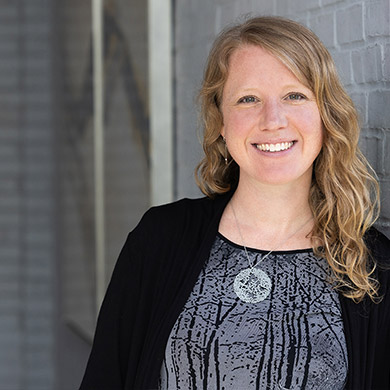
    Megan Feenstra Wall smiling at the camera

    ”That’s been a pretty consistent theme of mine—I’ll be the voice for the people who don’t feel like they’re being
    heard.

    And then found herself at Columbia University in New York City for graduate school in architecture for the next three years.

    “It was really hard, but in a really wonderful way, challenging, exhausting,” Megan said. “Architecture students don’t sleep, and you definitely don’t sleep in that school in that city—all you do is school,” she added. “But because of it I made some really wonderful friends. It broadened my worldview to just be aware of ‘the other,’ because there’s so many different ways of thinking—and it definitely put me on the spot as a Christian.”

    But in that challenging environment, she also recognized the “good base” built for her by her Christian schooling at ZCS, HC, and Calvin. And found that people on average didn’t have the same family support or social networks that she had growing up: “By being a person of peace, people saw that I had a different kind of grounding.”

    But it was also through that new awareness of being “the other” in a community that she found a second calling—to give those outside the “norm” a voice they might not otherwise have on their own.

    Immediately after graduating from Columbia, Megan worked in a private architecture firm in NYC—long hours for little pay, like most architects in NYC. “And all we did was work, and it felt very competitive, and there was so much ego in the profession,” she said.

    ”It broadened my worldview to just be aware of ‘the other,’ because there’s so many different ways
    of thinking.

    So she quit, not knowing for sure if she’d ever go back to architecture, and after one season of teaching skiing at Winter Park together with her husband, Josh, they backpacked through Asia for six months.

    Which was “just amazing, and again, broadening our view of the world and how amazing and vast it is, and how many different ways people live,” she said.

    But then Megan fell in love with the possibilities of architecture again in Durham, England, where she worked for an architecture firm in Newcastle while Josh pursued a second masters in theology. And she found a different way to do her career: Since the British firm often took Friday afternoons off, working just 36 hours a week, with 20 vacation days, she found that architecture as a profession could be both sustainable and fun. “Plus I saw how good design could be valued,” and was considered worth the additional cost, she said.

    After Josh finished his masters, they bought a car from exchange students for a bottle of whiskey—the deal of the century?—and traipsed through Europe for three months. Then moved back to West Michigan in 2009, smack in the middle of the recession.

    And found no jobs. Anywhere.

    She thinks she ended up with the only architecture job anywhere in Michigan, Iowa, or Colorado when she got a job at AMDG, a Catholic firm committed to working for the glory of God. Megan and Josh moved to Grand Rapids, bought a car for real, and settled into work, Megan helping design several major Christian school renovations, including Grand Rapids Christian High School and Middle School.

    “And that actually meant something to me: When I left it was under construction, and some of the teachers pulled me aside and were like, ‘We’re really sad that you’re leaving because we feel like you were our voice,’” she said. “And that’s been a pretty consistent theme of mine—I’ll be the voice for the people who don’t feel like they’re being heard.”

    A few years and one child later, Megan was offered a job at Mathison | Mathison, an architecture start-up at that time meeting in the owner’s private residence. And learned shortly after the interview that she was pregnant unexpectedly with twins.

    “I thought my life was over—it took me a couple months to get over. I feel bad, but it did,” Megan admitted. “Though now it’s awesome—everyone should be a twin! It’s like a built-in playmate, it’s like a confidence booster!”

    Megan went back to Mathison, told them about her pregnancy, assuming they would want to find someone else to fill the job. But they told her that she was still the right one for them.

    ”I think that beauty should be accessible for everyone and that everyone knows their own environment and the way they work and live best, and so
    I like to be able to tease that out and create spaces that can help them live and work better.

    “Isn’t that amazing?” Megan said. “I loved that it was a start up, it was the best in design—and I wanted to be able to email my work to my friends in NYC.”

    Eventually also an owner of Mathison | Mathison, Megan continued to design school renovations, including the original South Christian renovation before they decided to sell and start completely over with a large donation. A few modern private residences, but also commercial, like a big distillery in Traverse City and a food pantry in Wyoming. Plus historic places like St. Cecilia Music Center, a concert hall downtown Grand Rapids. “That was a really cool project because of the women who started it originally, the woman in charge of the renovation was really cool, and the contractor was female,” Megan said.

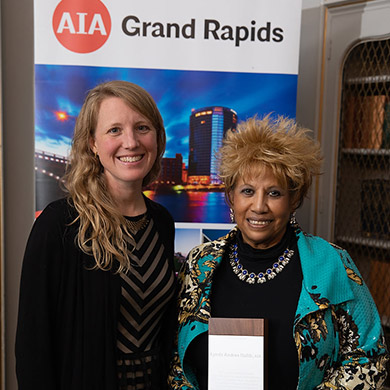
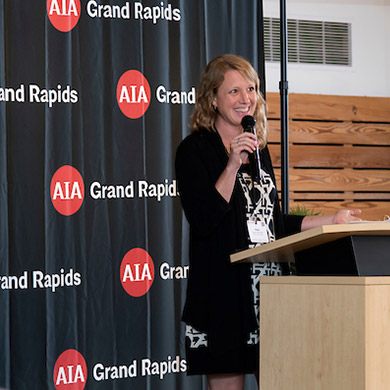
    And then the awards and accolades started pouring in. In 2016 Megan received the Michigan Young Architect award by the American Institute of Architecture (AIA). She joined the governing board at Kendall College of Design when they added an architecture program with Ferris, and she helped choose the program’s curriculum. She joined the AIA, and was voted president of the Grand Rapids chapter for 2021—the first female president ever. At the time almost 50% of architecture students were female, but only 17% of practicing architects were female.

    But it was through that experience and podium especially during the COVID years that Megan was able to cement her voice for the “other,” for those on the outside—for the other women, especially black women in the field. For those with disabilities, or for those affected first by the degradation of the environment—another passion of hers.

    One of Megan’s current projects is turning the old South Christian High School into community and office space for Special Olympics Michigan with several other non-profits that service a similar population—a design project she feels created to do as both a Christian and a female.

    ”I feel like that thread through Zeeland Christian and Holland Christian is kind of coming back full circle in a really wonderful way. In making sure that those voices can be heard.

    “That project is so cool—it’s rare for Special Olympics; usually Special Olympics doesn’t own buildings—they tend to rent, and when you rent you get last dibs, and the disability community almost always has last dibs,” Megan said.

    She thinks that inclusive philosophy may have started already back at ZCS in second grade, when she was in one of the first inclusive ed classes: “I still remember it being introduced, that we’re going to have these kids who look different in our classroom, and we’re just going to welcome them,” Megan said. “I feel like that thread through Zeeland Christian and Holland Christian is kind of coming back full circle in a really wonderful way. In making sure that those voices can be heard.”

    Megan’s design philosophy comes out of who she is as a person, but also as a Christian and a female: “Women are used to having to consider others in a way that men haven’t always needed to,” she said. “Is that Christian? It’s always something I do—to include, and make sure the voices that haven’t been heard can be heard.”

    “And I think that beauty should be accessible for everyone,” she continued, “and that everyone knows their own environment and the way they work and live best, and so I like to be able to tease that out and create spaces that can help them live and work better. And I think that everyone deserves that.”

  • Grandma Alice & DeRuiter Family

    Grandma Alice & DeRuiter Family

    Spring 2023 Connections Alumni Profile

    If you have heard of Grandma Alice, it’s probably because you have eaten her home-baked cookies, slightly crumbly, but melt-in-your-mouth from all the butter. If you’re really lucky, you’ve even tried her cream puffs, frosted with chocolate and just the right dainty size to fit perfectly into an elementary kid’s hand, with homemade custard oozing out the sides to lick off before you take a bite.

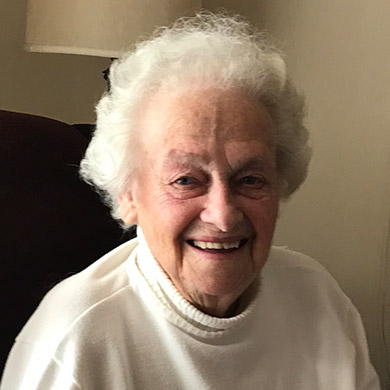
    Grandma Alice—or Alice DeRuiter, officially born in the Netherlands as Aalje—bakes cookies for her church, for her neighborhood, or for friends whenever the arthritis in her knees is just too painful. Instead of feeling sorry for her 93-year-old self, Alice generously whips up several batches of chocolate chip, pecan sandies, or Dutch sugar cookies. Then calls the next person on her list she has been praying for or wants to bless.

    You want to get on her cookie list. But you also want to hear her stories. Alice herself is not a Holland Christian alum, and neither was Case, or Cornelius, her husband of 63 years. Instead this is a story of how an amazing family sent six children through Holland Christian Schools: Five DeRuiter children graduated from Holland Christian and went on to college, four on to graduate school, three completed PhDs and postdocs. And the sixth? The DeRuiters’ fifth child, Paul, died of cancer while a third grader in Mrs. Homkes’class at Holland Christian in the early ’70s. That’s an amazing story for another article, and Alice still tears up talking about Paul’s death 50 years later. How at the very end he reached up his arms to Someone, smiled a huge smile, and joyfully said, “Oh!” to Someone only he could see.

    Grandma Alice smiling at the camera

    ”I always said ‘No matter what we go without, the kids go to the Christian school.’

    There also are WW2 stories of growing up in a small town near the southern Dutch border, about how Case hid from the Germans in a houseboat for two-plus years, working for a farmer who signaled to them when Germans were nearby. How as a teenager, Alice herself helped hide a boy under the floorboards in the dark wee morning hours, quickly changing his bedsheets in the dark so the Nazis wouldn’t discover an empty but warm bed. How she met Case when he was still hiding from the Germans, but living then with her neighbor, and how they wanted to get married in post-war Netherlands, but could find nowhere to live together. So they applied for visas to America.

    Case and Alice picked Holland, Michigan because Alice’s uncle lived there. A grumpy, controlling uncle they didn’t really know, but who let them move in and happily took half their income in rent until they could figure out in a foreign language how to get married and find their own apartment in this foreign country. (“We never met people who spoke Dutch here!” Alice said.) Case worked finishing furniture for Holland Furniture Company and eventually the Worden Company, and Alice worked at the shoe factory until their first son, John, came in 1952. They sent home $20 each month for her widowed mother, at the Dutch church’s request, their own rent $40 a month.

    So how on earth did they send six children through a Holland Christian education?

    A lot of really hard work: While Case worked four 10-hour days at the furniture factory, usually setting off in the early mornings walking or riding his bike, Alice “stayed home” with the kids, but also cleaned houses for Hope College professors or for cottages on the lake; took in laundry (including Dutch costumes one time accidentally!) for extra pay; and clerked at the donut store. On Fridays, Case painted houses or cared for lawns.

    Beth DeRuiter VanderWa smiling at the camera

    ”Our parents worked super hard—they set an example there, and I don’t remember them grousing—they just did it.

    “I cleaned six houses a week—and I wonder now why I got sore knees! [But Holland Christian] was worth every nickel to me!” Alice said. “I always said ‘No matter what we go without, the kids go to the Christian school,’ and the funny part—the money was always there, too.”

    Alice’s children talk of the work ethic passed on to them by their first-generation American parents and how important education always was to their parents. The fourth child and only daughter, Elizabeth ’78, said “Our parents worked super hard—they set an example there, and I don’t remember them grousing—they just did it, which helped shape our work ethic.” But also watching how hard their parents worked manually, “made us think about other options,” she admitted.

    Even though she ended up in the sciences and medical field eventually, Beth has “a lot of fond teacher memories” from Holland Christian, but especially loved history with Mr. Lanninga and Mr. Tuls—“both I think the world of!” she said, telling how Mr. Tuls “was the kind of guy who would meet us for breakfast on Saturday morning—he would always show up and pay for all of us!”

    John, the oldest son born in 1952, was often sick as a child and even had a kidney removed when he was four, continuing to struggle with health throughout his adult life. However, some of Alice’s favorite stories include how John and his HC buddies plotted their senior prank hiding out in a friend’s garage, carefully pulling the engine out of a small car, making it lightweight enough to drop down over a wall into the high school’s courtyard. They completely shocked teachers and students who all wondered how on earth a whole car could suddenly appear in the school’s walled-in courtyard!

    “To me, I thought it was awesome,” Alice chuckled— something she does a lot. “They came up with something that didn’t cost anything, it wasn’t anything nasty. I knew they were up to something—but I am glad I did not know that while it was happening. But it was something unique!”

    “Case and I always said how important it is to get an education,” Alice said. [That was one of] “the main reasons we left, because in the Netherlands you could only go to college by lottery at that time. I never had any diamonds—I always would tell my kids they’re my diamonds!” she said.

    Alice still speaks proudly of her adult children: John ’70, no longer secretly pulling engines out of cars for senior pranks, is retired from teaching special education in the Muskegon area, still plays the organ beautifully, and sends her small gifts to give to her neighborhood kids, after years of giving generously to his students throughout Muskegon. “You don’t know what that ‘boy’ does for so many poor kids in school!” Alice asserted.

    Jack, HC class of ’72, is a professor of Drug Discovery and Development at the Harrison College of Pharmacy at Auburn University in Auburn, Alabama. After 40 years of research and teaching both graduate and undergraduate pharmacology, Jack is currently postponing retirement at the request of the provost to create a whole new curriculum of pharmacology education for a BS pharmacology program. He’s published over 50 books and/or book chapters, along with 300 scientific papers and 200 journal articles, but his mother is probably just as proud of him for playing the organ in church weekly.

    Bill ’75, who as a three-year-old gave strict instructions to his mother heading out the door to the hospital to have their fourth child that she was NOT to come home with a girl, and was then hugely unhappy with the return of his newborn sister Elizabeth, is now married and with two grown children of his own. Content with his bachelor’s degree, he enjoys family and life in Kalamazoo.

    Whenever Alice needs medical advice, she calls Beth ’78, who teaches both undergrad and graduate-level nursing students pharmacology and pathophysiology at the University of South Alabama College of Nursing in Mobile, Alabama.

    ”I never had any diamonds—I always would tell my kids they’re my diamonds!

    Mark ’85 has double degrees and certifications in both audiology and speech-language pathology and is professor and director of the Clinical Science Doctoral Program in Speech-Language Pathology in the Department of Communication Science and Disorders at the University of Pittsburgh.

    “My kids really give Holland Christian a lot of credit for what they accomplished,” Alice added. “We never took help from anybody else, but paid [their tuition] all every year. It’s a big sacrifice, but we were proud of ourselves. Maybe that wasn’t so good? But we were so glad when it was all paid up!”

    Alice has eight grandchildren and recently five great-grandchildren, besides her extensive collection of fans and friends from her neighborhood, church, and vast community that she’s gathered and loved and blessed and fed cookies to over the years.

    Although we started out trying to tell through one story how so many families value Christian education, and the sacrifices they make to send their kids to Holland Christian Schools, in the end it’s really about the incredible people we get to do life with in our HC community. We are so grateful to be a part of each other’s stories for a time, both our students and their amazing families. But then we also treasure cheering on former students and families off doing amazing things in their own corner of God’s world, spreading His light–whether through teaching meticulous medical care, writing for national medical journals. Or playing the organ for church and baking cookies for neighbor kids.

  • HCHS Spanish Immersion Internships

    HCHS Spanish Immersion Internships

    Spring 2023 Connections

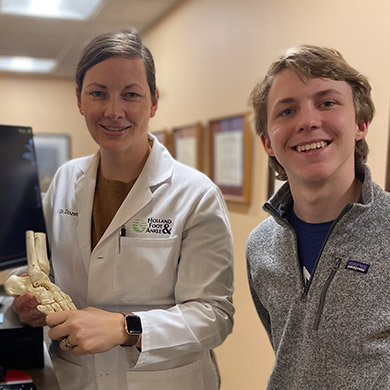
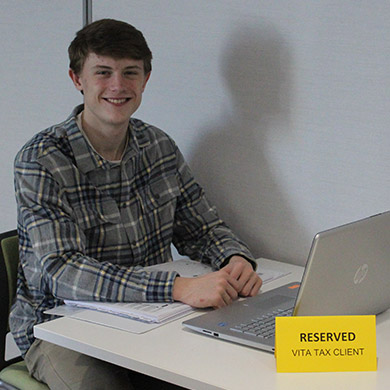
    HCHS Spanish Immersion student Aidan Delcalzo ’23 never anticipated that his Spanish speaking skills would allow him to watch foot surgery in person.

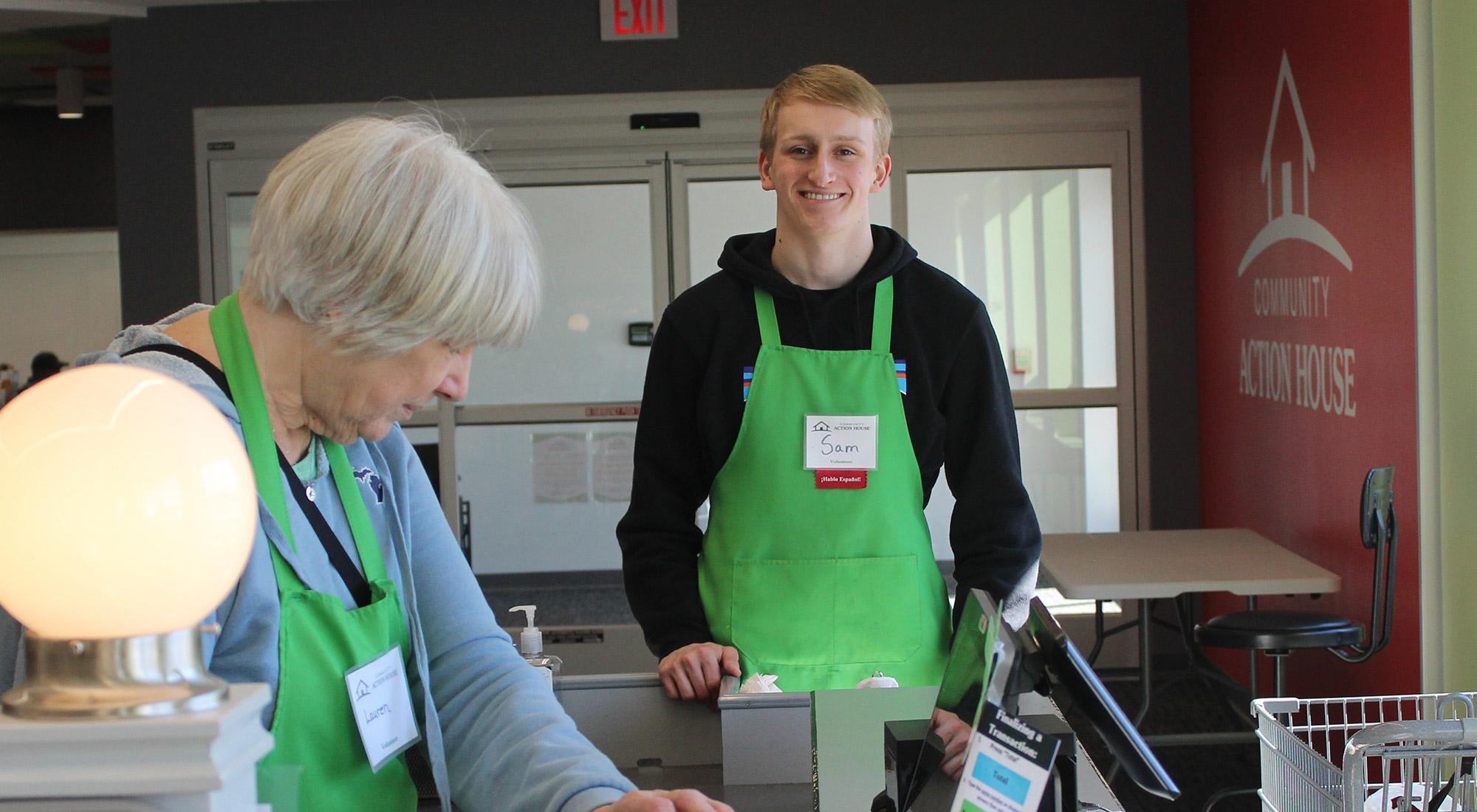
    And Sam DeBoer ’23 really never planned on bagging groceries at Community Action House, but found while doing it this spring that his Spanish was actually quite helpful.

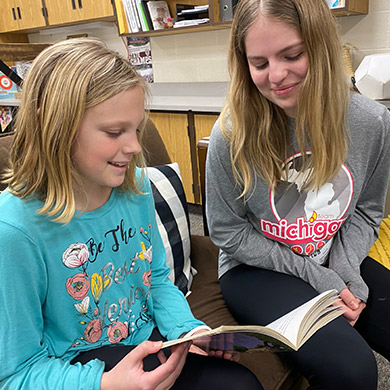
    Kate Schemper ’23 used her Spanish a little while interning this spring at Winning at Home, but she used it a lot at Zeeland Christian School, where she interned with Jodi Pierce, working with 3rd grade Spanish Immersion students there.

    This is the second year of the HCHS Spanish Immersion (SI) Senior Internship Class as the senior capstone class that placed HC students in a variety of work locations throughout Holland and Zeeland to try out their Spanish in a work setting.

    And most learned a new vocabulary.

    “They’re not at all similar!” Aidan exclaimed about Spanish vs English names for foot bones. “There’s all different parts of the foot—like 80 of them, and the English and Spanish are not at all similar.”

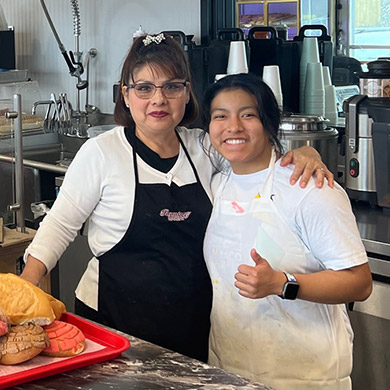
    Izzy Leys ’23 learned the nuances of Mexican pastries and baking terminology through Ramirez and Colin’s Bakeries. Kyle Cannon ’23 studied tax terms to help with filing taxes through the Community Action House. Students learned a few unexpected things as well.

    “It was helpful learning a lot about what a doctor does in day-to-day terms, and gave me insight into what I need to learn in college,” Aidan said, adding that he’s not sure if he wants to go into planes, feet, or business after college.

    “Being able to speak both English and Spanish and translate is a blessing to those [who] need [it],” Sam DeBoer emailed, “and doing what I’m doing can really have an impact on your life and the lives of others.”

    HCHS Spanish Immersion intern smiling at the camera with the podiatrist holding a foot skeleton.

    ”We’re getting [students] into a more authentic context of speaking Spanish.

    “I learned how different workplaces in the community of Holland and Zeeland use Spanish,” Kate Schemper added. “There are many workplaces in our community that work really hard to provide equal supplies to people in both Spanish and English (as well as other languages). This class has helped me see where my interests lie and what careers I could see myself in.”

    “Because I haven’t used my Spanish much outside of school, the language always seemed kind of far away, but being in this class I realized that there’s a whole community of Spanish-speaking people right here in Holland,” Isabelle Leys emailed. “The bakery business does not really fit the field I want to go into; however, the social aspect of the job helps me learn more about culture and how in different parts of the world, people just have different patterns of behavior…and the biggest bonus is that I get a LOT of free dessert!”

    Before her internship with Rose Park SI kindergarten teacher Hillary Klipp Lopez, Kayla Cannon ’23 was thinking about possibly going into education: “It’s been really fun!” Kayla said. “Before I was thinking 5th grade, but I do really like kindergarten, and I would probably consider teaching in Spanish Immersion,” she added.

    “We’re getting [students] into a more authentic context of speaking Spanish,” explained Anna Slenk ’02, HCHS’s SI coordinator, who helped create the class along with the class teacher, Noelle Solis. “Our students have [rarely] been in spaces where they are the minority. Plus there are so few chances for our students to work alongside and learn from more people, versus feeling like they need to serve someone.”

    “Having a second language is so much more than trying to get a leg up, or a better job,” Anna added—as beneficial as that might be. But it’s also “the ability to communicate, and understanding the cross-cultural community in order to do that well.”

    Once a week the internship students gather in class to read and discuss and compare notes, to assess the use of language, both English and Spanish, in the context of their internship location. At the end of the internships, students present to their friends and family at a banquet what they learned.

    We “want to understand how the Hispanic community is shaping Holland, look at how you can use [Spanish] now that you’re done [with high school], show them that you don’t need to go far to use your Spanish,” Noelle said.

    Anna says that too frequently students think they will reach a point when they know all the Spanish they need to know. Instead, she wants them to “understand what it’s like to be a lifelong language learner, that the language used in school is different than the medical profession, that every field has unique languages—that you never really arrive. It’s a reminder that maybe I still have a lot to learn, and … there’s a lot of new to be discovered!”

    HCHS’s SI program is in its eighth year, and has developed into an amazing program—one that other secondary SI programs have asked to copy. Despite some initial difficulties settling into which college program we could attach ourselves to for advanced/college Spanish credits, things have settled into place. We are able to offer a rotating variety of classes so that students and families have flexibility and choices, as well as a wealth of experiences.

    HCHS Spanish Intern Kyle smiling at the camera from his Vita Tax help desk, study materials in front of him.
    HCHS SPanish Immersion intern student reading with a 3rd grade ZCS Spanish Immersion female student

    “We went on tons of field trips, from churches to bakeries,” said Kayla. “We did service days—[Solis] found ways to apply our Spanish skills so much in the real world, rather than just in class.”

    Of course we are grateful for the plethora of community businesses and organizations willing to take in our SI students as interns, so our students not only use their second language in community, but can explore future careers:

    “Allowing high school students to experience a medical career firsthand is a special way for them to gain insight on understanding their own gifts and talents, and learn how God may lead them in the future,” emailed Dr. Allison Dozeman, DPM about Aidan’s internship with her at the Holland Foot & Ankle Center. “It is especially interesting for me to work with a Spanish Immersion student from Holland Christian. I studied Spanish as a high school and undergraduate student, and I am thankful to be able to use these skills in a practical sense in a medical setting.”

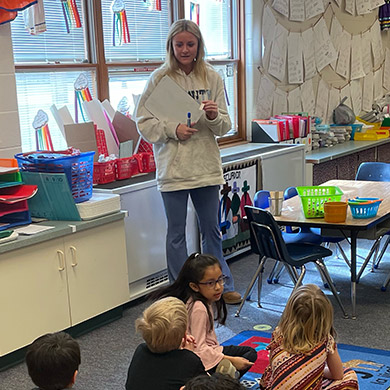
    HCHS Spanish Intern Kayla teaching a group of Spanish Immersion kindergartners.

    “The kids absolutely LOVE [Kayla] and are always asking if it is a day when ‘Maestra Kayla’ is coming to see them,” Hillary said. “They think it is so cool that she was once a Spanish Immersion kindergarten student just like them! It is also fun for me to work with Kayla as an aspiring future teacher, give her tips, show her what has worked or not worked for me in the classroom, and seeing her joy and enthusiasm with my students. It is truly a blessing to have this kind of full-circle partnership with our high school immersion students!”

    Plus the idea of our SI students in community internships fits in so beautifully with HC’s whole reason for existence: “The Spanish Immersion program at HCHS is an invaluable opportunity for our students not only because of the clear academic and professional benefits, such as higher critical thinking and problem-solving skills, but more importantly because immersion encourages students to see more intimately the image of God in people who speak the language around the world,” wrote HCHS principal Miles Colago. “Our students are learning Spanish in order to deepen their love of their neighbor and, in so doing, transform the world distinctively for Jesus Christ.”

    To read more about HCHS’ Spanish Immersion program, visit the HCHS Spanish Immersion page.

  • Building Community @ HCMS

    Building Community @ HCMS

    Spring 2023 Connections

    Behavioral scientists have learned that the ideal ratio of praise to criticism for students is 4:1—that there should be four positive comments for every criticism. You can imagine in an energetic middle school such as ours, this is easier to do for some students than others. And easier on some days than others.

    To help make praising students part of our daily routine, though, and to help standardize rules as well as consequences—both positive and negative—Holland Christian Middle School started a program last year called PBIS, or Positive Behavioral Interventions and Supports. It’s not a new program by any means—lots of area and national schools also participate in the program, including both Rose Park and Pine Ridge.

    But as is typical of so much of what they do, HCMS has folded their own creative, quality twist into the program: They added a house system at the same time, and are weaving the two programs together in a beautiful way.

    One of the beauties of PBIS is that “All staff have common expectations—in the alley, chapel, carpool lane, locker room. [We] want a system that really honors and encourages because that’s better for kids,” HCMS principal Tom Strikwerda explained. “It helps create a positive culture, and each house develops its own flavor.”

    Most of us are probably aware of educational “houses” from Harry Potter books or movies; however, academic houses are actually a long-standing British tradition coming back into vogue, partly through the Ron Clark Academy, which quite a few HC staff have attended recently.

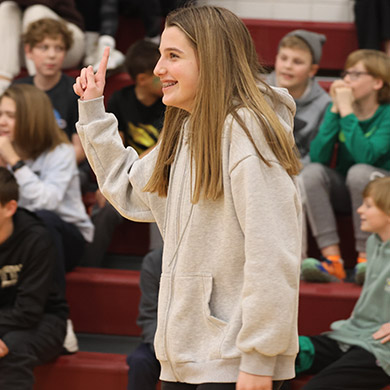
    HCMS female student called out to participate in the House Cup.

    ”It helps create a positive culture, and each house develops its own flavor…

    So HCMS started their own HC-specific, intergrade houses, each with unique logos designed by HCMS art teacher, Jenny Geuder: the Lighthouse, Dunes, Lake, and Windmill houses. At an all-school gathering starting each school year, each 6th-grade student picks their houses randomly out of a hat, then is cheered by their new housemates as their new houses are announced.

    “It gives [students] a chance to get excited and passionate about something in school—it’s fun to see them get into it, and a nice change of pace. When it goes well, kids celebrate each other really well—and in ways that wouldn’t happen otherwise,” Tom added.

    If a teacher happens to catch a student doing something positive, usually along the lines of their three guidelines of “Be Ready, Be Honorable, and Be Engaged,” then that student receives points for their house. The teacher can add the points right into a house app on his or her phone, and the student’s photo, along with the number of points they just earned, and the house they belong to, all register instantly on a TV screen in the alley where everyone can see it and celebrate it.

    HCMS is in year 1.5 of the three-year PBIS program introduction, so things are certainly not perfect. “We’re really good at the celebrating part,” said Katelyn Roskamp, HCMS Spanish teacher, who was hugely instrumental in getting PBIS started. “We just want to make sure we hold students to high expectations, too.”

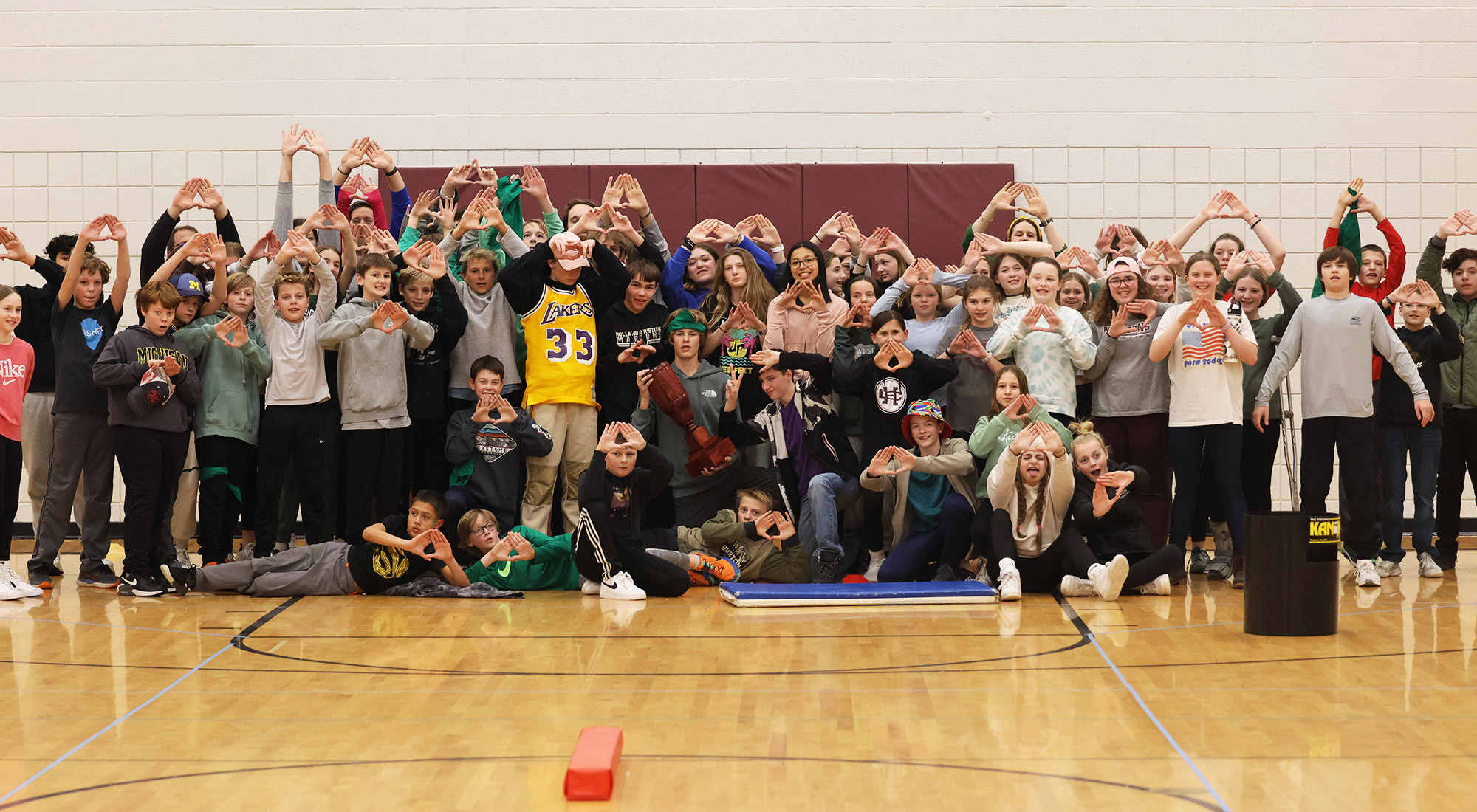
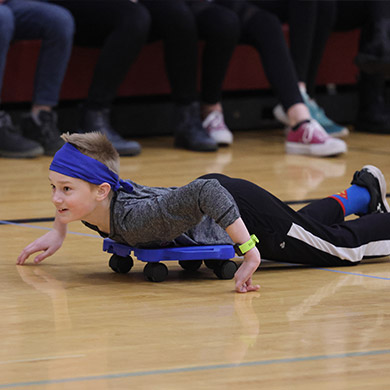
    House points are easy to incorporate into almost any middle school activity, from the monthly House Cup games in the gym, to decorating the halls for Christmas, raising money for the Walkathon or Special Olympics, or bringing food for food drives.

    Even for extra credit homework points.

    Paige VanderMolen, who serves lunch in the middle school, and Tom have noticed a marked difference in the lunch room in the alley—kids actually clean up after themselves and their friends after lunch, clearing tables, dumping trash, wiping tables with disinfectant spray and a rag. Students can earn extra house points for being extra helpful over lunch—cleaning up, but also helping friends with special needs.

    Tom also notices a higher rate of positive student encouragement. Like the time last fall a 6th grader won one of the monthly house Quad Cup games in front of the whole student body, thereby winning points for his Dune house, and the whole Dunes team went crazy cheering for him. “That’s not something that would have happened for him probably otherwise,” Tom said.

    Students can also choose to earn individual awards through PBIS, like weekly treats from the treat bin in the office. But it’s usually the house points that seem to inspire them onward to do good deeds—even sometimes doing homework on Fridays.

    HCMS student on floor scooter, pushing himself along in the House Cup races

    ”We hope it will lead us to be more like Christ, and that helps us as a school as well.

    “A nice feature of it is that it allows teachers to give points to students who are not always getting attention,” added Sam Fox, 7th grade English teacher, who also had a significant role in starting and organizing the house program. “It allows you to hopefully celebrate a lot of different students.”

    “The idea is that when [students are] consistently rewarded, then it becomes second nature, the behaviors we’re hoping for,” said Tyler Johns, HCMS Behavior Specialist. “It’s basically long-term operant conditioning.”

    Students stay with the same house all three years in middle school, along with the same teacher sponsors, building relationships across grade levels and with adults.

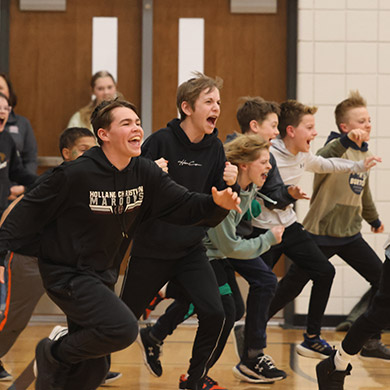
    Students cheering and running out on the gym floor together

    Teachers say that PBIS, along with the house system has helped them be more consistent with rules, as all expectations are phrased similarly, and students catch on more quickly since they hear the same rules from all teachers. “It changes the dynamics of how you speak to kids, how kids speak to each other,” Katelyn said. “I’ve really appreciated the shift for me in my language as I did it more and more.”

    A special addition to the program this year were student house leaders elected right before 7th-grade camp, four students selected by each house to lead them, take care of details behind the scenes, get a small taste of what it means to be a leader of a larger group. And teachers are learning how to incorporate them into the larger scheme of things, to help students build leadership skills.

    But meanwhile, “The houses fit into our vision of how we hope our school to be—our whole goal to learn how to love each other more,” Katelyn said. “We hope it will lead us to be more like Christ, and that helps us as a school as well.”

  • What in the World is MIFA?

    What in the World is MIFA?

    Spring 2022 Connections

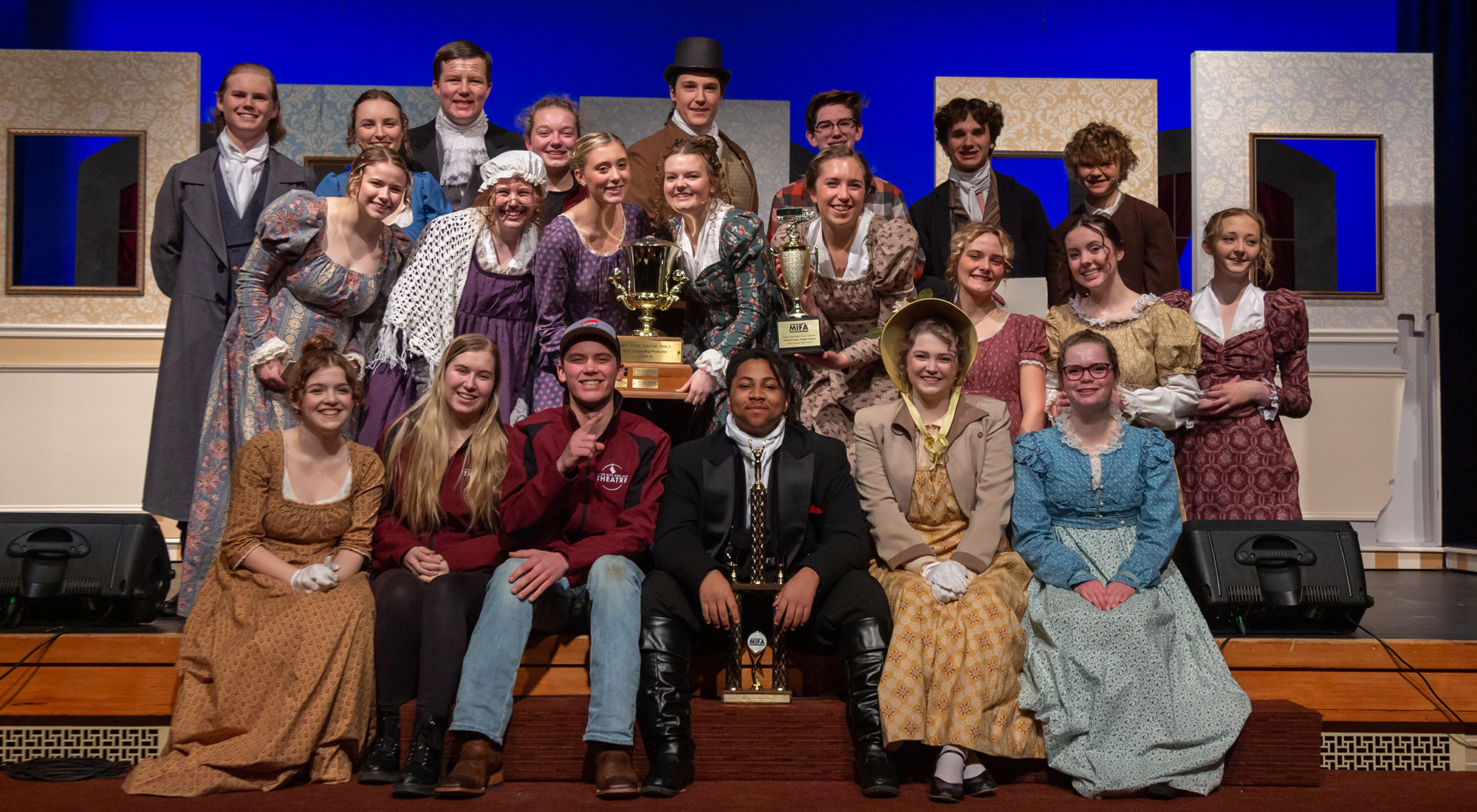
    Maybe you heard the good news already that HCHS’s MIFA team won State? Again? But then maybe, like most of us, you didn’t really understand what it meant—that our MIFA team won state for the 8th time since it started performing in the MIFA One-Act category in 1996. That makes eight state championships in 26 years?!

    So what is MIFA anyway? The acronym stands for the “Michigan Interscholastic Forensics Association,” and it’s the same organization that puts on competitions in debate every fall, and 12 individual forensic categories like speech and storytelling each spring. But the MIFA One Act competition that we have participated in, and won regularly each February, is well described by Owen Langellier ’23, a MIFA team member this year: “It’s like varsity theatre; you make a 45 minute show that competes against other 45 minute shows from schools around Michigan and you have divisions and get scores—like sports.”

    Elle Nieuwsma ’12, HCHS English teacher and one of the two staff directors of the program added a few details: She and her co-director, Justin Dreyer ’10, HC’s Technical Director of Theatre & Digital Media Designer, select a team of 20-25 students through applications, interviews, and auditions in late November. Once selected, the team meets every day after school from 3-6 pm, and usually on Saturdays for 4-5 hours from December-February, minus Christmas break.

    In that amount of time, they must work some minor miracles: Take what usually is a 2+ hour play, condense it to a 45-minute complete story line, include all technical aspects of a regular play such as full sets, costumes, make-up, as well as sound and lights, and be able to load and unload all of the equipment of the traveling show onto a truck so that the set and equipment not only does not get forgotten or broken, but also load and unload it as a team in a manner that is polite and professional—all while being judged on said politeness and professionalism—which, by the way, they did so well this year they also won the coveted Golden Truck Award.

    Naturally the question, why do this?

    ”It’s like varsity theatre; you make a 45 minute show that competes against other 45 minute shows from schools around Michigan and you have divisions and get scores—like sports.

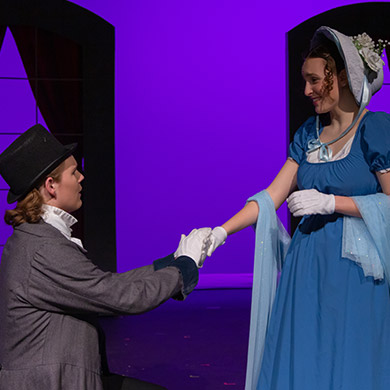
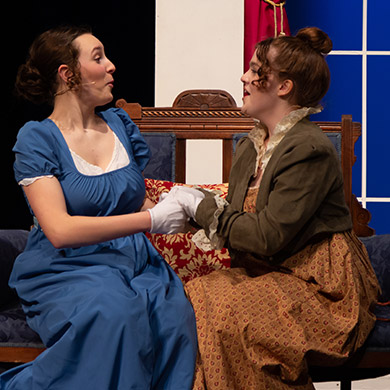
    Actor kneeling, holding actress's hand

    Pedagogically, it’s a no brainer: “Educationally, there are four different skills that modern education should teach: communication, creativity, critical thinking, and collaboration—and MIFA is all that!” Elle explained.

    Plus, you throw together kids with a “range of interests and personalities and skill sets.” Then add in the fact that adult theatre directors are not allowed to help with any of the actual MIFA performances, so neither Elle nor Justin is allowed backstage with a show, can’t help unload or load the truck, can’t help with lights or sound—and you’re teaching students a whole lot of independence, leadership, and self-reliance.

    “We’re hands-off and they make the show,” Elle said. “They learn a lot of leadership skills, and during competitions learn hard work and determination as well.”

    That being said, Elle typically spends the summer before pouring over directors’ catalogs to find a play she’s excited about, keeping in mind the student talents and potential team for the next winter; then she shortens the script to make a coherent and interesting 45 minute play. Since this year’s chosen play needed to be a comedy, she chose Jane Austen’s Emma.

    During the MIFA season, there’s not the usual play luxury of whole set teams, technical/sound/lighting teams, make-up or costume teams due to such a small group of 20 students. Instead, everyone learns how to do a little bit of everything.

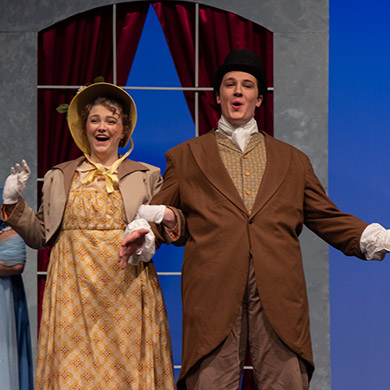
    Actor and actress facing the audience smiling together

    ”Educationally, there are four different skills that modern education should teach: communication, creativity, critical thinking, and collaboration—and MIFA is all that!

    “Actors do a lot of onstage work—but some days we’re just building the set, learning how to work power tools. Everybody has a job in the show, but there’s a lot more collaboration,” Elle said.

    “I never had used a saw or any tools before!” said stage manager Bebe Mulder ’22. “It’s great knowing how to cut wood correctly, use a staple gun, because of helping out in the scene shop.”

    “I’ve learned so many skills, not just as an actress, but through working in costumes, painting the set, building the set, stage managing, and student directing. I’ve learned what it means to jump in at any given moment to learn something new or help someone else. I’ve learned the importance of vulnerability and trust in a community aspect,” Grace McAboy ’22 added.

    Inject COVID into their season, with nine team members out with it at one point or another, six at one time, and you have even more impromptu problem solving and creative thinking, students scrambling, filling in for roles and jobs they had to figure out on-the-fly. But most agreed that the pressure cooker this year forced them to focus and work even harder together to pull it off, with huge improvements from one week to the next.

    “Over multiple weekends, you see incredible growth and progression of the students as a whole,” Justin explained. “It goes from ‘This is a really terrible piece of theatre we created’—to ‘We actually did do something here!’ and we’re able to see marked steps, growth.”

    “Personally, I love watching students grow, their progression in a particular show,” Elle added. “Parents are blown away by how much growth happens as a production, but because it’s a small group of 20-25 people on the team, watching those friendships form, and that community form. You see that on travel weekends especially. It’s special riding a bus with them and being in a hotel and having devotions together.”

    Another plus of MIFA is exposing HCHS students to “other kinds of theatre programs, other theatre styles, shows from outside our perspective,” Justin said. “Seeing what works and doesn’t work, hearing stories we haven’t told yet—kids get exposed to so much good theatre.”

    Plus, he added “For the last couple of years, we’re the only Christian school in MIFA. It’s an opportunity to represent faith in the arts.”

    “We talk about this every time before we travel—that a Christian label is always attached to what we do,” Elle added. “It’s not a Christian story necessarily, but a story that shares deeply Christian truths. To tell a story of hope and truth, put our faith on display and do it well.”

    And it’s being noticed: One judge at a regional performance back in 2020, when they performed the Spoon River Anthology even said “I don’t know how you can walk away from this production without a belief in the Divine,” Elle remembered. “There were enough moments in it, enough music that we included that somehow reflected God, and that was just so cool! [These students are] spreading the gospel in a really unique way and in a space where I think we really need to be.”

    Students learn to network, getting to know students from other schools, as well: “Although winning State is pretty cool, the best part about MIFA One-Act is meeting teams from all over the state, making new friends with them, and celebrating theater together. It’s so much fun to see all the shows each school puts on, and congratulating them in the hallways afterwards,” Grace added.

    ”I’ve learned what it means to jump in at any given moment to learn something new or help someone else.

    Elle agrees: “MIFA is a competition, but also a festival feel, because students are so supportive of each other,” she said. “I’m still Facebook friends with kids from other schools [from when I was a MIFA student]. Plus, for me as director, to have that network of directors is so helpful! It’s very much a supportive network, really collaborative.”

    But hands down, you ask any of the 23 kids on the team this year, and every single kid will tell you they were on the MIFA team for the amazing community that’s more than community—“it’s family,” they all say.

    “You can’t find a better community at HC. The people are so welcoming and warm,” Chris Kingdom- Grier ’23 said. “We grew into more than friends—we’re a family.”

    “You just get to know kids so well—you get some of that in the classroom, but this is a whole other level,” Elle said. “I just get to be part of their lives in a different way that’s so special. Watching them grow as people, and as theatre artists is the best!”

    “MIFA gave me great theater experience, but the things I learned about being on a team, leadership, and the confidence I built during my time on MIFA will be what I carry most into my future after high school,” emailed Grace. “I’ll never forget the family we built each year and the weird, funny, and heartwarming memories I have from them.”

    It all came to a head this year during the State performance: Because of the remaining COVID concerns in February, each school’s MIFA team performed in front of only the judges, loaded up their trucks, then headed back to their own assigned classroom to watch on a monitor the other schools’ performances. The HCHS team felt like they performed well, but needed to wait for the judges’ decisions.

    ”You can’t find a better community at HC. The people are so welcoming and warm. We grew into more than friends—we’re a family.

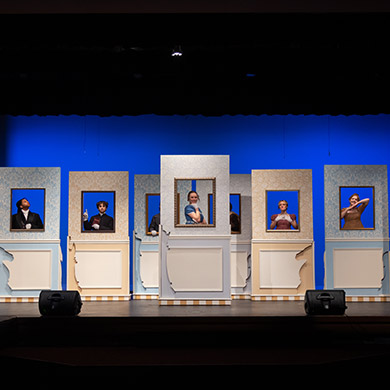
    Two actresses on stage looking like they are sharing secrets, smiling at each other

    “Before the results came in, we wanted to come before God and just thank Him,” Chris said. “Noah Tinholt [’23], I think it was, starts playing his guitar, and we just start joining in—worship is a vulnerable thing, you know—and for us to be able to go from a performance on Jane Austen to simply worshiping God—not even knowing if we’d won or not…?” he finished.

    And he wasn’t the only one who loved worshipping together:

    “It’s just really fun to worship with people who know how to sing really well,” Owen added. “A really special experience to be worshiping with people who both love God, want to worship as much as you do, and know how.”

    So that 8th MIFA State win? It is really great. But it’s really just icing on the cake.

    To read more about HCHS’ theatre program, including their spring show, visit the HC Theatre page.

  • Presenting HC Preschool

    Presenting HC Preschool

    Winter 2023 Connections

    Why Preschool?

    Is preschool really all that important if kids are simply read to and played with at home? Do kids even need it these days?

    The answer is an increasingly emphatic yes, preschool is actually growing even more important for three reasons: It builds social-emotional skills, decreases anxiety, and establishes an academic foundation necessary later in school.

    With COVID closing down schools, churches, and group social gatherings for almost two years, we are now seeing some of the impact that had on young children. And it’s not just in academics, although you hear about it more commonly in the news, with the current greater need for tutoring. However, because of COVID many young children weren’t able to participate regularly in social opportunities, and couldn’t practice important social interactions like sharing, making friends, and problem solving things that don’t go their way. As we deal with the aftermath of COVID, we’re realizing anew how critical these early stages of early childhood development actually are, and are seeing students handle these social situations in more immature ways.

    “Social emotional development is so critical with early childhood, that the earlier you can introduce them to social interactions and guide them through those, the better,” South Side principal Erin Wyma ’91 explained. “In our preschool settings, teachers are able to provide students a safe opportunity to learn and practice together all of the important social skills that are necessary for their development. Having the early intervention of preschool can help students build the social emotional maturity that they need in order to continue to flourish academically in their future school years.”

    A second bonus of preschool: With COVID reducing the opportunities for children to experience settings away from their parents, preschool provides a perfect opportunity to slowly get them used to being away from mom and dad for a short period of time. By doing this gradually, we see students’ anxiety decreasing—hugely helpful in later years when students attend school full time.

    “It is great to be able to start building an academic foundation while students are 3 and 4 years old, but the social-emotional piece with other children, of learning how to share, working through problems, being a friend, is probably even more important,” Erin added.

    You may know this already, that Holland Christian is blessed richly with exceptional and experienced preschool teachers. They are amazing, patient people who love the Lord, and love nothing more than sharing that love with very small children. But they also know how to do it in age appropriate ways, boosting both the social-emotional and academic skills, as well as spiritual joy. So just in case you have not yet met this modest, unpretentious, yet seriously talented group of preschool educators, we want to introduce them to you!

    ”I like playing with cars. Sometimes she plays the cleanup song, and she tells us to clean up.
    Sophia Boss ’37

    Tammy Grasmid ’87: 3s preschool teacher @ South Side

    Tammy Grassmid ’87 carries loads of educational experience into her classroom of three-year olds: 10 years of preschool, 20 years of 1st grade, six different schools. And she has this remarkable vision for educating preschoolers not just for the future, but teaches for the present, rejoicing in who these little people are now.

    “God has called me to teach at Holland Christian so that I can prepare the littlest students to go out into the world and share His love with those they meet,” Tammy said. “I use stories and verses from the Bible to show how God is in their lives and how He wants them to tell everyone about him.”

    “Tammy just knows the littlest learners, how to handle behavior, and what they can handle academically,” Erin Wyma affirmed. “And she nails it every time.”

    Tammy “has a unique empathy for kids who struggle,” Erin said, explaining that Tammy eagerly takes on students with disabilities in her inclusion classroom.

    All this learning happens in the context of guided play in her classroom, since “play is the most important activity that preschoolers can do!” Tammy asserted. “Play is where they use imaginations and interact with their peers. Play is where they strengthen gross and fine motor skills. If there is no play, then it isn’t truly a preschool setting!”

    Sarah Becksfort ’07: 4s preschool teacher @ South Side

    Sarah Becksfort ’07 taught kindergarten for years, “so she knows exactly what four-year-olds need,” Erin Wyma said. “She has some of the strongest classroom management that I’ve ever seen, plus very high academic standards, and kids rise to them. Kids flourish in her classroom structure.”

    But Sarah also sees her role as a partner to parents, naturally integrating faith formation into daily life: “I love experiencing the many ‘aha!’ moments that take place both in and out of our classroom,” Sarah said. “I am so thankful I get to walk alongside families in shaping some of our littlest kingdom builders.”

    One of Sarah’s favorite units to teach is the Building Unit: “There are a lot of engaging building and stem-based opportunities,” Sarah said, recognizing that this learning often takes place through purposeful play. “Preschoolers reinforce learning ideas, create and maintain relationships, and better understand their own social-emotional growth through play.”

    “Her classroom aligns great for students who need routine every day, and the warmth of a very loving, kind teacher bringing security for them,” Erin said.

    ”She gives me big hugs when I’m sad.
    Hazel Will ’36

    Preschool teacher Dawn Baker smiling at her student.

    ”On the 1st day I just met her and she was nice and when I just got in her class I hugged her.
    Ruby Veenhoven ’36

    Dawn Baker ’89: 4s preschool teacher @ South Side

    “There is never a dull moment, every day is different, they make me laugh, and I am blessed to share God’s love with them!” Dawn Baker ’89 said about teaching preschool.

    And she’s really good at it. She’s taught preschool for 11 years, and 4th and 5th graders for 12 years before that, so she is wise and experienced and calm. And continually trying new things—like going outside more with her class, pushing for inclusion, embracing new curriculum. (Yes, preschool curriculum is a thing, and yes, we have a new one, and are loving it!)

    “Kids are writing words when they leave her room,” Erin said, explaining that in the spring, Dawn’s classes are already doing research projects. “She excels with literacy and the sciences, and the [students’] depth of knowledge is off the charts!” Adding, “Dawn also has a heart and passion for students who require academic and behavioral modifications to flourish into God’s design for them.”

    Dawn especially enjoys teaching preschoolers about creation “because we learn that WE are the most important thing God made! It sets up how we treat each other in the classroom.”

    “I love teaching at Holland Christian because I get to be a part of nurturing young children’s faith,” Dawn said. “I love that kids are so excited about their faith!”

    Stacia Stoep ’04: Young Fives teacher @ South Side

    As a former 2nd and 3rd grade teacher at Rose Park, Stacia “loves to make sure that her students are achieving their learning to their own highest level possible,” Erin Wyma said, adding, “She is also very loving and kind.”

    One of the reasons that Stacia continues to teach at HC is “the high standards for their teachers, and the curriculum we are to implement” she said, along with “I can teach the total covenant child, and I appreciate the partnership between family and school.”

    Big important religious ideas that Stacia takes to a 4 or 5-year-old level. Through lessons like their “Plants” unit, when her students learn that not only is God the Creator of all things, but they come to appreciate the diversity of God’s creation anew through a variety of multi-sensory experiences all wrapped around plants: “We get our hands dirty by planting a garden. We taste different parts of the plant. We observe growth and life cycles of plants. We go off campus and into the woods to enjoy plant life…”

    “I love showing them the joy of learning and the adventure of trying new things,” Stacia said.

    ”She helps us learn reading books. And I like to play with my friends.
    Clayton Stephenson ’36

    Preschool teacher Allison DeLange smiling at the camera.

    ”I like the cars. There’s lots of cares at Mrs. DeLange’s class.
    Crew Clifton ’37

    Allison DeLange ’11: 3s preschool teacher @ Rose Park

    If you know how much three-year-old preschool students like to move, you can see how Allison DeLange’s first degree in kinesiology and recreation therapy comes in handy for teaching preschoolers. Then try lining up a class of three-year-olds to walk quietly down two hallways to the library, while not disturbing the other learning going on in the rest of the school. And you’ll have a whole new respect for Allison and the patient, creative work she does with her super cute, energetic bunch!

    “I love watching the kids discovering God’s world around them. There are so many lightbulb moments that I get to be a part of, and it’s beautiful to watch,” Allison said.

    It’s not always easy to find really good three-year-old preschool teachers— they’re a rare creation, and Allison fills those shoes so well. “Allison is very warm and affectionate, just perfect for our 3s,” Erin said. “She creates lots of fun activities for them.”

    But it’s not all fun activities, or playing—as important as that is—and walking to the library: “The most important thing that I want to teach kids over the course of the year is that there is a God who loves them and gave His son because He loves them so much,” Allison said. “If my students walk away knowing they are loved, I have done my job.”

    Laura Rotman ’00: 3-day 4s preschool @ Rose Park

    How many of our work assistants would be almost in tears talking about how much they enjoy working with us, or how important we are in the lives of their children? But Kylee Duistermars, the preschool aide in Laura Rotman’s class, and a parent of three former students of Laura overflows with compliments for Laura’s teaching: “She truly meets each student where they are,” she said. “She treats each one truly like they are the only one. She’s everything a preschool teacher should be and more.”

    Laura has taught preschool for 10 years, but she also is the Rose Park secretary two days each week, so she knows all the ins and outs of the business of education, particularly preschool paperwork. But then she’s also really good at taking a small and simple preschool lesson, say on the letter “P,” and turning it into so much more. Into a whole day of delight that includes preschool pancakes and pajamas, so that the lesson is much more fun—and memorable.

    “We have a lot of fun! I enjoy laughing, being silly and building a classroom where we have a lot of fun learning and exploring,” Laura said. “The preschoolers will always feel it is a safe and loving place to be.”

    But then Laura also realizes fully the foundation she is laying for future Christian life: “I also love seeing Christian values and relationships which begin in preschool, continue on through a child’s life,” Laura added.

    Preschool teacher Laura Rotman smiling at the camera.

    ”I like playing in her class and doing learning stations and making crafts and going outside.
    Andrew Baumann ’36

    Preschool teacher Leanne Bouwman helping students play.

    ”I like how she starts our day out by reading devotions.
    Emily Buck ’36

    Leanne Bouwman: 4s preschool teacher @ Rose Park

    “I teach preschool because I love being around the littlest learners and to be able to see God’s world through the eyes of a child,” Leanne said. “I love how they come to school with a big smile on their face, ready to learn, and an open heart ready to love God and others.”

    It is obvious from a few minutes in Leanne’s classroom that she loves kids and she loves her work with them. But what differentiates Leanne is “The energy she brings—she knows how to be a kid and get on their level, and get them excited about learning,” said Kathy Kuipers, Leanne’s preschool aide.

    Leanne has enjoyed teaching preschool at Rose Park for 10 years now, long enough to “feel very blessed to be able to build long lasting relationships with my students as well as parents,” Leanne said. “It’s a privilege to be able to share my faith with my students, parents, and co-workers.”

    Which is probably why her favorite unit to teach is right at the beginning of the school year when they’re learning that “God made me.” “I love being able to have my students observe that we all look different from each other, but we are all created by God and in His image.”

    Daniella Castro-Fernandez: Spanish Immersion 3s preschool teacher @ Rose Park

    Daniella is originally from Mexico, but moved to Michigan with her family in 2005 thanks to a job opportunity for her husband. In Mexico she attended college for psychology and worked for Amway as a marketing assistant. She and her husband have four children elementary age through high school. They attend Holland First Assembly of God where they actively serve the Lord, a pillar in their lives.

    Daniella has been working at HC since 2016, and finds it a very rewarding experience. She originally started working in the English preschool classrooms, but when she heard about the Spanish immersion initiative, she was very excited to be a part of it!

    “I love what I get to do in the classroom, and knowing that for some kids, I am a part of their first school experience,” Daniella said. “I am very committed to creating a loving environment, and to teaching in my native language–something that I am very passionate about!”

    ”I love what I get to do in the classroom, and knowing that I am a part of their first school experience.

    ”She always has a smile and welcome hug for our littlest learners.
    Dinah Pereira

    Perla DeLeon: Spanish Immersion 4s preschool teacher @ Rose Park

    Born in Mexico, Perla came to America as a young adult not knowing the English language, so she has understanding for students in her Spanish Immersion class who are new to Spanish: “God gave me the strength and ability to assimilate,” Perla said. “This experience is helpful when teaching my students a language and culture that may not be their native one. I love having the opportunity to help set a strong academic and spiritual foundation.”

    After many years of teaching preschool at both ZCS and Head Start, then teaching FLES Spanish at Rose Park, Perla was the perfect teacher to help start the HC Spanish Immersion program five years ago.

    “Perla is an energetic bilingual teacher who likes to have fun no matter if she is teaching letters, sounds, numbers, or shapes,” said Dinah Pereira. “She advocates for students’ needs and is always looking for best ways to get kids up and moving around to learn through experiences.”

    A peek into Perla’s classroom shows a room filled with colorful student artwork and creative play stations labeled in Spanish. Plus this hugely important quality of a preschool teacher: “She always has a smile and welcome hug for our littlest learners,” Dinah added.