Category: Connections Articles

  • Building Community @ HCMS

    Building Community @ HCMS

    Spring 2023 Connections

    Behavioral scientists have learned that the ideal ratio of praise to criticism for students is 4:1—that there should be four positive comments for every criticism. You can imagine in an energetic middle school such as ours, this is easier to do for some students than others. And easier on some days than others.

    To help make praising students part of our daily routine, though, and to help standardize rules as well as consequences—both positive and negative—Holland Christian Middle School started a program last year called PBIS, or Positive Behavioral Interventions and Supports. It’s not a new program by any means—lots of area and national schools also participate in the program, including both Rose Park and Pine Ridge.

    But as is typical of so much of what they do, HCMS has folded their own creative, quality twist into the program: They added a house system at the same time, and are weaving the two programs together in a beautiful way.

    One of the beauties of PBIS is that “All staff have common expectations—in the alley, chapel, carpool lane, locker room. [We] want a system that really honors and encourages because that’s better for kids,” HCMS principal Tom Strikwerda explained. “It helps create a positive culture, and each house develops its own flavor.”

    Most of us are probably aware of educational “houses” from Harry Potter books or movies; however, academic houses are actually a long-standing British tradition coming back into vogue, partly through the Ron Clark Academy, which quite a few HC staff have attended recently.
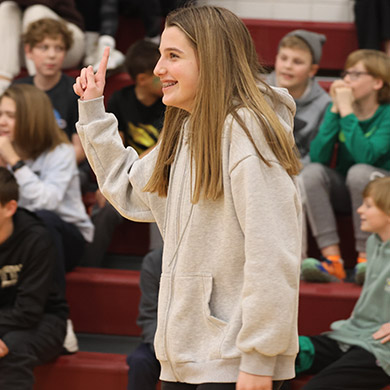
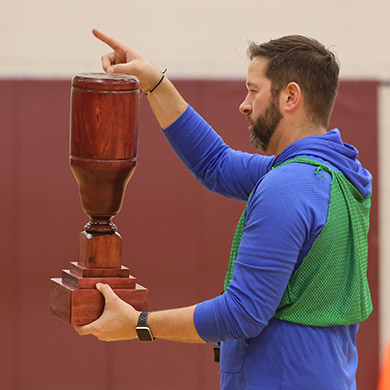
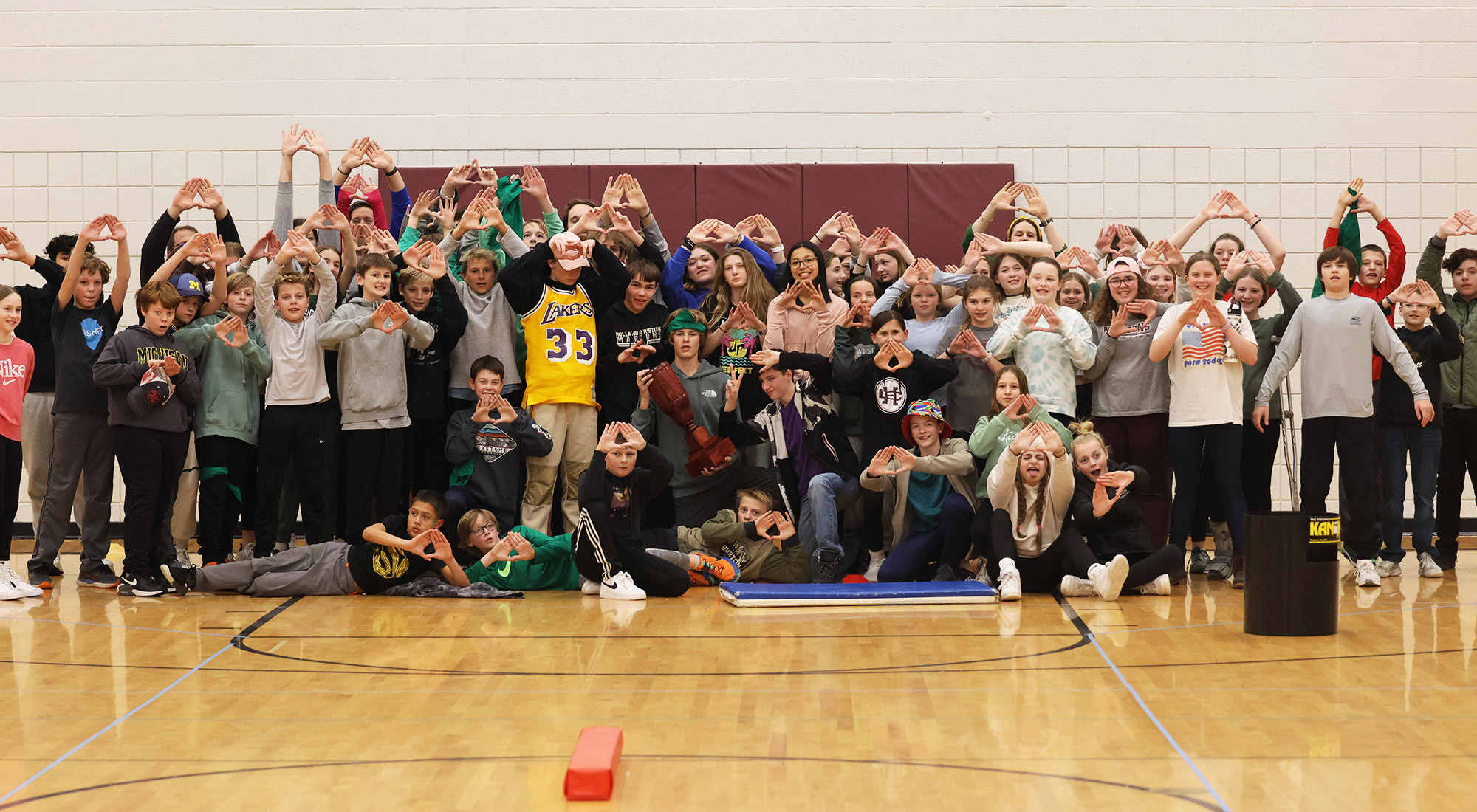
    HCMS female student called out to participate in the House Cup.

    ”It helps create a positive culture, and each house develops its own flavor…

    So HCMS started their own HC-specific, intergrade houses, each with unique logos designed by HCMS art teacher, Jenny Geuder: the Lighthouse, Dunes, Lake, and Windmill houses. At an all-school gathering starting each school year, each 6th-grade student picks their houses randomly out of a hat, then is cheered by their new housemates as their new houses are announced.

    “It gives [students] a chance to get excited and passionate about something in school—it’s fun to see them get into it, and a nice change of pace. When it goes well, kids celebrate each other really well—and in ways that wouldn’t happen otherwise,” Tom added.

    If a teacher happens to catch a student doing something positive, usually along the lines of their three guidelines of “Be Ready, Be Honorable, and Be Engaged,” then that student receives points for their house. The teacher can add the points right into a house app on his or her phone, and the student’s photo, along with the number of points they just earned, and the house they belong to, all register instantly on a TV screen in the alley where everyone can see it and celebrate it.

    HCMS is in year 1.5 of the three-year PBIS program introduction, so things are certainly not perfect. “We’re really good at the celebrating part,” said Katelyn Roskamp, HCMS Spanish teacher, who was hugely instrumental in getting PBIS started. “We just want to make sure we hold students to high expectations, too.”

    House points are easy to incorporate into almost any middle school activity, from the monthly House Cup games in the gym, to decorating the halls for Christmas, raising money for the Walkathon or Special Olympics, or bringing food for food drives.

    Even for extra credit homework points.

    Paige VanderMolen, who serves lunch in the middle school, and Tom have noticed a marked difference in the lunch room in the alley—kids actually clean up after themselves and their friends after lunch, clearing tables, dumping trash, wiping tables with disinfectant spray and a rag. Students can earn extra house points for being extra helpful over lunch—cleaning up, but also helping friends with special needs.

    Tom also notices a higher rate of positive student encouragement. Like the time last fall a 6th grader won one of the monthly house Quad Cup games in front of the whole student body, thereby winning points for his Dune house, and the whole Dunes team went crazy cheering for him. “That’s not something that would have happened for him probably otherwise,” Tom said.

    Students can also choose to earn individual awards through PBIS, like weekly treats from the treat bin in the office. But it’s usually the house points that seem to inspire them onward to do good deeds—even sometimes doing homework on Fridays.
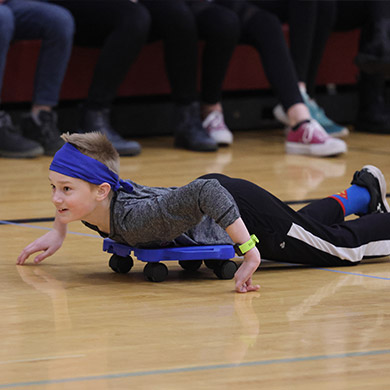
    HCMS student on floor scooter, pushing himself along in the House Cup races

    ”We hope it will lead us to be more like Christ, and that helps us as a school as well.

    “A nice feature of it is that it allows teachers to give points to students who are not always getting attention,” added Sam Fox, 7th grade English teacher, who also had a significant role in starting and organizing the house program. “It allows you to hopefully celebrate a lot of different students.”

    “The idea is that when [students are] consistently rewarded, then it becomes second nature, the behaviors we’re hoping for,” said Tyler Johns, HCMS Behavior Specialist. “It’s basically long-term operant conditioning.”

    Students stay with the same house all three years in middle school, along with the same teacher sponsors, building relationships across grade levels and with adults.
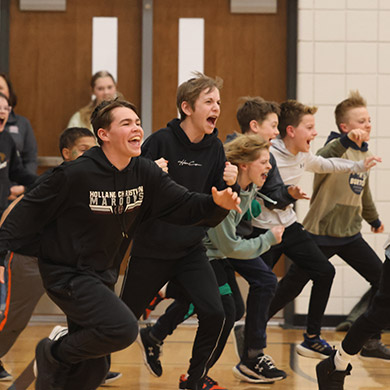
    Students cheering and running out on the gym floor together

    Teachers say that PBIS, along with the house system has helped them be more consistent with rules, as all expectations are phrased similarly, and students catch on more quickly since they hear the same rules from all teachers. “It changes the dynamics of how you speak to kids, how kids speak to each other,” Katelyn said. “I’ve really appreciated the shift for me in my language as I did it more and more.”

    A special addition to the program this year were student house leaders elected right before 7th-grade camp, four students selected by each house to lead them, take care of details behind the scenes, get a small taste of what it means to be a leader of a larger group. And teachers are learning how to incorporate them into the larger scheme of things, to help students build leadership skills.

    But meanwhile, “The houses fit into our vision of how we hope our school to be—our whole goal to learn how to love each other more,” Katelyn said. “We hope it will lead us to be more like Christ, and that helps us as a school as well.”
  • What in the World is MIFA?

    What in the World is MIFA?

    Spring 2022 Connections

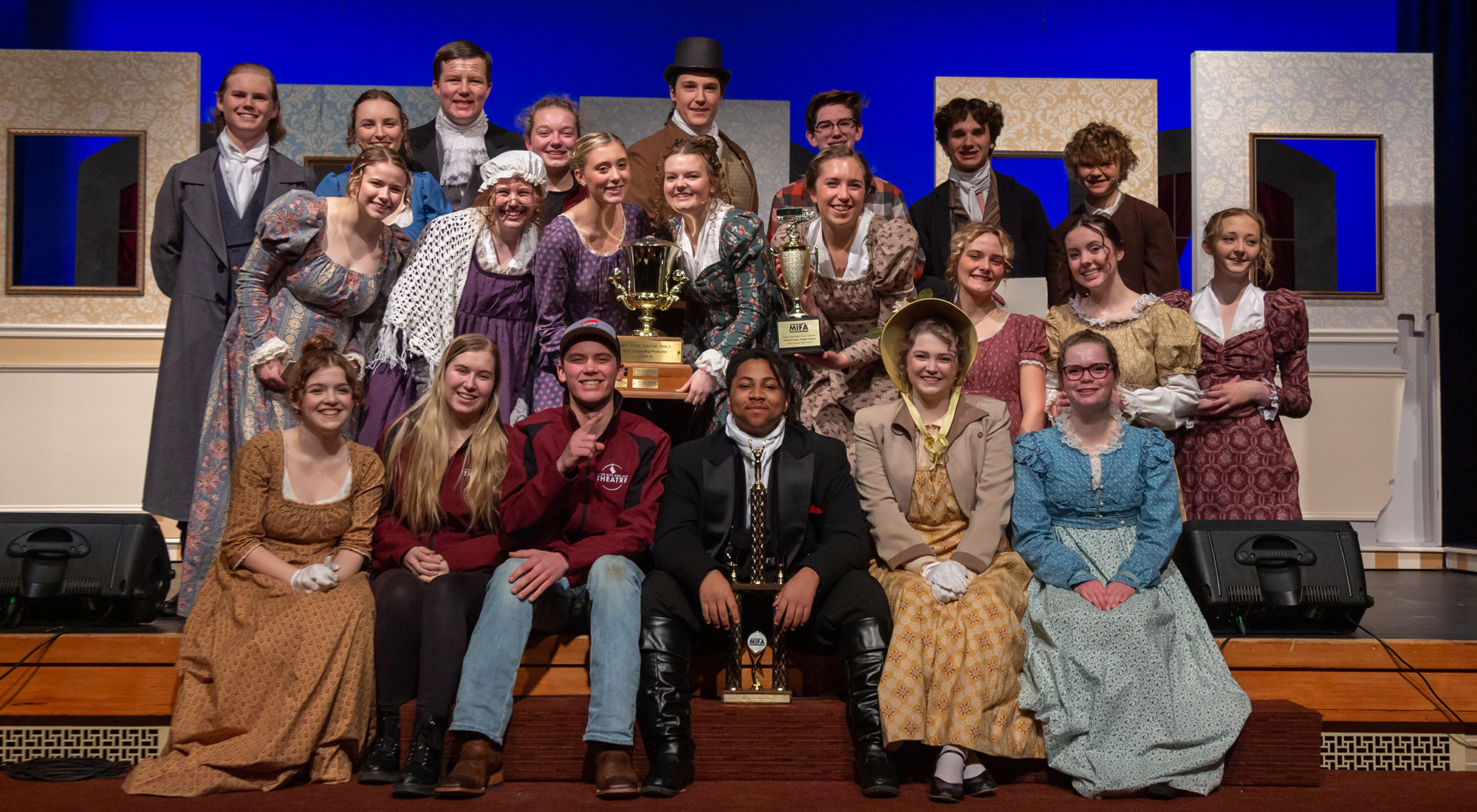
    Maybe you heard the good news already that HCHS’s MIFA team won State? Again? But then maybe, like most of us, you didn’t really understand what it meant—that our MIFA team won state for the 8th time since it started performing in the MIFA One-Act category in 1996. That makes eight state championships in 26 years?!

    So what is MIFA anyway? The acronym stands for the “Michigan Interscholastic Forensics Association,” and it’s the same organization that puts on competitions in debate every fall, and 12 individual forensic categories like speech and storytelling each spring. But the MIFA One Act competition that we have participated in, and won regularly each February, is well described by Owen Langellier ’23, a MIFA team member this year: “It’s like varsity theatre; you make a 45 minute show that competes against other 45 minute shows from schools around Michigan and you have divisions and get scores—like sports.”

    Elle Nieuwsma ’12, HCHS English teacher and one of the two staff directors of the program added a few details: She and her co-director, Justin Dreyer ’10, HC’s Technical Director of Theatre & Digital Media Designer, select a team of 20-25 students through applications, interviews, and auditions in late November. Once selected, the team meets every day after school from 3-6 pm, and usually on Saturdays for 4-5 hours from December-February, minus Christmas break.

    In that amount of time, they must work some minor miracles: Take what usually is a 2+ hour play, condense it to a 45-minute complete story line, include all technical aspects of a regular play such as full sets, costumes, make-up, as well as sound and lights, and be able to load and unload all of the equipment of the traveling show onto a truck so that the set and equipment not only does not get forgotten or broken, but also load and unload it as a team in a manner that is polite and professional—all while being judged on said politeness and professionalism—which, by the way, they did so well this year they also won the coveted Golden Truck Award.

    Naturally the question, why do this?

    ”It’s like varsity theatre; you make a 45 minute show that competes against other 45 minute shows from schools around Michigan and you have divisions and get scores—like sports.

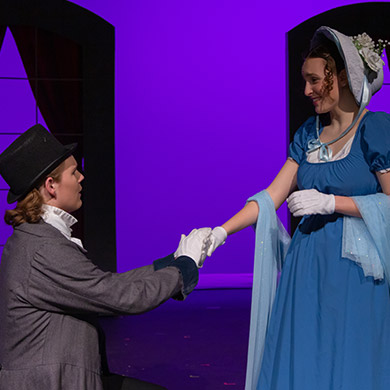
    Actor kneeling, holding actress's hand

    Pedagogically, it’s a no brainer: “Educationally, there are four different skills that modern education should teach: communication, creativity, critical thinking, and collaboration—and MIFA is all that!” Elle explained.

    Plus, you throw together kids with a “range of interests and personalities and skill sets.” Then add in the fact that adult theatre directors are not allowed to help with any of the actual MIFA performances, so neither Elle nor Justin is allowed backstage with a show, can’t help unload or load the truck, can’t help with lights or sound—and you’re teaching students a whole lot of independence, leadership, and self-reliance.

    “We’re hands-off and they make the show,” Elle said. “They learn a lot of leadership skills, and during competitions learn hard work and determination as well.”
    That being said, Elle typically spends the summer before pouring over directors’ catalogs to find a play she’s excited about, keeping in mind the student talents and potential team for the next winter; then she shortens the script to make a coherent and interesting 45 minute play. Since this year’s chosen play needed to be a comedy, she chose Jane Austen’s Emma.

    During the MIFA season, there’s not the usual play luxury of whole set teams, technical/sound/lighting teams, make-up or costume teams due to such a small group of 20 students. Instead, everyone learns how to do a little bit of everything.

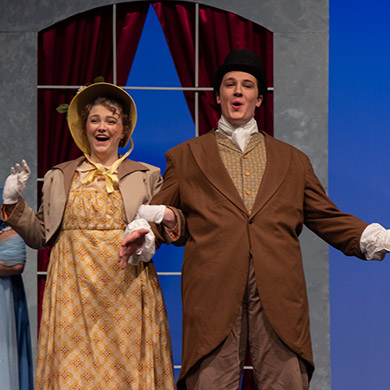
    Actor and actress facing the audience smiling together

    ”Educationally, there are four different skills that modern education should teach: communication, creativity, critical thinking, and collaboration—and MIFA is all that!

    “Actors do a lot of onstage work—but some days we’re just building the set, learning how to work power tools. Everybody has a job in the show, but there’s a lot more collaboration,” Elle said.

    “I never had used a saw or any tools before!” said stage manager Bebe Mulder ’22. “It’s great knowing how to cut wood correctly, use a staple gun, because of helping out in the scene shop.”

    “I’ve learned so many skills, not just as an actress, but through working in costumes, painting the set, building the set, stage managing, and student directing. I’ve learned what it means to jump in at any given moment to learn something new or help someone else. I’ve learned the importance of vulnerability and trust in a community aspect,” Grace McAboy ’22 added.

    Inject COVID into their season, with nine team members out with it at one point or another, six at one time, and you have even more impromptu problem solving and creative thinking, students scrambling, filling in for roles and jobs they had to figure out on-the-fly. But most agreed that the pressure cooker this year forced them to focus and work even harder together to pull it off, with huge improvements from one week to the next.

    “Over multiple weekends, you see incredible growth and progression of the students as a whole,” Justin explained. “It goes from ‘This is a really terrible piece of theatre we created’—to ‘We actually did do something here!’ and we’re able to see marked steps, growth.”

    “Personally, I love watching students grow, their progression in a particular show,” Elle added. “Parents are blown away by how much growth happens as a production, but because it’s a small group of 20-25 people on the team, watching those friendships form, and that community form. You see that on travel weekends especially. It’s special riding a bus with them and being in a hotel and having devotions together.”

    Another plus of MIFA is exposing HCHS students to “other kinds of theatre programs, other theatre styles, shows from outside our perspective,” Justin said. “Seeing what works and doesn’t work, hearing stories we haven’t told yet—kids get exposed to so much good theatre.”

    Plus, he added “For the last couple of years, we’re the only Christian school in MIFA. It’s an opportunity to represent faith in the arts.”

    “We talk about this every time before we travel—that a Christian label is always attached to what we do,” Elle added. “It’s not a Christian story necessarily, but a story that shares deeply Christian truths. To tell a story of hope and truth, put our faith on display and do it well.”
    And it’s being noticed: One judge at a regional performance back in 2020, when they performed the Spoon River Anthology even said “I don’t know how you can walk away from this production without a belief in the Divine,” Elle remembered. “There were enough moments in it, enough music that we included that somehow reflected God, and that was just so cool! [These students are] spreading the gospel in a really unique way and in a space where I think we really need to be.”

    Students learn to network, getting to know students from other schools, as well: “Although winning State is pretty cool, the best part about MIFA One-Act is meeting teams from all over the state, making new friends with them, and celebrating theater together. It’s so much fun to see all the shows each school puts on, and congratulating them in the hallways afterwards,” Grace added.

    ”I’ve learned what it means to jump in at any given moment to learn something new or help someone else.

    Elle agrees: “MIFA is a competition, but also a festival feel, because students are so supportive of each other,” she said. “I’m still Facebook friends with kids from other schools [from when I was a MIFA student]. Plus, for me as director, to have that network of directors is so helpful! It’s very much a supportive network, really collaborative.”

    But hands down, you ask any of the 23 kids on the team this year, and every single kid will tell you they were on the MIFA team for the amazing community that’s more than community—“it’s family,” they all say.

    “You can’t find a better community at HC. The people are so welcoming and warm,” Chris Kingdom- Grier ’23 said. “We grew into more than friends—we’re a family.”

    “You just get to know kids so well—you get some of that in the classroom, but this is a whole other level,” Elle said. “I just get to be part of their lives in a different way that’s so special. Watching them grow as people, and as theatre artists is the best!”

    “MIFA gave me great theater experience, but the things I learned about being on a team, leadership, and the confidence I built during my time on MIFA will be what I carry most into my future after high school,” emailed Grace. “I’ll never forget the family we built each year and the weird, funny, and heartwarming memories I have from them.”

    It all came to a head this year during the State performance: Because of the remaining COVID concerns in February, each school’s MIFA team performed in front of only the judges, loaded up their trucks, then headed back to their own assigned classroom to watch on a monitor the other schools’ performances. The HCHS team felt like they performed well, but needed to wait for the judges’ decisions.

    ”You can’t find a better community at HC. The people are so welcoming and warm. We grew into more than friends—we’re a family.

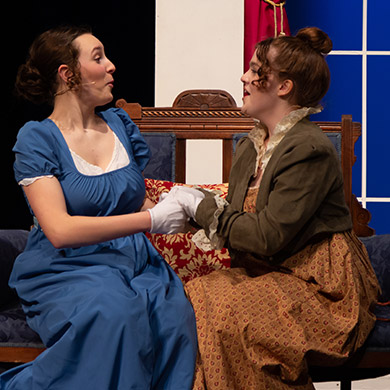
    Two actresses on stage looking like they are sharing secrets, smiling at each other

    “Before the results came in, we wanted to come before God and just thank Him,” Chris said. “Noah Tinholt [’23], I think it was, starts playing his guitar, and we just start joining in—worship is a vulnerable thing, you know—and for us to be able to go from a performance on Jane Austen to simply worshiping God—not even knowing if we’d won or not…?” he finished.

    And he wasn’t the only one who loved worshipping together:

    “It’s just really fun to worship with people who know how to sing really well,” Owen added. “A really special experience to be worshiping with people who both love God, want to worship as much as you do, and know how.”

    So that 8th MIFA State win? It is really great. But it’s really just icing on the cake.

    To read more about HCHS’ theatre program, including their spring show, visit the HC Theatre page.

  • Presenting HC Preschool

    Presenting HC Preschool

    Winter 2023 Connections

    Why Preschool?

    Is preschool really all that important if kids are simply read to and played with at home? Do kids even need it these days?

    The answer is an increasingly emphatic yes, preschool is actually growing even more important for three reasons: It builds social-emotional skills, decreases anxiety, and establishes an academic foundation necessary later in school.

    With COVID closing down schools, churches, and group social gatherings for almost two years, we are now seeing some of the impact that had on young children. And it’s not just in academics, although you hear about it more commonly in the news, with the current greater need for tutoring. However, because of COVID many young children weren’t able to participate regularly in social opportunities, and couldn’t practice important social interactions like sharing, making friends, and problem solving things that don’t go their way. As we deal with the aftermath of COVID, we’re realizing anew how critical these early stages of early childhood development actually are, and are seeing students handle these social situations in more immature ways.

    “Social emotional development is so critical with early childhood, that the earlier you can introduce them to social interactions and guide them through those, the better,” South Side principal Erin Wyma ’91 explained. “In our preschool settings, teachers are able to provide students a safe opportunity to learn and practice together all of the important social skills that are necessary for their development. Having the early intervention of preschool can help students build the social emotional maturity that they need in order to continue to flourish academically in their future school years.”

    A second bonus of preschool: With COVID reducing the opportunities for children to experience settings away from their parents, preschool provides a perfect opportunity to slowly get them used to being away from mom and dad for a short period of time. By doing this gradually, we see students’ anxiety decreasing—hugely helpful in later years when students attend school full time.

    “It is great to be able to start building an academic foundation while students are 3 and 4 years old, but the social-emotional piece with other children, of learning how to share, working through problems, being a friend, is probably even more important,” Erin added.

    You may know this already, that Holland Christian is blessed richly with exceptional and experienced preschool teachers. They are amazing, patient people who love the Lord, and love nothing more than sharing that love with very small children. But they also know how to do it in age appropriate ways, boosting both the social-emotional and academic skills, as well as spiritual joy. So just in case you have not yet met this modest, unpretentious, yet seriously talented group of preschool educators, we want to introduce them to you!

    ”I like playing with cars. Sometimes she plays the cleanup song, and she tells us to clean up.
    Sophia Boss ’37

    Tammy Grasmid ’87: 3s preschool teacher @ South Side

    Tammy Grassmid ’87 carries loads of educational experience into her classroom of three-year olds: 10 years of preschool, 20 years of 1st grade, six different schools. And she has this remarkable vision for educating preschoolers not just for the future, but teaches for the present, rejoicing in who these little people are now.

    “God has called me to teach at Holland Christian so that I can prepare the littlest students to go out into the world and share His love with those they meet,” Tammy said. “I use stories and verses from the Bible to show how God is in their lives and how He wants them to tell everyone about him.”

    “Tammy just knows the littlest learners, how to handle behavior, and what they can handle academically,” Erin Wyma affirmed. “And she nails it every time.”

    Tammy “has a unique empathy for kids who struggle,” Erin said, explaining that Tammy eagerly takes on students with disabilities in her inclusion classroom.

    All this learning happens in the context of guided play in her classroom, since “play is the most important activity that preschoolers can do!” Tammy asserted. “Play is where they use imaginations and interact with their peers. Play is where they strengthen gross and fine motor skills. If there is no play, then it isn’t truly a preschool setting!”

    Sarah Becksfort ’07: 4s preschool teacher @ South Side

    Sarah Becksfort ’07 taught kindergarten for years, “so she knows exactly what four-year-olds need,” Erin Wyma said. “She has some of the strongest classroom management that I’ve ever seen, plus very high academic standards, and kids rise to them. Kids flourish in her classroom structure.”

    But Sarah also sees her role as a partner to parents, naturally integrating faith formation into daily life: “I love experiencing the many ‘aha!’ moments that take place both in and out of our classroom,” Sarah said. “I am so thankful I get to walk alongside families in shaping some of our littlest kingdom builders.”

    One of Sarah’s favorite units to teach is the Building Unit: “There are a lot of engaging building and stem-based opportunities,” Sarah said, recognizing that this learning often takes place through purposeful play. “Preschoolers reinforce learning ideas, create and maintain relationships, and better understand their own social-emotional growth through play.”

    “Her classroom aligns great for students who need routine every day, and the warmth of a very loving, kind teacher bringing security for them,” Erin said.

    ”She gives me big hugs when I’m sad.
    Hazel Will ’36

    Preschool teacher Dawn Baker smiling at her student.

    ”On the 1st day I just met her and she was nice and when I just got in her class I hugged her.
    Ruby Veenhoven ’36

    Dawn Baker ’89: 4s preschool teacher @ South Side

    “There is never a dull moment, every day is different, they make me laugh, and I am blessed to share God’s love with them!” Dawn Baker ’89 said about teaching preschool.

    And she’s really good at it. She’s taught preschool for 11 years, and 4th and 5th graders for 12 years before that, so she is wise and experienced and calm. And continually trying new things—like going outside more with her class, pushing for inclusion, embracing new curriculum. (Yes, preschool curriculum is a thing, and yes, we have a new one, and are loving it!)

    “Kids are writing words when they leave her room,” Erin said, explaining that in the spring, Dawn’s classes are already doing research projects. “She excels with literacy and the sciences, and the [students’] depth of knowledge is off the charts!” Adding, “Dawn also has a heart and passion for students who require academic and behavioral modifications to flourish into God’s design for them.”

    Dawn especially enjoys teaching preschoolers about creation “because we learn that WE are the most important thing God made! It sets up how we treat each other in the classroom.”

    “I love teaching at Holland Christian because I get to be a part of nurturing young children’s faith,” Dawn said. “I love that kids are so excited about their faith!”

    Stacia Stoep ’04: Young Fives teacher @ South Side

    As a former 2nd and 3rd grade teacher at Rose Park, Stacia “loves to make sure that her students are achieving their learning to their own highest level possible,” Erin Wyma said, adding, “She is also very loving and kind.”

    One of the reasons that Stacia continues to teach at HC is “the high standards for their teachers, and the curriculum we are to implement” she said, along with “I can teach the total covenant child, and I appreciate the partnership between family and school.”
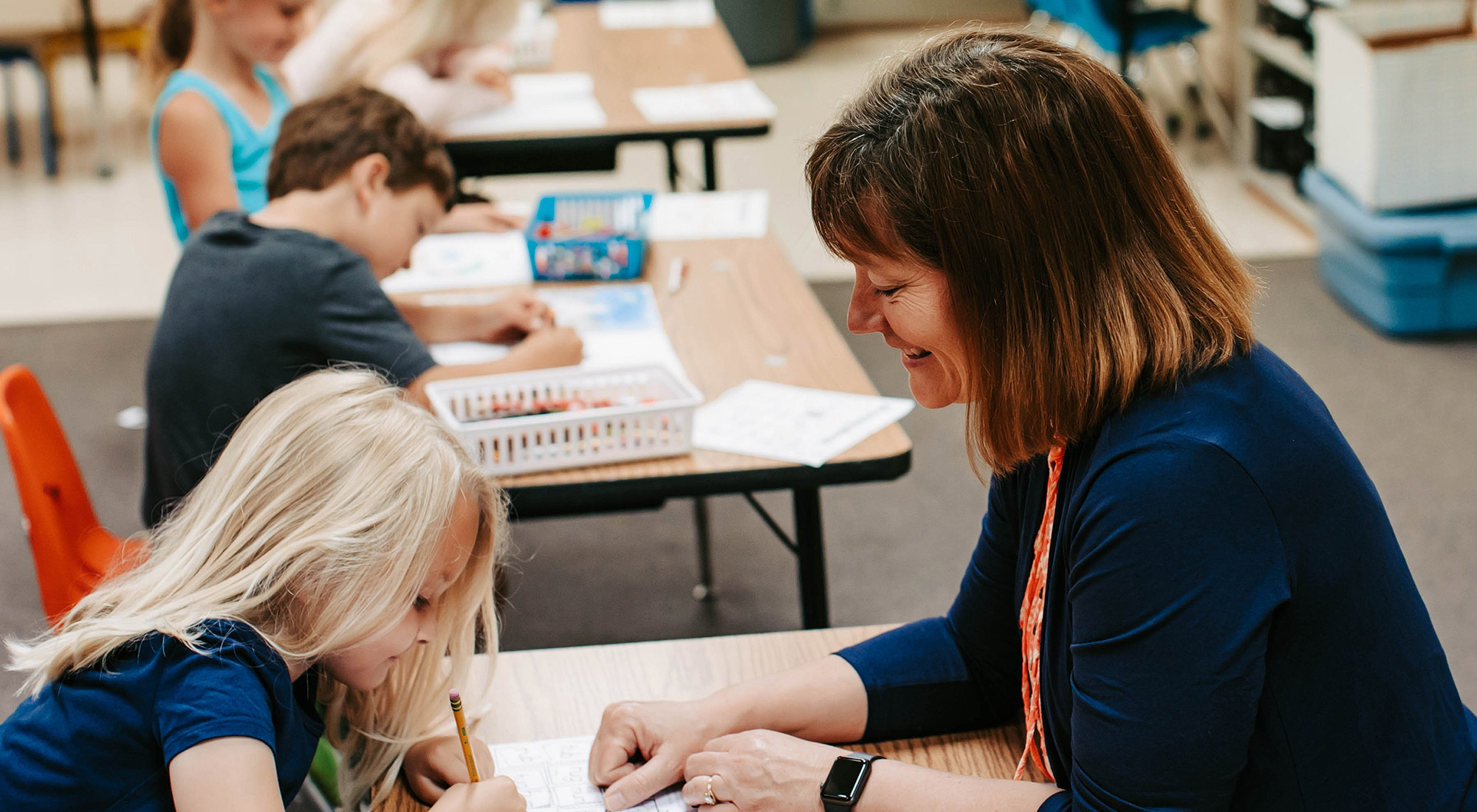
    Big important religious ideas that Stacia takes to a 4 or 5-year-old level. Through lessons like their “Plants” unit, when her students learn that not only is God the Creator of all things, but they come to appreciate the diversity of God’s creation anew through a variety of multi-sensory experiences all wrapped around plants: “We get our hands dirty by planting a garden. We taste different parts of the plant. We observe growth and life cycles of plants. We go off campus and into the woods to enjoy plant life…”

    “I love showing them the joy of learning and the adventure of trying new things,” Stacia said.

    ”She helps us learn reading books. And I like to play with my friends.
    Clayton Stephenson ’36

    Preschool teacher Allison DeLange smiling at the camera.

    ”I like the cars. There’s lots of cares at Mrs. DeLange’s class.
    Crew Clifton ’37

    Allison DeLange ’11: 3s preschool teacher @ Rose Park

    If you know how much three-year-old preschool students like to move, you can see how Allison DeLange’s first degree in kinesiology and recreation therapy comes in handy for teaching preschoolers. Then try lining up a class of three-year-olds to walk quietly down two hallways to the library, while not disturbing the other learning going on in the rest of the school. And you’ll have a whole new respect for Allison and the patient, creative work she does with her super cute, energetic bunch!

    “I love watching the kids discovering God’s world around them. There are so many lightbulb moments that I get to be a part of, and it’s beautiful to watch,” Allison said.

    It’s not always easy to find really good three-year-old preschool teachers— they’re a rare creation, and Allison fills those shoes so well. “Allison is very warm and affectionate, just perfect for our 3s,” Erin said. “She creates lots of fun activities for them.”
    But it’s not all fun activities, or playing—as important as that is—and walking to the library: “The most important thing that I want to teach kids over the course of the year is that there is a God who loves them and gave His son because He loves them so much,” Allison said. “If my students walk away knowing they are loved, I have done my job.”
    Laura Rotman ’00: 3-day 4s preschool @ Rose Park

    How many of our work assistants would be almost in tears talking about how much they enjoy working with us, or how important we are in the lives of their children? But Kylee Duistermars, the preschool aide in Laura Rotman’s class, and a parent of three former students of Laura overflows with compliments for Laura’s teaching: “She truly meets each student where they are,” she said. “She treats each one truly like they are the only one. She’s everything a preschool teacher should be and more.”

    Laura has taught preschool for 10 years, but she also is the Rose Park secretary two days each week, so she knows all the ins and outs of the business of education, particularly preschool paperwork. But then she’s also really good at taking a small and simple preschool lesson, say on the letter “P,” and turning it into so much more. Into a whole day of delight that includes preschool pancakes and pajamas, so that the lesson is much more fun—and memorable.

    “We have a lot of fun! I enjoy laughing, being silly and building a classroom where we have a lot of fun learning and exploring,” Laura said. “The preschoolers will always feel it is a safe and loving place to be.”

    But then Laura also realizes fully the foundation she is laying for future Christian life: “I also love seeing Christian values and relationships which begin in preschool, continue on through a child’s life,” Laura added.

    Preschool teacher Laura Rotman smiling at the camera.

    ”I like playing in her class and doing learning stations and making crafts and going outside.
    Andrew Baumann ’36

    Preschool teacher Leanne Bouwman helping students play.

    ”I like how she starts our day out by reading devotions.
    Emily Buck ’36

    Leanne Bouwman: 4s preschool teacher @ Rose Park

    “I teach preschool because I love being around the littlest learners and to be able to see God’s world through the eyes of a child,” Leanne said. “I love how they come to school with a big smile on their face, ready to learn, and an open heart ready to love God and others.”

    It is obvious from a few minutes in Leanne’s classroom that she loves kids and she loves her work with them. But what differentiates Leanne is “The energy she brings—she knows how to be a kid and get on their level, and get them excited about learning,” said Kathy Kuipers, Leanne’s preschool aide.

    Leanne has enjoyed teaching preschool at Rose Park for 10 years now, long enough to “feel very blessed to be able to build long lasting relationships with my students as well as parents,” Leanne said. “It’s a privilege to be able to share my faith with my students, parents, and co-workers.”

    Which is probably why her favorite unit to teach is right at the beginning of the school year when they’re learning that “God made me.” “I love being able to have my students observe that we all look different from each other, but we are all created by God and in His image.”

    Daniella Castro-Fernandez: Spanish Immersion 3s preschool teacher @ Rose Park

    Daniella is originally from Mexico, but moved to Michigan with her family in 2005 thanks to a job opportunity for her husband. In Mexico she attended college for psychology and worked for Amway as a marketing assistant. She and her husband have four children elementary age through high school. They attend Holland First Assembly of God where they actively serve the Lord, a pillar in their lives.

    Daniella has been working at HC since 2016, and finds it a very rewarding experience. She originally started working in the English preschool classrooms, but when she heard about the Spanish immersion initiative, she was very excited to be a part of it!

    “I love what I get to do in the classroom, and knowing that for some kids, I am a part of their first school experience,” Daniella said. “I am very committed to creating a loving environment, and to teaching in my native language–something that I am very passionate about!”

    ”I love what I get to do in the classroom, and knowing that I am a part of their first school experience.

    ”She always has a smile and welcome hug for our littlest learners.
    Dinah Pereira

    Perla DeLeon: Spanish Immersion 4s preschool teacher @ Rose Park

    Born in Mexico, Perla came to America as a young adult not knowing the English language, so she has understanding for students in her Spanish Immersion class who are new to Spanish: “God gave me the strength and ability to assimilate,” Perla said. “This experience is helpful when teaching my students a language and culture that may not be their native one. I love having the opportunity to help set a strong academic and spiritual foundation.”

    After many years of teaching preschool at both ZCS and Head Start, then teaching FLES Spanish at Rose Park, Perla was the perfect teacher to help start the HC Spanish Immersion program five years ago.

    “Perla is an energetic bilingual teacher who likes to have fun no matter if she is teaching letters, sounds, numbers, or shapes,” said Dinah Pereira. “She advocates for students’ needs and is always looking for best ways to get kids up and moving around to learn through experiences.”

    A peek into Perla’s classroom shows a room filled with colorful student artwork and creative play stations labeled in Spanish. Plus this hugely important quality of a preschool teacher: “She always has a smile and welcome hug for our littlest learners,” Dinah added.

  • Life Ready: HCHS Applied Tech

    Life Ready: HCHS Applied Tech

    Fall 2022 Connections

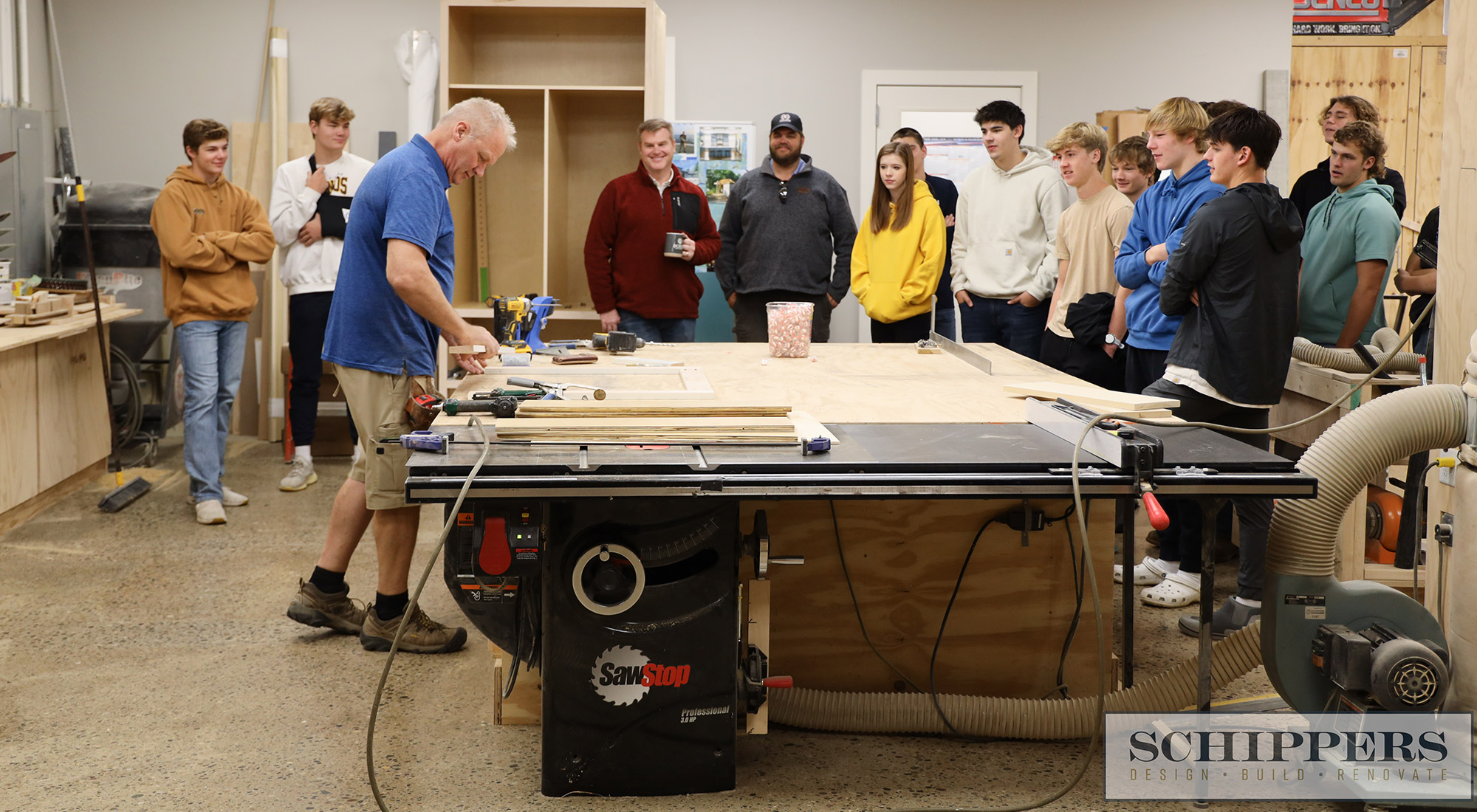
     Top photo courtesy of Schippers Construction

    All kinds of really cool things pour out of Mike Jacobs’ classroom.

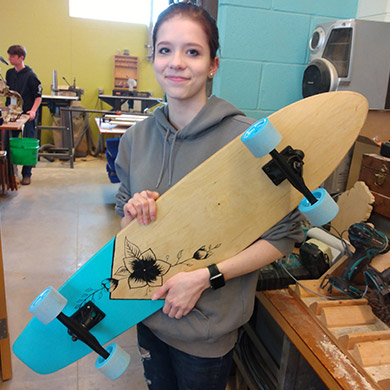
    They line the HCHS southwestern halls at the end of each semester—stacks of wooden birdhouses and step stools, shiny galvanized tool boxes. Pinball machines, foosball tables, crazy lights, end tables, longboards, and bow tie racks. Adirondack chairs in every color, charcuterie boards, clocks.

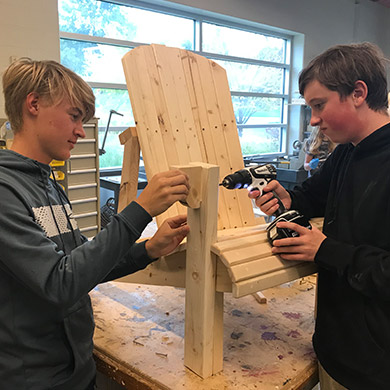
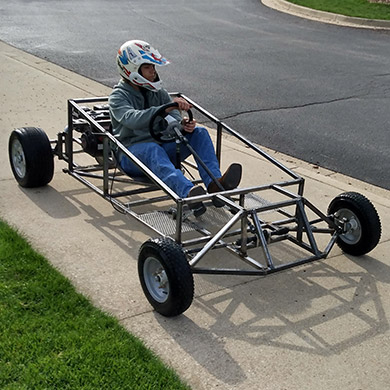
    Then there are the really cool kids who pour out of there, too. Girls who know how to use a table saw, boys who had never painted anything before, but now do. Teams of students who together built rocking horses for each HCS teacher who became a parent last year, or built Adirondack chairs for Resthaven, or welded go-karts to zip around the parking lot.

    Students who learned how to plan, design, and engineer projects from start to finish, guided along the way by actual Gentex engineers willing to put their time and talents into our students.
    And Mike Jacobs ’96, HCHS’s applied technology teacher is a huge part of that.

    “I want kids to experience what their vocation looks like, I want them to find His will for their lives because I know He has a plan for their lives,” he said. “God gave us talents—I want these kids to explore to figure out ‘Is this what God wants me to do?’”

    ”God gave us talents—I want these kids to explore to figure out ‘Is this what God wants me to do?

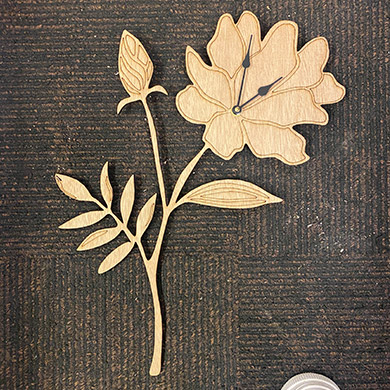
    HC’s Applied Tech classes are not just the stereotypical shop class anymore— mostly male classes learning how to use woodworking tools by making birdhouses—though that is a large part of Mike’s job. More female students are taking Applied Tech, and taking them at all levels, from basic woodworking to the engineering classes as well. The projects are getting more creative, more highly engineered, more community-oriented, thanks in part to the donated 3-D printers and laser cutter. Plus Mike and his classes give away a lot of their finished projects to the larger community—something that really matters to Mike.

    “A lot of the things we make go into the community as much as we can—the more we can make for the community, build for the community, the better—because that’s just loving your neighbor,” he said.

    2 boys drilling an Adirondack chair

    ”The more we can build for the community, the better—because that’s just loving your neighbor…

    Mike sees his role at HC is to get students ready for a hands-on Christian life—whether they’re planning for college or not, and whether they’re learning skills to improve their own homes and communities, or learning skills they will use directly in a job or career.

    This year Mike is expanding the Woods class into a second semester Woods 2 class that focuses on large scale building and construction framing—not just carpentry—and plans to build the announcers’ booth for the new track behind the middle school based on a student design. “We’ll do real stuff for the community we live in,” he said. “If we’re going to be making real things, we might as well bless others with them.” If he gets his way and enough students sign up, he also hopes to add a second semester of Metals, so that students can try a wider variety of welding techniques, too.

    “The further I can take them, they can be that much more prepared for the Tech Center,” he said. “They can find out, is this a talent God gave them? And from there take it to the Tech Center, or sometimes not. Sometimes kids want the skills, but don’t want the Tech Center.”

    And kids in Metals class are learning a whole lot more than “just” fabrication and welding, as they are split into groups to design and fabricate a go-kart. “What I like about that, it teaches collaboration,” Jacobs said. “Whoever is building the rear end has to talk to the people building the front end. It’s design thinking, collaboration, but also problem solving because nothing ever works the first time!”

    There already is an Engineering Design class that’s kinda like Snap Circuits on steroids. Students learn basic programming so they can run the 3-D printer, motors, lasers, and lights they want to add to their end-of-semester projects before presenting to a panel of local engineers. Last spring, students designed things like a Star Wars AT-AT walker, and a head to head pinball machine with lights and lasers. Interactive corn hole boards with lights and lasers so you can play in the dark and know when the bean bag dropped through the hole. Another student made a random cat exercise toy with lasers for the cat to chase.

    “The idea is to give kids some of the tools that engineers use, and they have to come up with a project, and then use the engineering design process,” Jacobs explained, “It’s more about the design process—not super math focused. They have to be able to build stuff, but it’s not like we’re going to do all kinds of calculus problems.”

    Not only are HC’s Applied Tech classes intentionally giving more stuff away to the community, they’re also being invested into by our community, so students are making local connections too. Gentex engineers walk students through their semester projects the same way that Gentex engineers walk through their own projects, from presenting ideas to get professional feedback, brainstorming and evaluating together, then creating a prototype, testing and evaluating their functional design, and finally presenting it at the end of the semester to a team of Gentex engineers who give professional engineer feedback.

    Forged by Design gives the HC wood shop their “scraps” to use, K-Line Industries donates steel, while Transmatic, Metal Flow, Gentex, Schippers Construction and Smart Vision Lights have all been hugely supportive with both donated supplies and time. And the classes have their own volunteer, Vern Prins, whose building company Mike worked for back in high school, remodeling houses. “He has more than 50 years of woodworking experience and he has been an amazing help to the class—just so much experience!” Mike said.

    “I’ve had kids in that class who weren’t thinking engineering, but loved it so much that they said “That’s what I want to do! This class changed my life!” he said.

    Anna Larsen ’22 was one of those students: Anna combined her love of art and design from AP Art this year with the technology in the Technical Drawing class to create kinetic art—the kinds of things you’d see on a bigger scale at Art Prize.

    “It’s really cool to be able to use the laser cutter, and not many schools have one especially that big,” Anna said, before leaving for University of Michigan this fall to study engineering. “I thought that I knew how to do certain things, but I didn’t know I can do them together,” she said, adding that “Mr. Jacobs gives us real life experiences, how it would be in a real engineering job.”

    Brody Nelson ’23 is another of those students. He took Metals class because it sounded interesting, but then learned that he really enjoyed electrical work. So he signed up for the electrician’s program at the OAISD Tech Center this school year, got a summer job at Hoekstra Electric, and is loving it.

    Sam Perton ’22 is another. After making a robotic AT-AT walker this past spring in the Engineering Design class, he’s off at GVSU this year for mechanical engineering, thanks in part to Jacobs’ classes and his teaching style.

    “He’s really good at providing you with what you need, and really helpful as well—he’ll know the answers to your questions, and give you more knowledge as well,” Sam said. “He’s very dedicated to students, even outside of class. He even brings in his own stuff.”

    ”It’s design thinking, collaboration, but also problem solving because nothing ever works the first time!

    ”Mr. Jacobs gives us real life experiences, how it would be in a real engineering job…

    Joseph Stielstra ’24 took Metals as a freshman because he had heard rumors about building a go kart and wanted to learn how to weld. “It’s handy for around the house—a good life skill to have,” he said, adding that at this point he really has no idea what he’d like to pursue as a career.

    “It’s easy to do stuff on paper, but hard to do it in real life—kids are learning that all the time,” Jacobs said, adding that he’s just helping all his students become prepared for whatever their choices are. For wherever God takes them—college, a trade, or just capable home-owning adults. “I want these kids to be able to find God’s will for their lives, to expose them so they can figure out is this what God wants them to do? God gives us talents, and God has a plan.”

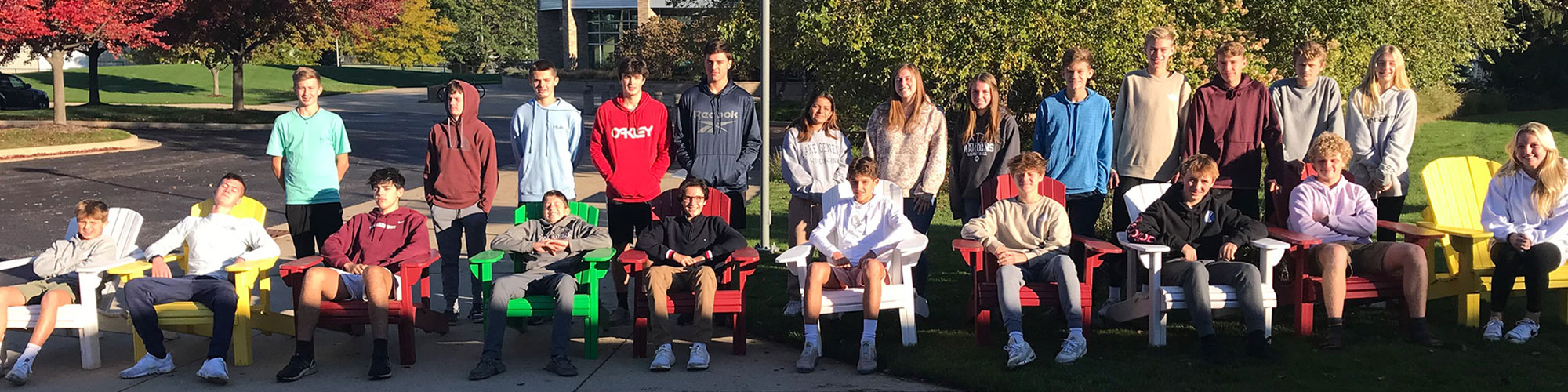
    HCHS Woods students smiling from their Adirondack chairs they made
  • Where in the World is 3rd Grade?

    Where in the World is 3rd Grade?

    Fall 2022 Connections

    Here’s some advice before you read this article: If you know a 3rd grader, now 4th grader at Pine Ridge or Forest School, please stop reading this and instead go ask them about their spring geography learning experiences—about what happened when they were asked every Wednesday by their three (amazing) teachers “Can you guess where we’re going today?” You can even ask your 3rd, now 4th grader, about specific local geographic features, like what are riparian buffers. If you live a long way away from them, they can send you links to their online storyboards they made about their spring semester of learning local geography.

    But if you live close by, they can take you to a lot of really interesting places right here in the Holland area and point out all the physical features using correct geography terminology. And you won’t get lost, either, because they know how to use a compass and a map, and can even draw you a map of where you are.

    The only thing they can’t do is drive you there. Yet.

    But if you don’t personally know a 3rd, now 4th grader from Pine Ridge or Forest School, you might want to read on about all the cool local parks they visited this spring, and how much they learned, and how excited they were about all they learned. And then you can scan the code at the end of this article and check out their websites they made, and then go visit a few new places right here under our noses that I bet a lot of us have never visited before. Places with riparian buffers.

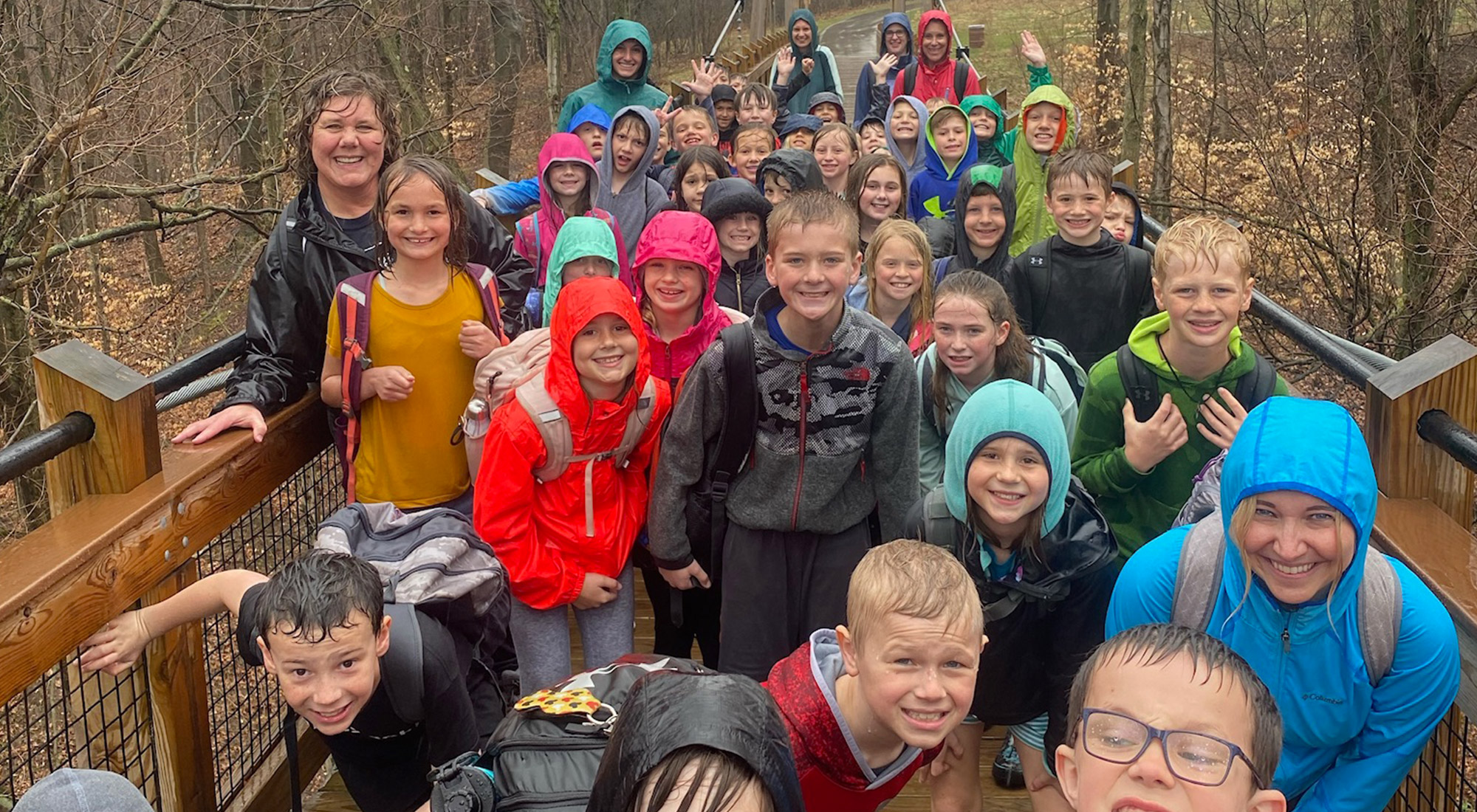
    ”Sometimes they just endured, and learned how well 57 3rd graders can do while hiking three miles in an April downpour, soaked completely to their skin…

    It all started last August when the third grade Forest School students moved into their classroom in the Pine Ridge school building so they could take advantage of the educational extras like art, music, PE, and ESS. And the experienced Pine Ridge teachers, Chris DeZwaan ’88 and Natalie Boer ’11, started collaborating with the brand new Forest School teacher, Erica Slenk ’16, team-teacher style, so that not only she, but all the Forest School 3rd graders would feel included in the whole Pine Ridge community. (Because that’s one of Holland Christian’s “discipleship flags,” you know? Read about “Community-Growing” at hollandchristian. org/academics/faith-development/.) And together Chris and Natalie decided they wanted to improve the state-mandated 3rd grade social studies unit on geography that they weren’t crazy about, and do it a little more Forest School style.

    Which means they took it outdoors. But with intentionality. And hours and hours of planning. And a whole lot of experimenting where things didn’t always go as planned. Sometimes things went better, and sometimes they learned how to do something a little (or a lot!) different the next time. And sometimes they just endured, and learned how well 57 3rd graders can do while hiking three miles in an April downpour, soaked completely to their skin, and still learn and stay (mostly) positive. And still rejoice in how good is our God. Because that’s another Holland Christian discipleship flag they learned—“God- Glorifying,” which became one of their teachers’catch phrases as they all discovered multiple delights.

    What they were doing is often dubbed “Project Based Learning,” or PBL in educational terms, and they were grateful for the wisdom, encouragement, and expertise of the Outdoor Discovery Center’s (ODC’s) Ted Malefyt who helped them dream, plan, and problem solve, especially the techy stuff like how to teach 3rd graders to make a map through ARCGIS, and then their online story maps/website. But mostly he gave them the freedom to “live in the mess a little bit, week by week” as they explored “what can be ‘sticky’ for kids,” Natalie explained.

    The teachers started out with around 18 state-mandated terms for geography features, then had students research a list of local parks in groups of three, with each group member from a different 3rd grade class, so they were all getting to know different kids than their regular classes. And found new friends.

    “It was so cool—it was like they had three teachers, and we each had 50 kids,” Erica said. “They had whole new friend groups on the playground. These are kids going through middle school and high school together, and some of these friendships will last into high school.”

    Out of the list of 20 Ottawa County parks and places given to them, each student group researched online, then picked their favorite and pitched it to the class and teachers why they should visit that park in particular. Then the classes together decided on 6 or 7 to visit, and their teachers scheduled buses—one per week for the next 7-8 weeks.

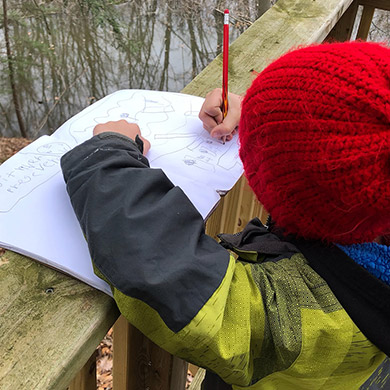
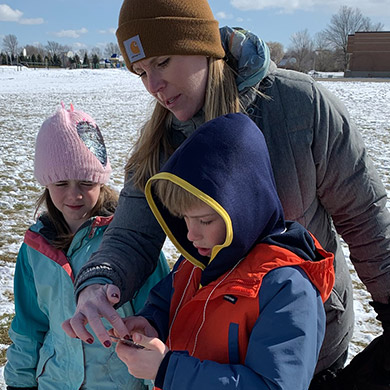
    Then students learned a few things you wouldn’t necessarily think to tie into 3rd grade geography: How to write good captions. How to take good photographs. How to make a website. How to use a needled compass, read a map. How to draw a map to an estimated scale. How to notice geographical features around you and why they’re important to our ecology. How to conduct an interview, greet someone new, how to ask questions, how to take notes during an interview. Then they learned how to present their findings to real audiences, to convince them (us!) to visit a particular park, and how invaluable it was to our community, and why they should not only visit it, but love it.

    ”Because you can only protect what you know and love; our job was to help others know and love what was around them to help protect it.

    “Because you can only protect what you know and love,” Chris explained. “Our job was to help others know and love what was around them to help protect it.”

    Because that’s another HC discipleship flag they were practicing—“Creation-Keeping.”

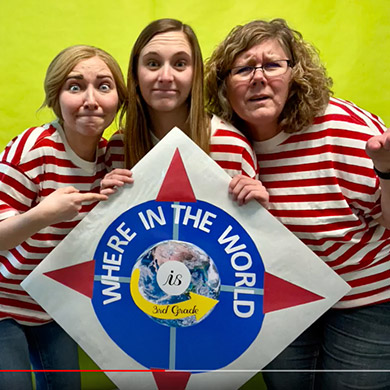
    Before each weekly visit to a new park the teachers surprised their classes with a creative intro video, with themselves dressed as Where’s Waldo, giving clues so the students could guess where they were adventuring that day. Then they all grabbed their iPads and gear, and headed out to the park for the day.

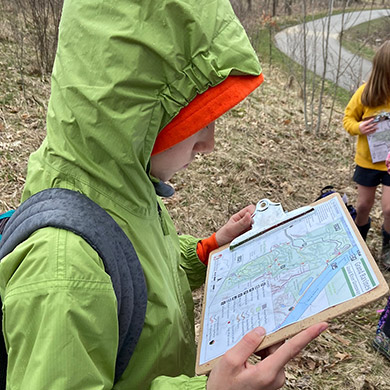
    Each visit followed a similar pattern: Get off the bus, and break up into preassigned groups with a teacher; look at a trail map for that location, find the trailheads, and choose an end location as a group; hike to the end location, taking photos with their iPads of the various unique geographical physical features along the way; also enroute, sketch a map of the trail from a birds eye view, add a key, estimate the distance; hike back; once back in the classroom, pin their locations and finish their maps, adding photos and captions in the app Survey 123.

    Simple, right? But packed with so much learning: estimation, location, art, math, spatial awareness, communication and collaboration, geography, how to stay warm in the rain, how to blow your nose outside without any Kleenexes…

    “They also knew that work came first, and then they could explore,” Chris added. “We learned a lot about doing hard things, together, and listening to each other, having fun despite the circumstances, and we talked a lot about how cool is our God!”

    And it made for a much more interesting and memorable way to learn about local geography. Better, but not necessarily easier. Or cheaper. But that’s where Ted recommended grants through GroundSwell and MiSTEM at Grand Valley, to help pay for the extra supplies.

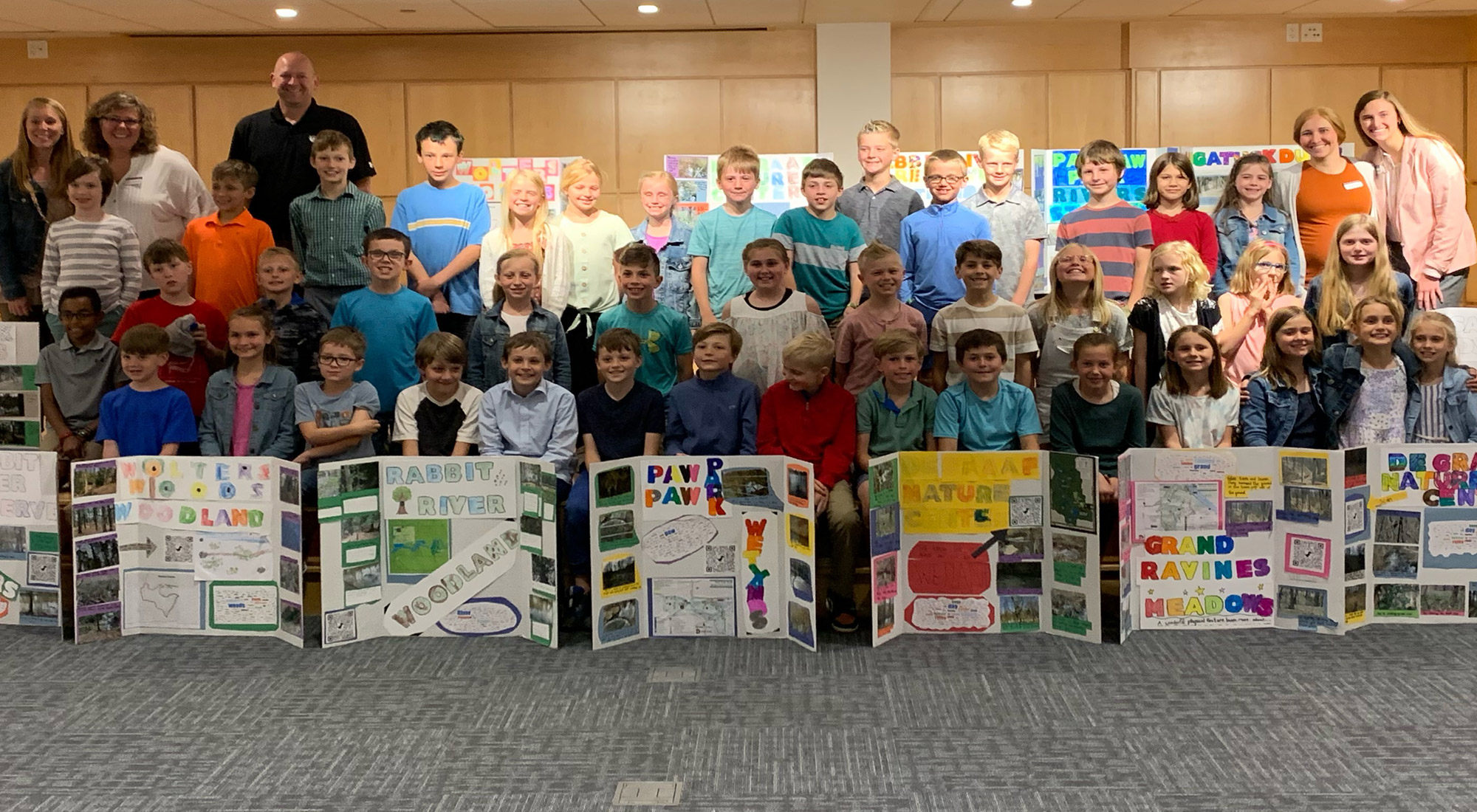
    The 3rd graders presented their findings at the Herrick Public Library to parents and grandparents and general passers-by. A select few even presented their findings at the GroundSwell’s Project Showcase at Celebration Cinema, and watched their video on the big screen there, along with some yummy popcorn, all courtesy of GroundSwell that was following their educational growth, connecting them and their teachers with other STEM teachers around the area.

    And here’s where you come into their story: Our 3rd, now 4th graders, would love nothing more than to present their findings to you, as well. Because we all learn better if we have a real audience to share with. So if you scan the code at left by holding your phone’s camera in front of the code, you can access their whole website of local parks and the geography features you’ll find at storymaps.arcgis.com/stories/145964dd55c648e38072dce962d2439d—and then put on your hiking shoes! And please stay tuned for what cool learning projects this year’s 3rd graders come up with!

    3rd graders holding posters looking at camera
  • Streams of Living Water

    Streams of Living Water

    Fall 2022 Connections

    by Bryant Russ, HCS Director of Faith Formation

    All Israel had gathered in Jerusalem for Sukkot, a festival commemorating the 40 years their ancestors spent in the dry, thirsty wilderness after their exodus from Egypt. There, on the last and most important day of the festival, as the frenzied crowd called on God to bless the world with water, “Jesus stood and shouted, ‘Let anyone who is thirsty, come to me and drink! Whoever trusts in me, as Scripture has said, streams of living water will flow from within them!’” (John 7:38).

    “…As Scripture has said…” Which specific scripture is Jesus talking about? Running water, or living water as it was called in the world of the Bible, is a motif that runs throughout the entire biblical text and is often a picture of God’s dynamic Spirit at work in the world.

    One of the most beautiful examples of this living water–and one that has powerful implications for the way we do Christian education–comes from a vision Ezekiel experiences in Ezekiel 47:1-12. The prophet is shown a small drip…drip…drip of water coming out from under the temple in Jerusalem. Further down the mountain the small drip becomes a trickle, which becomes a steam, which becomes a river, until finally the rush of water is so strong and wide that it couldn’t be crossed. Over the roar of the rapids, God asks Ezekiel, “Son of man, do you see this?” Ezekiel looks and sees that lush trees are busting up on both sides of the river. Amazed, the prophet exclaims: “Wherever the river flows everything comes to life!”

    At this point in the vision I start wondering where this River of Life is headed. Will it fill a valley somewhere calm and quiet, creating a peaceful lake for people to enjoy? Will it circle back to the temple to avoid becoming contaminated by anything less than the freshest water?

    ”Let anyone who is thirsty, come to me and drink! Whoever trusts in me, as Scripture has said, streams of living water will flow from within them!

    The river cascades directly to the unlikeliest of places: the Dead Sea. And when the flow crashes into this body of water notorious for lifelessness (due to its extremely high salt content), the Dead Sea actually bursts into life!!! Fish, frogs, fruit trees, you name it. This place that was once barren is now Exhibit A of God’s transforming power, further evidence that God brings dead things to life.

    I believe this vision is essential to our understanding of education from a “Reformed perspective.” Our calling has never been to hide or hunker down, but to actually join God in His work of transformation! Shalom to chaos, light to darkness, life to the dead places of the world…or in the case of Ezekiel’s vision, freshwater to saltwater. This is our calling and mission. This is what Christian education is all about!

    ”The trickle that becomes a stream that becomes a life-giving river does not find its source in you or me.

    And yet, if I’m honest with you, I’m actually intimidated by this vision in the same way I’m intimidated by the part of our mission statement that talks about transforming the world for Jesus Christ. The truth is…(I hope I can say this)…we don’t have it in us. We can’t muster the strength or energy to live into this calling on our own. We too are broken, weary, salty.

    But that’s the very best part. The trickle that becomes a stream that becomes a life-giving river does not find its source in you or me. If we walk with Ezekiel back to the beginning of his vision, we find the source is the very wellspring presence of God. Specifically, the altar on which the lamb is sacrificed. I love this vision of Streams of Living Water because it both raises the bar, and at the same time, relieves the pressure. Our job is not to transform the world merely for Jesus Christ, but also through him, animated and sustained by his love every step of the way.

    “Let anyone who is thirsty, come to me and drink! Whoever trusts in me, as Scripture has said, streams of living water will flow from within them!”

    My prayer for the coming year is that we live boldly into our mission of transformation, but also that we cling desperately to Jesus so that his sacrificial love flows into us, and overflows out of us.

  • HC’s Artesian Well: The Education Foundation

    HC’s Artesian Well: The Education Foundation

    Winter 2022 Connections

    by Leanne Halma ’99, HCS Director of Advancement

    When our family, the Halmas, moved back to Holland four years ago, the priority of our house hunt was finding a location close to Holland Christian Schools. We settled into a home just west of Pine Ridge, in Laketown Township. We had become accustomed to city water in our previous Cincinnati home and were in our new house for about a week when we decided that it was time to call someone to take a look at our well in the backyard, since it was constantly spilling over with water. I was certain this was an issue and that the well needed to be capped.

    When the well technician came out to our house, he explained that we have an artesian well, an unusual kind of well from which the water flows up from the ground naturally without pumping. The constant spilling over that we were so concerned about was actually good, and meant the well was in proper running order with an abundance of water below.

    The Holland Christian Education Foundation reminds me of this well. Under the surface sits an abundance of gifts that, when invested well, spill over to positively impact the lives of all full-time HC students and families through tuition-reducing grants. And, like our artesian well, it takes very little effort on our part—a little direction and oversight with a whole lot of blessing.

    In the late 1980s, HCS parents and the Board of Trustees were recognizing that Christian school tuition was taking a growing percentage of annual household incomes than previous decades.

    ”Under the surface sits an abundance of gifts that, when invested well, spill over to positively impact the lives of all full-time HC students…

    So they started the Foundation in 1989 as a means for friends of Holland Christian to support the school during and beyond their lifetime, and to help Holland Christian keep tuition as affordable as possible for more families. This well, The Foundation, accepts donations of all kinds, but is most commonly filled through estate gifts, also called bequests, given with the intention to keep tuition affordable today, but also making it sustainable for years to come.

    In a continued effort to keep HCS tuition affordable, a faithful HC supporter has generously offered a matching gift opportunity of $1,000,000 to help grow the Holland Christian Education Foundation, to provide support for both today and the future. For any household committing to a donation from their future estate plan for either 5% or $50,000, a $20,000 matching gift will be given to the Foundation today through this matching gift offer. What an amazing opportunity for wide-spread community participation to help grow the Foundation and support the worthy cause of Christian education for future generations! Because the larger the total Foundation amount, the more each HCS student can be given in a tuition grant!

    ”RVL gives a lesson on “living waters” and how special they were in Hebrew culture— water like the oasis En Gedi that is moving, refreshing and incredibly encouraging…

    Would you consider joining Holland Christian in completing this match? Maybe you’ve already included Holland Christian in your estate, but haven’t let us know yet. Now would be a great time to tell of this commitment and join our Heritage Society, while also earning our Foundation a $20,000 matching gift! Or maybe you’ve been considering a revision to your estate that would include Holland Christian Schools. We’d love to hear from you as we work to complete this match as well!

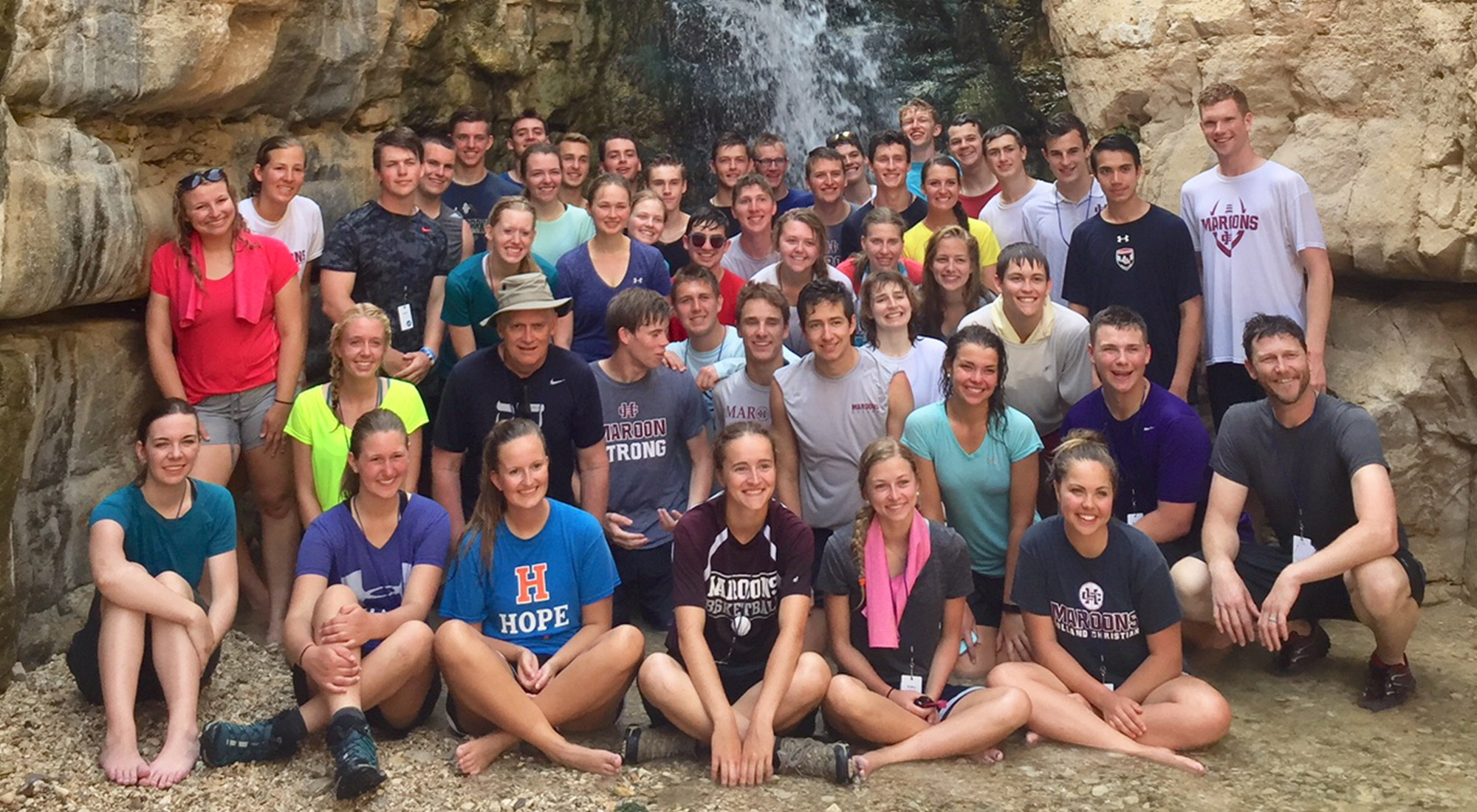
    When HCS Bible teacher Ray VanderLaan tours student groups through Israel, he always gives a lesson on “living waters” and how special they were in Hebrew culture— water like the oasis En Gedi that is moving, refreshing and incredibly encouraging in the middle of difficult desert terrain. En Gedi is water that flows out of a rock literally— similar to my artesian well in my backyard—just a complete gift and blessing to those who come across it. Our HC Education Foundation is this gift and blessing to a host of students and their families, helping to make their attendance at Holland Christian viable now and in the future.

    Thank you to all of you who have invested in the Holland Christian Education Foundation, who have included it in your estates, or who might be thinking about doing so soon. We’ve all been blessed by those who created and donated to the Foundation—they encourage us, challenge us, and refresh us at Holland Christian Schools to press on for equipping students and nurturing their hearts. We are overcome with gratitude for the many of you who invest in the lives of our HC students, families and staff. And we look forward to the continued growth and blessings that the Foundation provides.

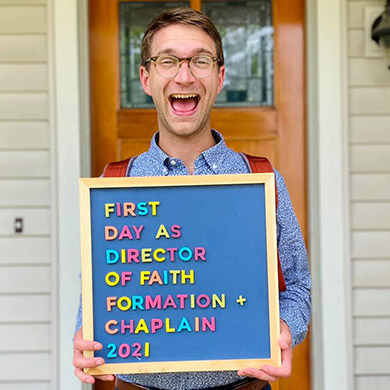
  • What does it mean to be the Director of Faith Formation?

    What does it mean to be the Director of Faith Formation?

    Winter 2022 Connections

    by Bryant Russ, HC Director of Faith Formation

    So what exactly does it mean to be the Director of Faith Formation?

    I get asked this question fairly often…and don’t quite know how to answer.

    I’ve been in this role for several months now, but still haven’t figured out how to succinctly describe just what it is that I get to do. The truth is, it means lots of different things. It means getting to be a part of big-picture brainstorming as well as helping teachers examine daily lesson plans. It means lining up chapel speakers, collaborating with local pastors, helping plan events like Senior Camp and Dance Marathon, and exploring best practices related to faith integration in the classroom. Sometimes it means meetings, google docs., and phone calls. But more often than not, it means visiting the middle school dressed up as King David, brewing a pot of coffee for a senior who stayed up too late, or connecting squirrelly high schoolers (sorry guys) with Miss Wierenga’s Forest School class to learn how to build a fire in the rain. It means reading “Dinner at the Panda Palace” to a kindergarten class and then teaching them a new word: hospitality. It means recording a podcast conversation with a couple of board members about how to pursue unity in Jesus in these polarizing times. It means praying with a student whose mother was recently diagnosed with cancer, or having lunch with the young man who has lots of questions about faith.

    Though I’m still trying to figure out how to answer that question in a simple sentence or two, I can readily point to a few themes that have defined my short experience as Director of Faith Formation. Three themes in particular stand out as lessons God is teaching me, and they also offer a glimpse into daily life at Holland Christian Schools:

    ”I was recently convicted about how many times I say the word “hurry!” to my children in a single day…

    3 Miles Per Hour

    I was recently convicted about how many times I say the word “hurry!” to my children in a single day. While I was speed-walking my 6-year-old daughter to her kindergarten class, she said something that stopped me in my tracks: “Dad, you don’t hear me very good when you’re walking so fast.”

    I think, perhaps, the Holy Spirit is saying something similar. Though 90 mph might feel like the minimum requirement in our frantic, frenzied world, it is not at all conducive for relationships. And at the end of the day, if we accomplish our to-do lists but miss the God we’re invited to know and the neighbor we’re called to serve—if we miss one another—then I’m not so sure we accomplished anything of lasting value. 3 mph is the approximate speed at which people walk with one another, speak to one another, get to know one another. 3 mph was, and is, the pace of Jesus and his disciples. This has been such an important lesson that I now have a 3 mph sign hanging in my office as a reminder that seeing, noticing, and knowing have to take priority if we are going to live our mission. When I slow down to that 3 mph pace I have eyes to see some of the incredible ways God is working in this place…which leads to a second significant theme.

    ”I want to associate Jesus’ name with great joy, to the point that God’s laughter spills out of me and onto my neighbor.

    Joy

    Though these have been challenging times for so many reasons (you probably don’t need the list at this point), the chaos of the past several years does not define what I see happening at Holland Christian. Don’t get me wrong, this has been and continues to be an exhausting stretch. But when I step back from the 30,000 ft. perspective of social media or the evening news, the defining characteristic I see is joy.

    Whether walking the halls of the middle school or peeking inside a Spanish class, I’ve come to think of my new role as the “best seat in the house” for witnessing the delight of learning in a distinctively Christian community. I get to see hundreds of elementary students raising their precious voices in song, and a wide-eyed biology class learning about evapotranspiration (it’s a thing)—and everything in between! Joy has been such a hallmark in my observations and experiences in Holland Christian classrooms that it is quickly becoming one of the first words I associate with Christian education.

    I saw this when one of my new elementary friends ran over to introduce me to her mother. “Mom, this is Mr. Russ, the guy who talked in chapel today!” Her mom asked, “And what did he talk about?” The little girl paused as though thumbing through a file cabinet in her brain. “Umm… the only thing I remember is that he talked about Jesus.” And upon saying “Jesus” a smile broke across her face and spilled out into laughter.

    In that moment I realized: I want to say “Jesus” like this little girl. I want to associate Jesus’ name with great joy, to the point that God’s laughter spills out of me and onto my neighbor. This is a lesson I’m learning from Holland Christian teachers who so beautifully model what the biblical authors call “the joy of the Lord” (Neh. 8:10) in every grade level and discipline. This joy is indeed our strength.

    Dependance

    Every morning I enter my office and plug in the small fountain that sits beside my desk. As the water bubbles over I speak a simple prayer, “Jesus, make your home in me.” I learned long ago that I cannot be an effective educator (or chaplain) in my own strength. I am simply not enough. On my own I don’t have the skill, energy, or insight required to manage my personal brokenness, let alone participate in the school’s mission of equipping minds and nurturing hearts to transform the world for Jesus.

    Because of this, my first and foremost job is to embrace my dependence and invite God’s animating presence to breath, speak, move—through God’s Word and through prayer. Only when richly receiving God’s generous love will any of us be able to offer it in return. There’s just no other sustainable way. What we sometimes call “ministry” is simply the overflow of grace in a person. I (re)learned this truth recently from Italian Renaissance artist Fra Angelico. Renowned for his innovative paintings depicting scenes from the life of Christ, Angelico’s advice for aspiring artists was simple: “He who wishes to paint Christ’s story must live with Christ.” I see this so clearly in the lives of HC people on a daily basis. One of the surprise blessings of such a turbulent season is the increased awareness of our dependence, and an increased desire to abide in Christ so that good fruit can continue to grow. As the Lord said to the Apostle Paul, “My grace is sufficient for you, for my power is made perfect in weakness.”

    As I settle into the new perspective that goes along with my new role, I believe more than ever that Holland Christian is a special place to be. I get to see firsthand just how minds are being equipped and hearts are being nurtured for the purpose of transforming the world for Jesus, and I’m grateful. Looking ahead, my prayer is a simple one (and a borrowed one 🙂

    ”One of the surprise blessings of such a turbulent season is the increased awareness of our dependence, and an increased desire to abide in Christ so that good fruit can continue to grow.

    I pray that out of his glorious riches he may strengthen you with power through his Spirit in your inner being, so that Christ may dwell in your hearts through faith. And I pray that you, being rooted and established in love, may have power, together with all the Lord’s holy people, to grasp how wide and long and high and deep is the love of Christ, and to know this love that surpasses knowledge—that you may be filled to the measure of all the fullness of God (Ephesians 3:16-19).

  • All I really need to know I learned in kindergarten…

    All I really need to know I learned in kindergarten…

    …from some really great HC kindergarten teachers

    Winter 2022 Connections

    When we pause to take stock of our blessings here at Holland Christian Schools, or when we survey our parents about what they appreciate at Holland Christian, we are always brought back to our teachers. They are amazing and talented people who also love the Lord with all their hearts. And our kindergarten teachers set the standard from the very beginning—these seven teachers on three different HC campuses are a dedicated bunch who throw themselves wholeheartedly into teaching some of our youngest learners, introducing them to the delights of school and learning. We thought you might like to get to know them just a bit!

    Karen Strikwerda @ South Side

    When kindergartners first meet Karen Strikwerda ’83, they never guess that her favorite pet is her ball python named Freddy. And when her South Side kindergarteners ask what her favorite animal is—a very important question in kindergarten, of course—they’re excited to discover she loves reptiles instead of cats or dogs.

    Karen has been teaching kindergarten at Holland Christian for 15 years, and remains current, curious and creative, happily trying new teaching techniques. “Kindergartners have a curiosity and a love of learning and that gets me excited each day,” Karen says. “It brings me joy to teach them how to do school and how to continue this love of learning.”

    But she also has an incredible heart for the Lord, and is passionate about showing kindergarteners their God. “In kindergarten, we often reflect on how great and strong and mighty is our God,” Karen said, “Yet there is also the lesson that this BIG God loves each of us so deeply. Teaching kindergartners that God loves them and is always with them gives them such comfort.”

    This love for God not only directs academics in Karen’s kindergarten classes, but also a growing ability to know themselves and their friends: “As kindergartners are learning more about themselves and their friends, I strive to let them know that they are each a unique creation with gifts and talents that God has given to them specifically.”

    ”I love that she gives me hugs and she makes it so I don’t cry during school.
    Lydia Kruithof ’34

    ”I like that Mrs. Timmer teaches us a lot of things about reading.
    Nora Timmerman ’34

    Stephanie Timmer @ South Side

    This is Stephanie Timmer’s fourth year teaching kindergarten, her first at South Side. But a quick peek into her classroom shows she definitely “gets” kindergarteners, and it’s a joy to watch her students help each other out in the hallways, stuffing and zipping each others’ backpacks on the way to the bus, or making their own word problems in math class.

    “Stephanie comes to Holland Christian this year as an experienced kindergarten teacher with new ideas and ways for us to continue to explore differentiated learning opportunities to meet the learning and behavioral needs of our students,” said South Side principal Erin Wyma. “She has an extensive background in creating and implementing student-centered reading interventions.”

    Stephanie is grateful to be teaching at South Side: “I love that I get to read the Bible, pray, praise and worship with these students everyday!” she said. “I get to live into the fullness of who God created me to be here at Holland Christian. I love watching and supporting students in their spiritual journey.”

    One of her favorite subjects to teach is creation because “It is so exciting to see how impressed [students] are [with] all that God has created,” she said. “They are thrilled to share their favorite parts of God’s creation—whether that is animals in the sky, on land, in the waters, the stars, the people, or their favorite foods.”

    “Kindergartners love school and bring such a special joy with them each day!” Stephanie added.

    Rita Bos @ Rose Park

    Every July Rita Bos ’92 holds a huge pool party in her backyard for all her Rose Park “gems”—the kindergarteners she will be teaching in the fall, along with their families.

    “These little blessings are an extension of my family, and I work super hard for them to know and feel that they are loved by God FIRST—and also Mrs. Bos!” she said. Plus, with all her years of experience teaching kindergarten, she knows that the relationships built in kindergarten among classmates, and even between families from the classroom, can last a lifetime.

    So she takes the time to get to know her little “gems” purposefully creating family gatherings like field trips to Crane’s Orchard to create a classroom community.

    “Each day the little ones are SO excited about EVERY learning opportunity!” she said. “The ‘aha’ moments that I get to constantly witness are simply beautiful!” And she’s grateful to be teaching at a Christian school—“To be able to teach all subjects through the Biblical lens is a gift!”

    One of her favorite topics to teach is science, lessons that Rita carefully creates to integrate faith. But the main thing that she works to send her kindergarteners away with is “That God loves them fiercely! I know that these treasures won’t care to learn until they know I care [about them],” she said.

    ”She teaches us math and how to be kind and friendly to other people. She’s sweet—when we
    need a bandaid she gives us one outside.
    Abigail Disselkoen ’34

    ”When we mess up she says, “Try again!”
    Sophia VanDorp ’34

    Amanda Brouwer @ Rose Park

    Two things that are important to understanding Rose Park kindergarten teacher Amanda Brouwer: She is really really good at wacky hair day hairdos. And second, it is a total blessing to watch her lead young students in worshiping God together.

    After 18 years of teaching preschool, this is Amanda’s second year teaching kindergarten. And she is a rock star at it. “I love watching our littlest learners get excited about discovering the world around them and I get to be a part of that— amazing!” Amanda said. “I get to sing, dance, move, explore, and get messy with our learning!”

    “Amanda shines with creativity, music, and joy,” Rose Park principal Miska Rynsburger said. “She is masterful at creating a family in her kindergarten space where every child is known, loved, and well cared for in every aspect of development: academic, social, emotional, and spiritual.”

    She has an academic understanding of the skills that are so important in kindergarten— including play. “Play allows kindergartners to take ‘risks’ and teaches them so many social emotional development skills that carry into academic skills,” she explained.

    But the most important thing she teaches, alongside reading and writing? “I want my students to walk away from my class knowing that God loves them very much and created them each with gifts and talents that they can use to build His kingdom,” she said.

    Hillary Klipp Lopez, Spanish Immersion @ Rose Park

    It’s a rare person who can take a full classroom of 20+ rambunctious English-speaking 5-year-olds and have them speaking Spanish in a few quick months. But Hillary Klipp Lopez has done that for the past four years as Rose Park’s Spanish Immersion kindergarten teacher.

    Rose Park principal Miska Rynsburger appreciates Hillary’s energy, and how she is “an excellent communicator with her children, her families, and her colleagues,” Miska said. “She advocates graciously and truthfully for the needs of her developing students, our growing program, and for Holland Christian’s impact on our greater community.”

    Hillary likes that Holland Christian is “a place where students are loved and are taught how much they are loved by God,” she said. “I love how we focus on the whole child, fostering spiritual, academic, social, and emotional growth. It is great to be surrounded by colleagues and families who love Jesus and want to serve Him with a whole heart.”

    Hillary sets high standards for herself and subsequent grade levels, besides introducing us to the beauty of language immersion, of Hispanic culture, and the idea that we all “form part of God’s big world, which spans across ALL countries, languages, and cultures.”

    One of her favorite times of the year is around November when kindergartners “realize that they can speak ALL in Spanish,” she said. “They are incredibly proud of themselves, and I love celebrating their growth with them.”

    ”My favorite part is that we speak Spanish and we play and it’s very fun. We got to watch
    a show.
    Cecily Mortensen ’34

    ”God created Ron to love and grow young children…he has married that skill with his passion for creation.
    Miska Rynsburger ’92

    Ron Harig @ Forest School

    Statistically speaking, there can’t be that many former Marines who have found their second career in teaching kindergarten, right? But you also don’t find many kindergarten teachers happily teaching 25 5-year-olds outside 6-7 hours a day, snow or shine, either, like Ron Harig does in HC Forest School.

    Which is maybe why he still finds teaching kindergarten fulfilling, even after 15 years: “I love hearing the kindergarteners’ laughter and joy as they play. Their forgiveness and energy is just unique,” he said. Plus, “I want to be a foundation builder. To be in a place where all kids could all leave my classroom knowing what they should know before entering 1st grade—and play for hours and hours.”

    Ron taught 27 years at Jenison Public Schools, but left to teach HC Forest School when it started four years ago, and has been hugely instrumental in its success.

    “I am surrounded by individuals who love Jesus and work crazy hard,” he said. “The support and encouragement from parents is amazing. We also have some one-of-a-kind, crazy talented administrators.”

    Besides watching kids explore outside, Ron delights in teaching them to read: “We are learning how to read so that we can read the Bible. If we want to spend time with Jesus, we can open our Bibles and read. He will guide and comfort us throughout this life as we spend time with Him.”

    Mackenzie Wierenga @ Forest School

    Last January, Mackenzie Wierenga was dipping her toes into all things Holland Christian and Forest School, basically dropping her previous life as a Hope College student to take up student teaching kindergarten Forest School with Ron Harig.

    And her life changed. She realized not only how much she enjoyed teaching, but also being in a Christian school and in an all-day outdoor program.

    “I love how unique the program is,” Mackenzie said. “There is nothing quite like it. We get to learn about our Lord every day out in nature. The program is very hands-on and I love how the kids can see Jesus all day long.”

    “Mackenzie’s compassion for children makes her unique,” Forest School principal Miska Rynsburger said. “She adapts to the needs of her learners and meets them where they are.

    Besides enjoying the daily laughter and joy of energetic 5-year-olds, and rejoicing in their huge academic growth in a year, Mackenzie appreciates the all-inclusive, comprehensive nature of Forest School kindergarten. One of her favorite units is all about rocks: “We learn about different kinds of rocks, go to the beach and take home rocks to use for art, learn how the Lord is our Rock, learn about the bucket filling approach, etc.,” she said. “I love when you can tie lots of subjects all in the same unit!”

    ”Mackenzie’s children trust her and love her because they know they are respected and loved
    with authenticity and joy.
    Miska Rynsburger ’92

  • HC Live! Growing Through a Global Pandemic

    HC Live! Growing Through a Global Pandemic

    Whether you consider it providence, foreknowledge, or simply an accidental good idea ahead of its time, back in the 2016-17 school year, Dan Vos, HC’s Registrar, had this seemingly crazy idea that he and a few students could live stream HC athletic events. Not only that it might be possible, but also that it might be a good idea for students to learn, and could maybe even be good for the whole community. Dan knew of some old HC iPads mostly collecting dust in storage, and when tinkering around in his off-time, found software to connect them to each other.

    And it worked—not too badly for a few old iPads pulled out of dusty closeted retirement. And despite some initial limitations: they couldn’t zoom in to the action, they had to prop iPads on folding chairs, and the internet was often spotty. But some students noticed from the sidelines what Dan was doing, and their interest piqued. Plus a few grandparents noticed they could watch their grandkids’ games while wintered elsewhere…

    And then one wintry walk out of a Civic Center basketball game that Dan and his skeleton student crew were experimentally live streaming, back in the old Civic Center still, the parent of a player walked out with Dan and told him how much his parents loved watching their granddaughter’s game streamed online. And then asked Dan what would it take, how much money would he need to do this at a higher level, to do it really well? Dan went home that night, researched, sent him a bare bones equipment list with prices, and the next week found a check arrived in the mail

    “It was this weird idea—just this brain child that we should do this, and do it well—really get at the emotions and energy, get at the story of the game, with multiple cameras to get the floor, get up high, get in close to the action,” said Dan.

    Five years and one COVID pandemic later, we’re so grateful for that conversation that turned into HC Live! Because that’s when things really got going, in the fall of 2017, after Dan purchased new equipment that enabled him to use four cameras borrowed from HCHS chapels in combo with new cables, monitors and a switch box with an intercom system, so the camera operators could be warned ahead of time their cameras were about to go live.

    The very first 2018 Winterim class called “HC Live!” helped as well, and Dan learned along with his students from professionals in the field more than happy to share their expertise with a teenage crew. For that first school week each January, Dan and his HC Live! Winterim class visited Hope College, WOOD TV8, the VanAndel Arena, WGVU, and the City of Holland to learn from each of their professional camera crews. A huge highlight was visiting the “old warehouse in Grand Rapids,” Dan said, that stores the equipment used by Matt Johnston—an expert videographer recognized by all the students for his motosport and tradesport Youtubes, especially for his Ken Block’s Climbkhana: Pikes Peak Featuring the Hoonicorn V2, Ken Block’s race up Pikes Peak.

    The “HC Live!” Winterim class

    The Winterim classes not only educated a large group of kids on how to do the actual live streaming, but also gave Dan a significant crew of kids to draw from willing and able to do the volunteer work throughout the school year, since the culmination of the class was to live stream an HC basketball game together.

    It also started a student community within our HC community, a draw for those students not necessarily interested in joining the mayhem on the sidelines of sporting events as much as running cameras behind the scene, kids who enjoy seeing a product that potentially blesses others.

    “HC Live is a great thing to be a part of—especially this past year when it was more important than ever,” Kyle Kossen ’22 emailed. “I really felt like I was doing something that helped a lot of people this year, which is a great feeling to have. For me personally HC Live was important because it’s made me more interested in studying film and broadcasting, which I hope to study in college.”

    Lauren Hemmeke ’23 enjoyed working chapel cameras, so she decided to join the HC Live team “mostly because I liked running cameras,” she commented. But then she found something else as well: “I enjoy the sense of community that I feel when we’re making random jokes and comments through the headsets, or going out for ice cream after a game or event, and just getting to know the people who do this with me,” she continued. “It’s a really fun experience, and it’s great to be able to get a nice looking livestream out so other people can see it, even if they can’t be there in person.”

    The view of graduation from “HC Live!”

    Each HC Live streamed event takes a significant amount of time—figure an hour to set up, 30-45 minutes of take down afterwards, besides the 2+ hours of the actual event. And high school students can be difficult to nail down timewise, especially for a volunteer gig—you can’t just send out a request at the beginning of the semester and expect them to A. sign up for it that far in advance; or B. remember show up for something they signed up for that far ahead of time. So things are a little more influx, and with a big enough team, like the 32 he had this year, he can usually pull together 2-4 students the day before the event. A little nerve wracking, perhaps, but it generally pans out.

    “I like to have students run everything,” Dan said. “Graduation [livestream] was all run by students—cameras directing, drone flying, everything! I’m there to oversee, step in if needed, but I prefer students do it all. And it can be quite a commitment,” he agreed. Dan generally starts by showing students how to set up and work a camera, then have them watch directing a few times, and maybe eventually do some crew directing, though not all students choose to direct.

    One rare student has “taken the time to learn how everything works, how to put all the pieces together,” Dan said. “To be honest, he’s the linchpin of the whole thing. When he came on the scene, he made everything just work.” That linchpin is Adam Wassink ’22, the curly red haired kid you may have seen behind the cameras at the recent graduation or live streamed sporting events. “Adam is very good at it—he anticipates what’s coming, is very encouraging. One time on the fly he says, ‘Let’s do a coach in a box!’ and he whipped it together in the midst of game directing so you see the action, and [HCHS boys basketball coach] Brad’s reaction to the action—that’s the kind of stuff Adam can pull off.”

    Adam Wassink wearing a Steady Camera

    “I love doing HC Live!” Adam added. “I love that I get to sit behind what feels like an airplane seat and turn what could be a very boring one camera live stream into a multi-camera stream full of graphics, audio mixing, and replay which really pulls the viewer in.” Plus “I get real life practice video producing and directing which is not easy!” he said.

    As you might imagine, HC Live viewership increased hugely this past school year during COVID—boys basketball views went from 500-800 views preCOVID to closer to 2000 views for varsity games, and over 700 for JV. A girls JV basketball game that previously might get 200 views tops was getting almost 700. Varsity girls swimming even got 1200 views last fall for a swim meet narrated by two mothers—mainly so they could get into the swim meet to watch their daughters swim in person!

    Now that we’re hopefully shifting back to more in-person indoor event attendance this fall, Dan has ideas for where he’d like to see HC Live grow: He’d like to add in more play-by-play narration on a regular basis, and hopefully with more students interested in doing it if possible. He’d also like to figure out a way to entice more students to do HC Live. He’s tossed around the idea of getting sponsors so he can maybe pay kids for their time. Or at least provide them with food? Or he wonders if he should make it a semester-long class, to train students not only how to work the cameras and direct the show, but also how to set it up and promo it on YouTube, do more with graphics. Maybe students could learn to create a 30 second highlight video for posting on social media the next day. Or create fillers before the event—interview coaches and players ahead of time. He’d also like to figure out how to get cross country, golf, and tennis matches live streamed, since they’re currently limited by technology and lack of wireless internet in those situations.

    But for now, it’s been a great way for so many of us parents and grandparents kept out of the gym or field or swim meets by COVID or proximity to still cheer our kids on, to know what happened enough to rehash and relive good times with each other, and to remain part of each others’ lives.

    And for the kids behind the cameras?

    “I have a perspective of what it actually takes to get an event on the big screen,” Adam said. “I now watch football, baseball, etc. in a completely different way.”