Category: Connections Articles

  • Not One, but TWO Huge Property Donations!

    Not One, but TWO Huge Property Donations!

    Early last September, shortly after being named HC’s interim Head of Schools, Jeff Pett was visiting each Holland Christian campus to better understand their focus for the school year. His last stop was Forest School at Sassafras Ridge. He popped in unannounced, hoping to observe how the classrooms in the house were functioning, and to see the second grade students and their teachers in action. But when he knocked on the door there was silence. The rooms were completely vacant. He had picked a bad time, he thought.

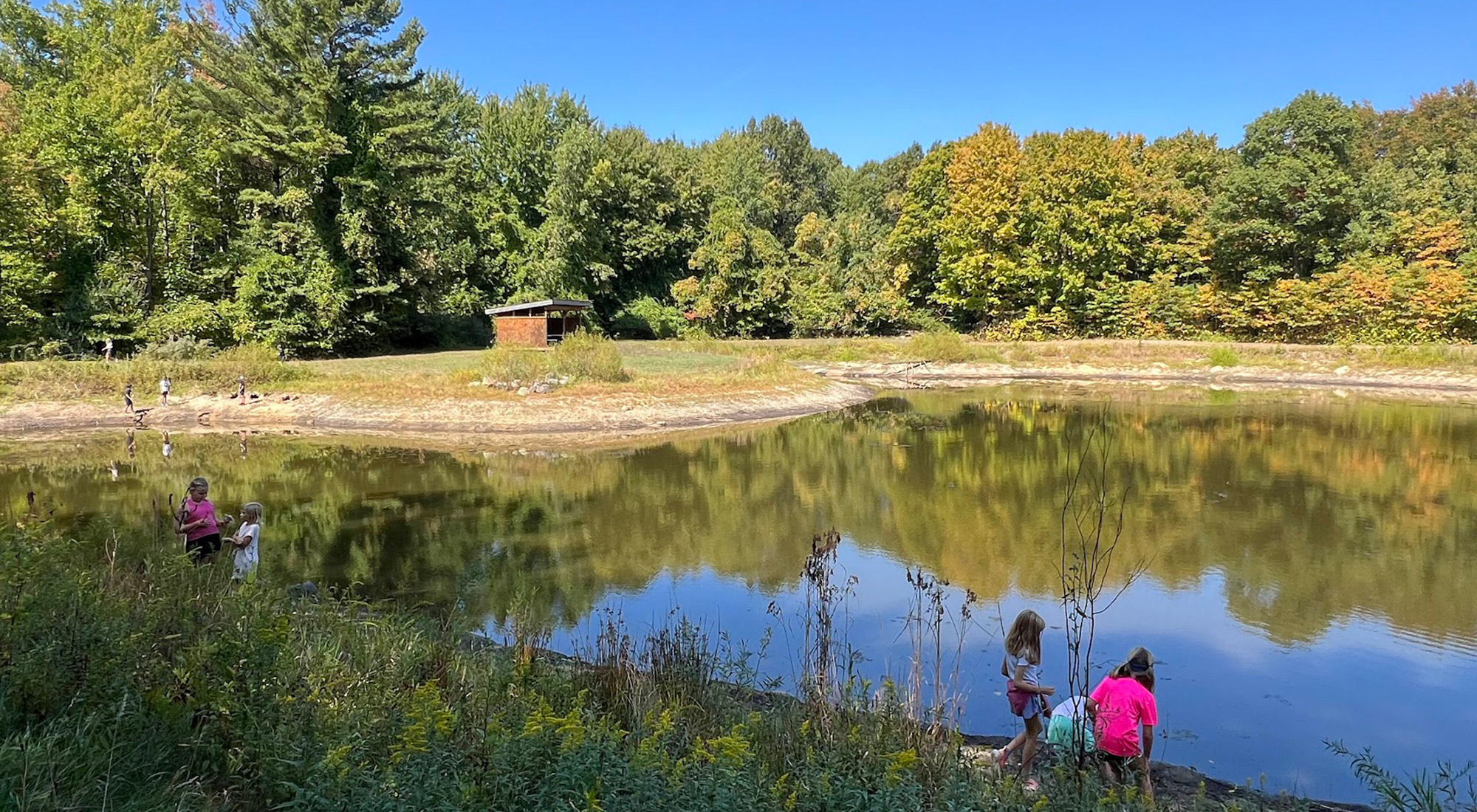
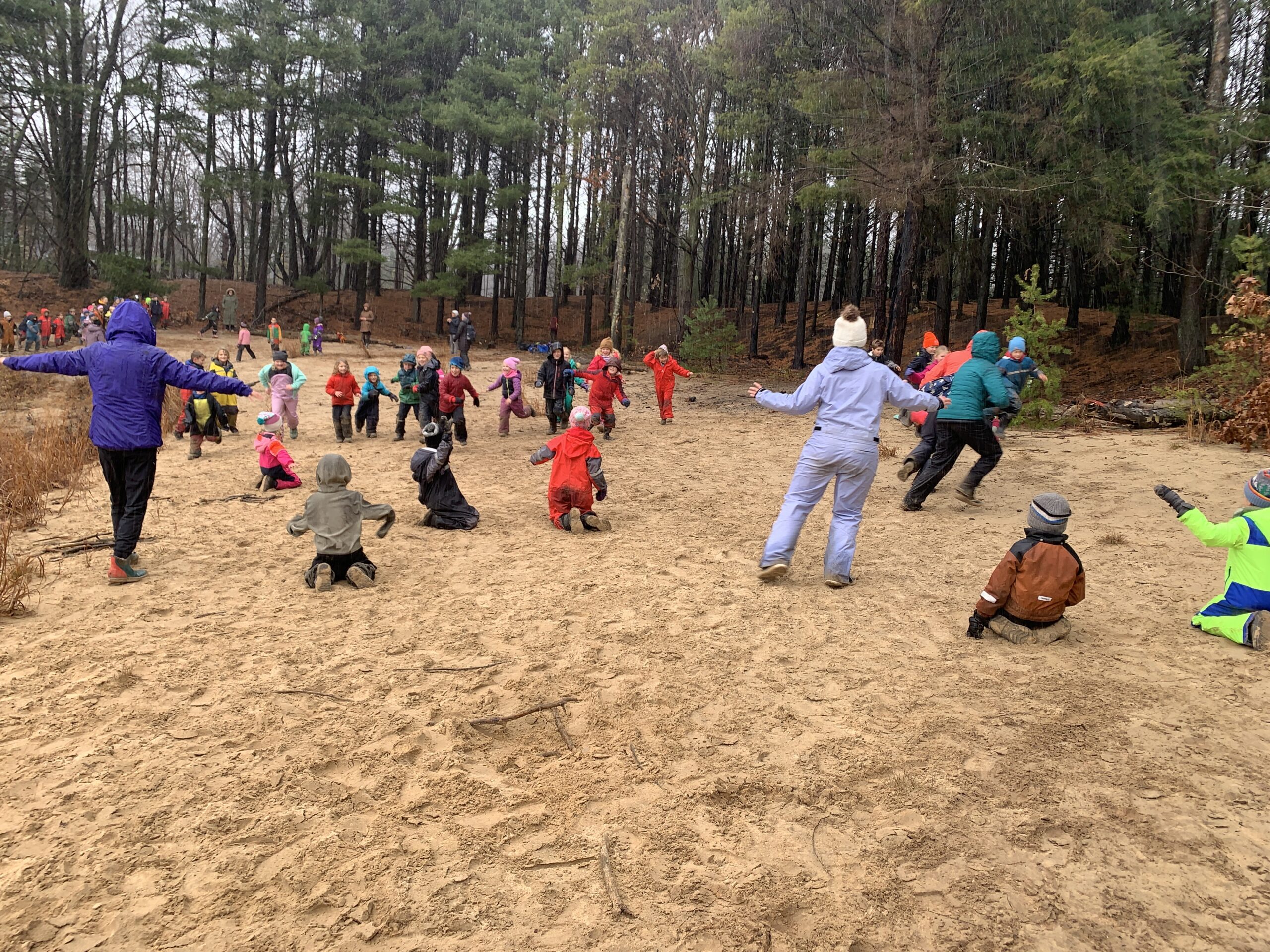
    “Then—faintly, I heard voices of children somewhere out in the woods behind the house. Lots of laughter!” Jeff recalled. “I just followed my ears and found that both classes of second graders were starting a hike out to the far west end of the property. I wasn’t exactly prepared for hiking in my dress pants and shoes, but who could resist this opportunity?! The kids marched two-by-two through the woods, passed ponds and creeks, with teachers interspersed amongst them.

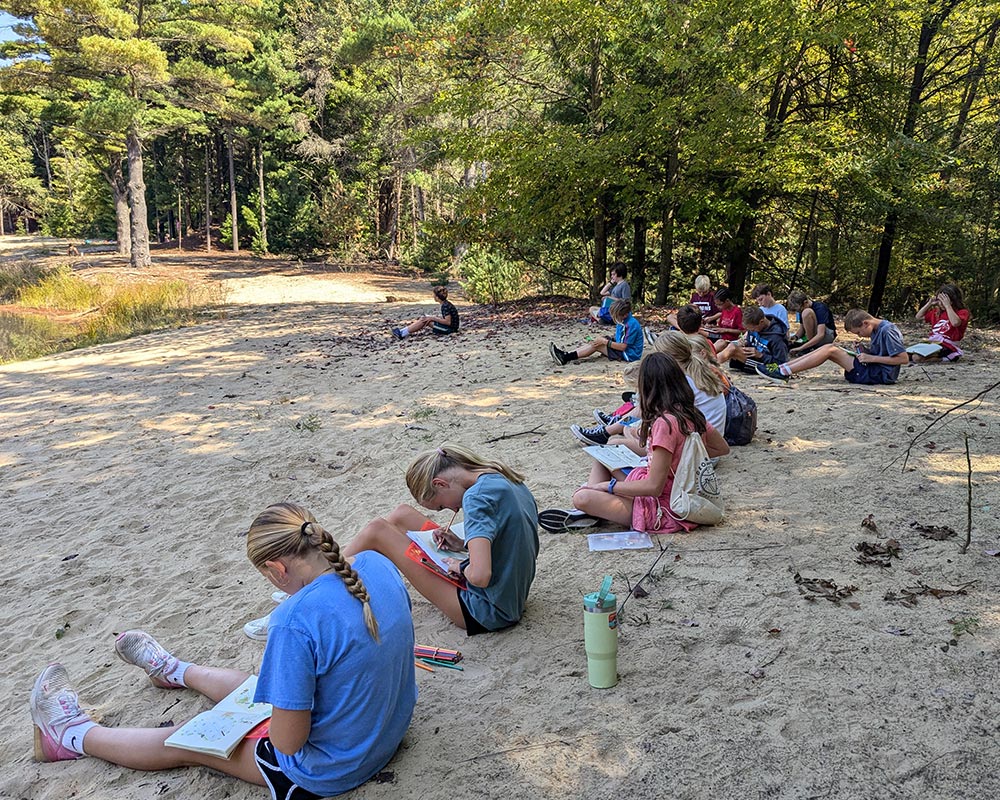
    “The kids were well behaved and obviously excited. It wasn’t a short hike! When we finally stopped we were in a dune-type sandy area. Another beautiful spot! The kids dropped their backpacks and circled up around the teachers eagerly awaiting instructions. This day was the day they would learn how to put up their [reading] hammocks. The teachers did a great job and as the students spread out and were finding their ideal hammock hanging spots, I turned and made my way back to the house and my car.”
    Four years ago Holland Christian was gifted 10 acres of land with a house on it southwest of the main HC campus—what we now know and love as Sassafras Ridge—while also being allowed to use the surrounding 50+ acres of wild property. “It is an amazing piece of property and our second graders in Forest School are absolutely loving having school out there,” Jeff added.

    However, with a growing Forest School program, space-locked Forest School cabins on HC’s campus, and the whole preK-12th grades becoming more proficient in outdoor immersed education, Holland Christian could actually use more wild space. An HC admin team explored how to best help Forest School continue to grow and thrive, including possible additional space at Sassafras Ridge to perhaps “create a center a bit further off the road with maybe four cabins and some parking and a place for buses to turn around,” Jeff said.

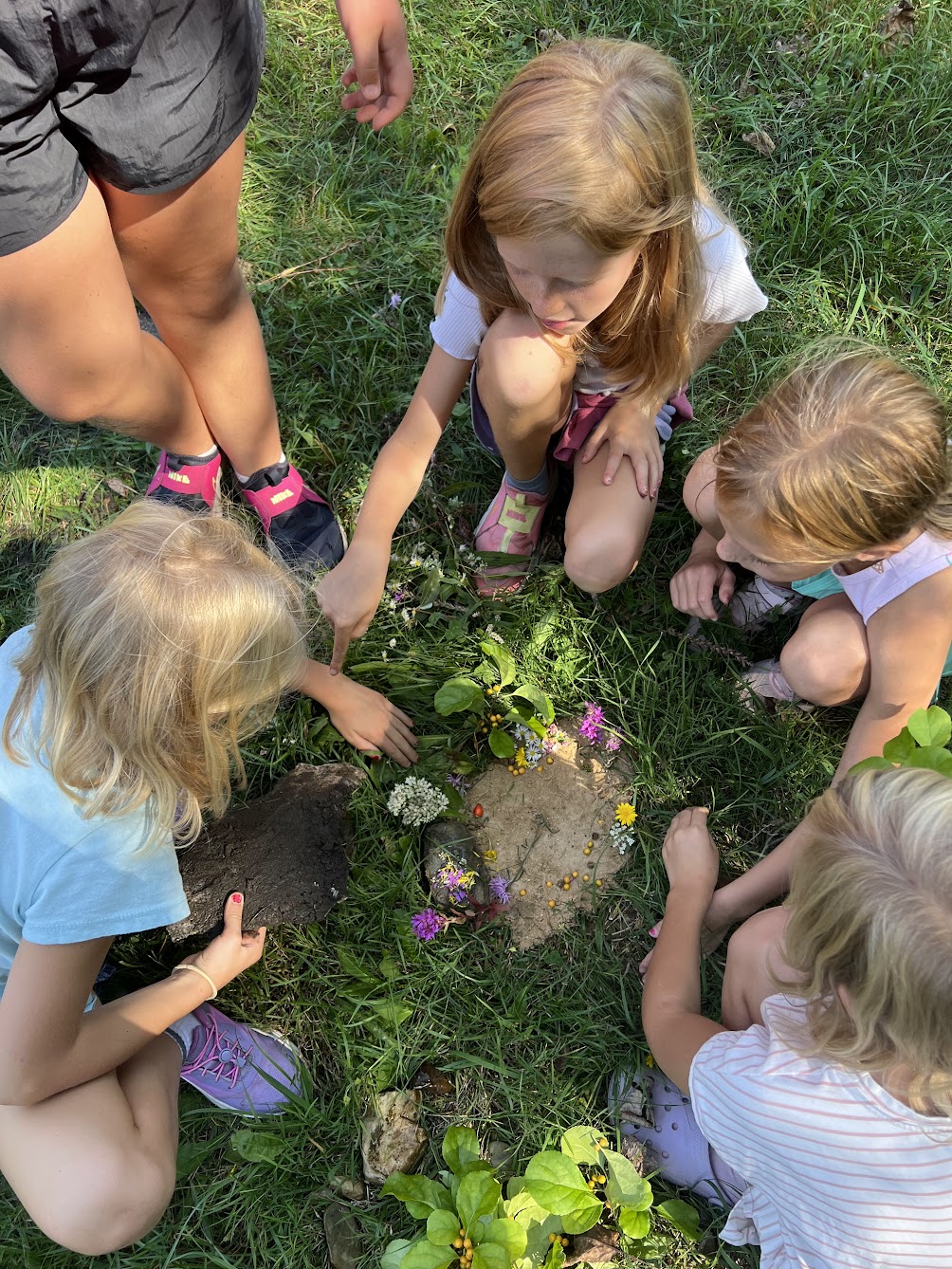
    Underlying this interest is one thing we’ve learned over the last seven years of Forest School: that there is a difference between what kind of outdoor learning kids do. We are seeing more benefits in what is being called “nature immersion learning” vs simply learning outside—though that is also beneficial. We’re discovering that kids learn best by exploring freely, seeing God at work in a myriad of ways by uncovering bugs and buds and tree bark, measuring and climbing and identifying trees, tapping for maple syrup, making fires and shelters, constructing dams in the creeks.

    So after a significant conversation and investigation, a donor who wishes to remain anonymous generously decided to gift the entire 45+ surrounding acreage to Holland Christian Schools to continue to promote and foster our outdoor learning programs!
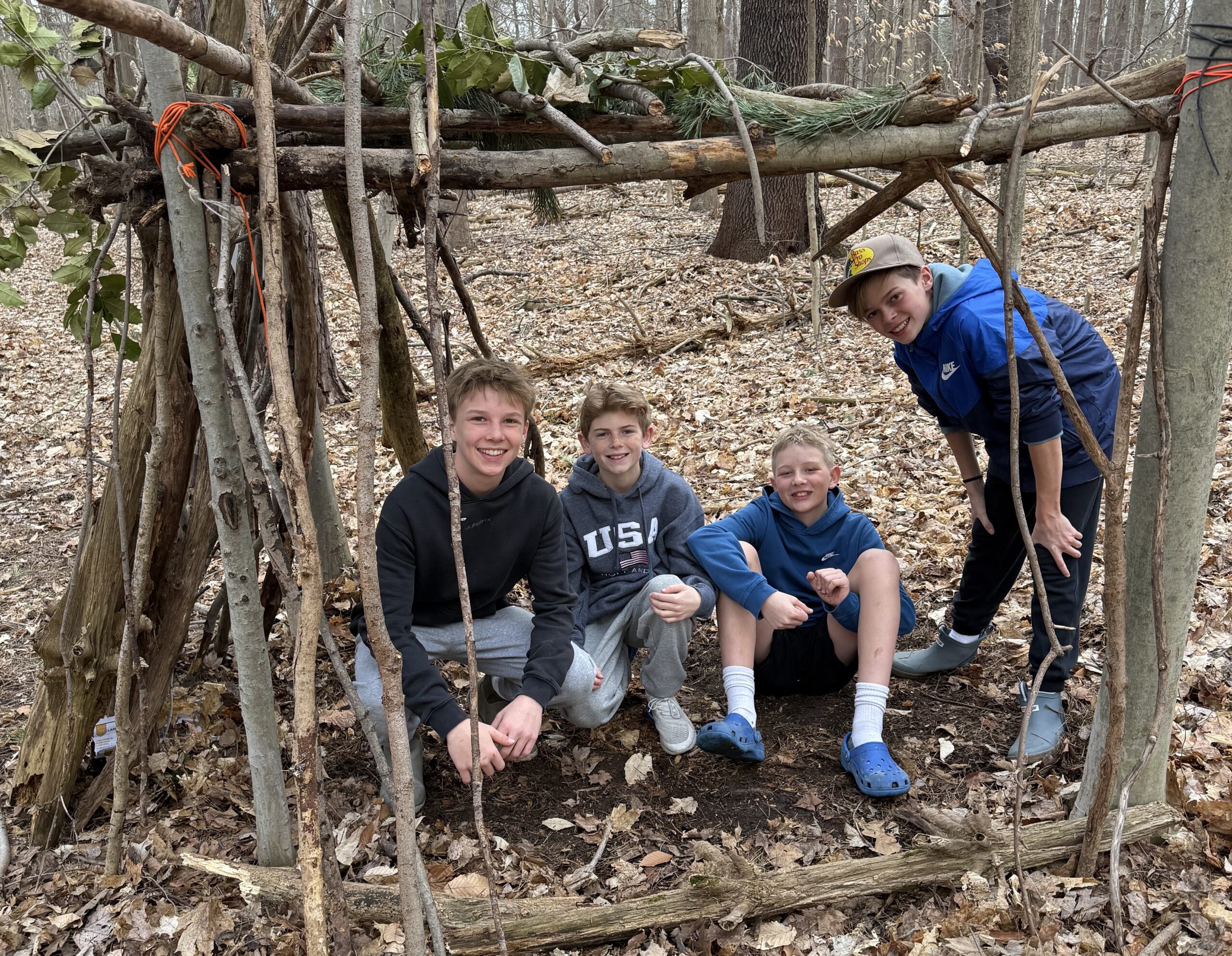
    So after a significant conversation and investigation, a donor who wishes to remain anonymous generously decided to gift the entire 45+ surrounding acreage to Holland Christian Schools to continue to promote and foster our outdoor learning programs!

    “With more land, Forest School can offer longer, more immersive learning experiences across multiple habitats—woodlands, meadows, and dune lands—allowing children to return to the same spaces over time and develop a sense of belonging, stewardship, and wonder,” Miska Rynsburger, Forest School principal and outdoor coach, emailed. “The land creates room for unhurried learning, deeper curiosity, and seasonal rhythms that are foundational to how young children learn best.”
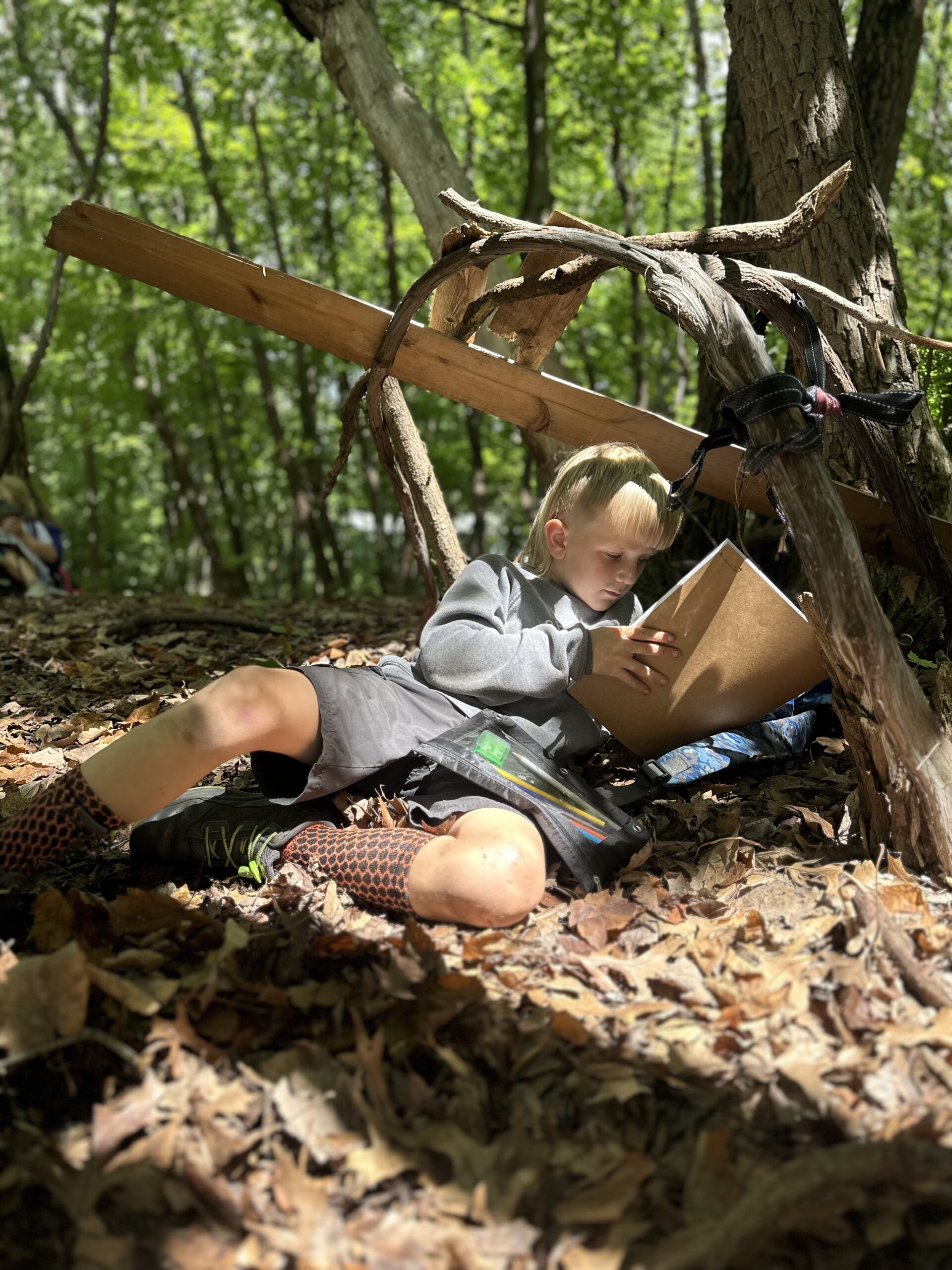
    So when you’re given over 45+ acres to allow your over 1600 students access to do that kind of learning, it gets our outdoor education geeks over the moon over here! And super excited about how our students can best learn and care for the property. Besides the fact that it is a beautiful piece of God’s creation:

    “I’ve had the opportunity to be out on this property a number of times over the years and have marveled at its beauty, its peaceful open areas around small lakes, and its rolling hills through the forest. It really is a natural wonderland!” Jeff Pett remarked. “For us to now own over 55+ acres here is an amazing gift! The lessons that can be planned for the students in so many possible locations over the next 50 years are countless.”

    “Sassafras Ridge is a shared gift for the entire Holland Christian community, preschool through high school,” Miska continued. “While Forest School will use the property most frequently, students across all grades will engage in learning experiences connected to science, social studies, art, physical education, service learning, and spiritual formation.
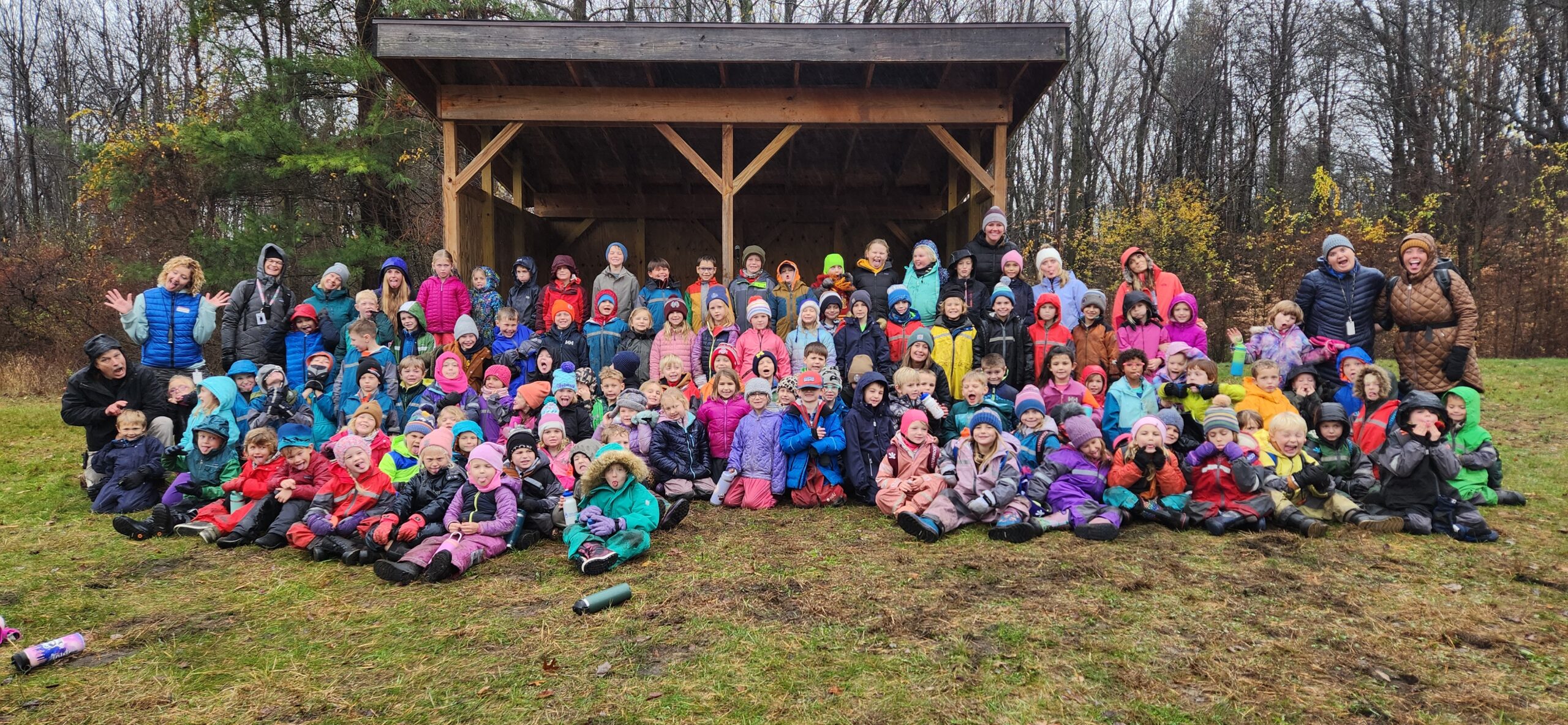
    We are so grateful for the donor’s generosity and vision for the future of Holland Christian Forest School! Now we can dream big and start the planning process to properly integrate this new asset into our long range plans for Forest School! We could not be more excited!
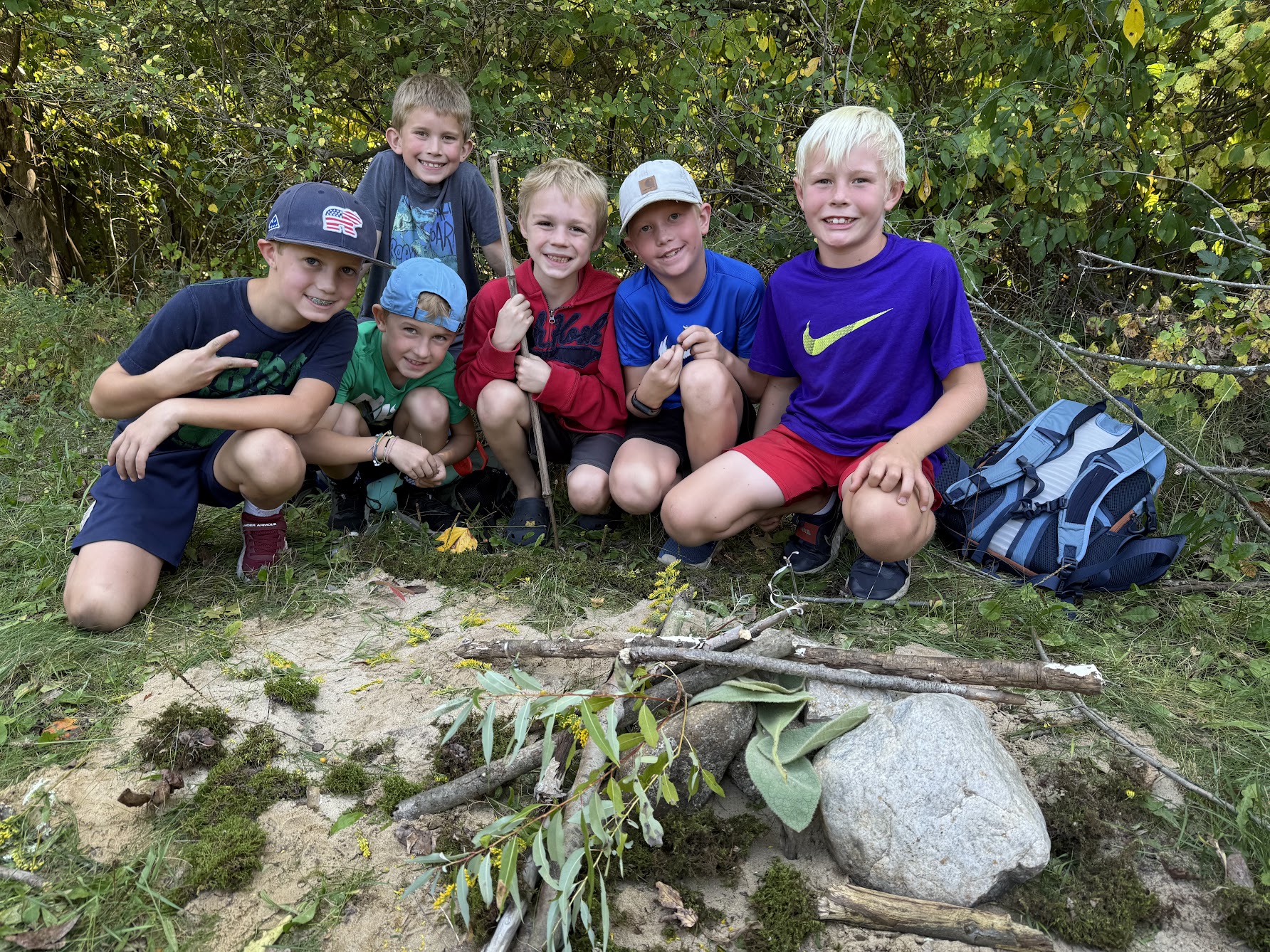
    Add to all this a second extremely generous anonymous donation that allowed Holland Christian to purchase a house and surrounding 1.77 acres formerly known as the “Wolters House” from Laketown Township in December. Holland Christian had previously leased the house with a creek in its front yard and an acre of largely undeveloped woods abutting the Wolters Woods township park, from the township the 23-24 school year to use as an outdoor education hub. We are thrilled to now own the property ourselves, which we are affectionately calling “Cedar Creek”!

    Renovations in the yard and in the house interior have already begun in order to accommodate our new Forest School Young Fives program that HC is starting with the continued partnership of the Outdoor Discovery Center (ODC). With the property’s proximity to our main HC campus, preexisting outbuildings that can house bikes, a creek running nearby, and a large variety of trees, plants and animals to discover on the property you can just imagine how our outdoor education brains are turning!

    The land creates room for unhurried learning, deeper curiosity, and seasonal rhythms that are foundational to how children learn best.”

    Miska Rynsburger
    Have Questions?

    We look forward to meeting you and your family and introducing you to the fresh, creative, personalized education at Holland Christian! We are here to help! Get in touch using the contact form linked below or call us at 616.820.2805.
    Get in Touch!
  • Power of Prayer: Fish Hoek, South Africa

    Power of Prayer: Fish Hoek, South Africa

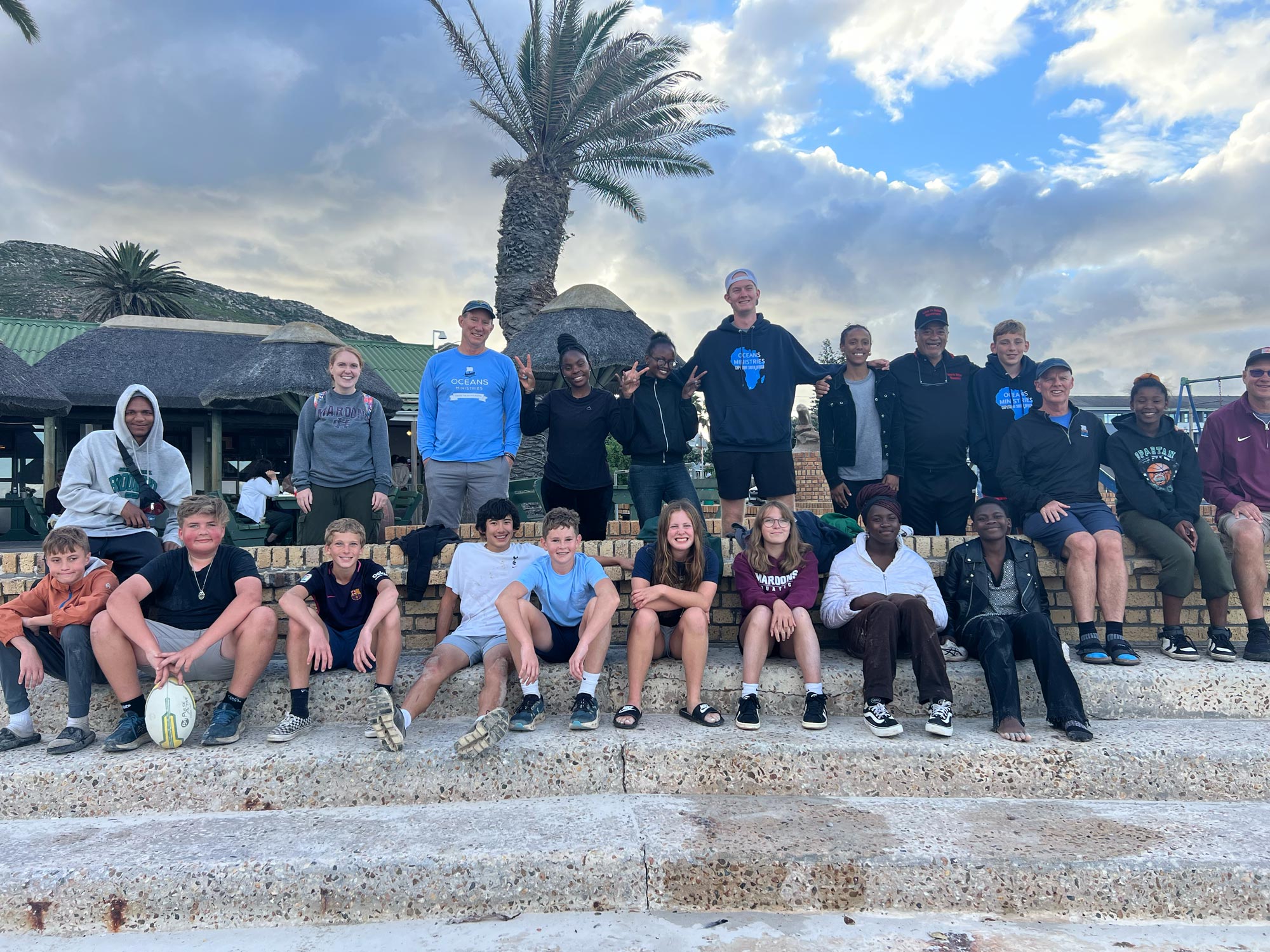
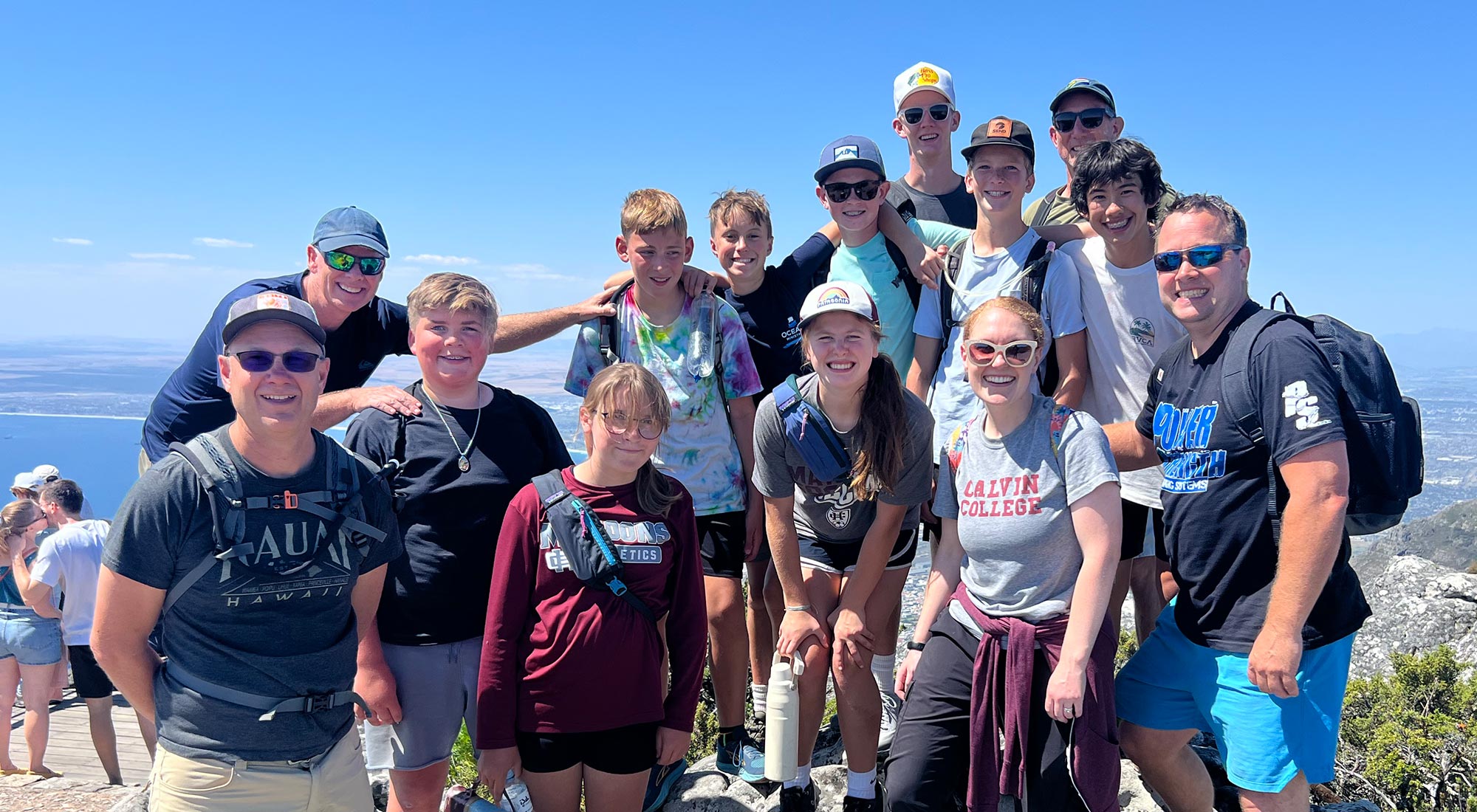
    A couple of years ago, HCMS principal Tom Strikwerda was chatting with HCHS math and Bible teacher, and former track coach Mike Verkaik, about the HCHS South Africa trips he leads every summer through Oceans Ministries. The trips sounded amazing—the high school juniors and seniors spent 10 days volunteering, learning, worshiping, and hiking at the Oceans Ministry Center in Fish Hoek, South Africa. And Tom wondered, why can’t middle school kids do this?

    Mike couldn’t really see why not, so they tried it in February 2023 with eight HCMS students. “And it was fantastic,” Tom recalled. “Better than fantastic!”

    The plan was to give these students a variety of experiences, from interacting with kids in the school program, making dinner and serving families in poverty, from hiking mountains, swimming in the ocean, playing pickup rugby on the beach, to worshiping with a couple of different church communities, listening to special local guests, and praying together. All this to draw closer to God and each other, while also learning about Christian leadership. An unbelievable experience—and a tall order.
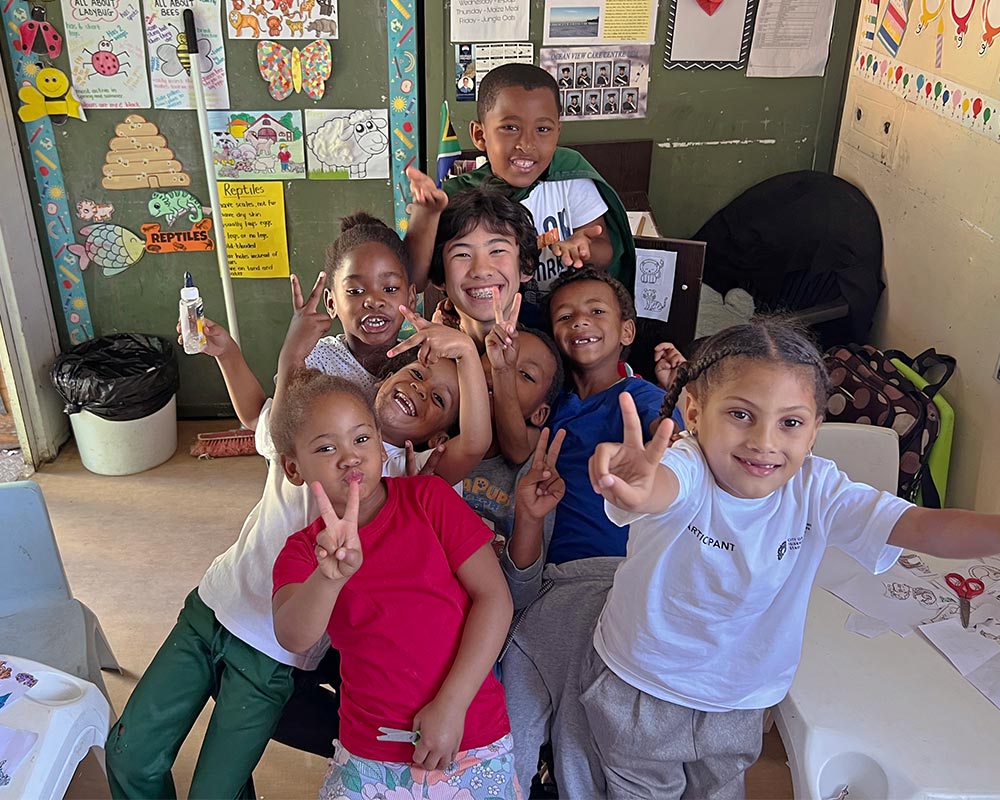
    Tom and Mike switched the 10-day trip from February to fall break so that students would miss less school, and this past November, HCMS returned from its 4th trip there.

    “And it was even better than fantastic,” Tom asserted.

    The curious thing about middle school kids is that they can be uninhibited in beautiful ways. And people notice and watch them, often without them realizing it.

    Which is what happened on HCMS’s second trip, the first fall trip: The students gathered at the end of the day—as they do every day—and shared their “highs and lows” of the day, singing “Firm Foundation” together. A fellow Fish Hoek resident and guest speaker for the evening, Brian Steele, happened to overhear them, and his ears perked up. An educator by trade, he was struggling to decide whether or not to help run a new Christian school in the Ocean’s Ministry Center, or remain in his current job as an educator in the local public school. Hearing the HCMS students’ highs and lows and prayer time intrigued Brian, and helped him discern that he should accept the calling of running the Christian school.

    Because of that meeting with those HCMS students, Brian went on to take over an online school, VTC House, and turn it into a dual online/physical but also Christian school, now housed at the Oceans Ministries center in Fish Hoek, SA. Brian told the HCMS students that night that, “I’ve been a teacher, educating with salt and light with my actions, but I want to be salt and light with my words, too.”

    The first week of that school year, Brian was already seeing fruit, in particular with a student, Gabriel, who received Jesus as his Savior! Later that year, Brian visited West Michigan, including Holland Christian, to learn how we run Christian schools in our region.

    It’s stories like that, that abound after these trips—God working in amazing ways. During this most recent trip, a Muslim government official hanging out in the courtyard overheard HCMS students praying over the school’s teachers, and unexpectedly asked for prayer from them as well, surprising the locals more than the students.

    “Our special guest, Andrew (Mr. Haig’s brother-in-law), talked about glorious inefficiency, which is the idea that we try to do things efficiently and don’t always think about the big picture plan. Glorious inefficiency means that God does stuff, maybe not the most efficient way, but always the big picture, best way. We also talked a lot about the power of prayer. Looking back on our days and the opportunity to pray over the teachers, we have started to realize more than ever how important prayer is. It can truly change a situation around.”

    Alex Chawla ’30

    The group also tried something new this trip—plumbing! Whenever it rained, the Oceans Ministry Center’s sewage would back up, causing extensive damage, as you may imagine. So Brian Schrotenboer, owner of Specialized Plumbing Services, came along on the trip thanks to Haven Church in Zeeland. For the first day, most of the HCMS kids dug ditches and moved huge rocks, so Brian could lay the pipe and fix the sewage drains, alleviating huge headaches for the center in just a few days.

    Other days, the students prepared and served food for 700 at Jim Se Bos; played with the Care Center’s children; hiked Table Mountain; journaled, prayed, and read the Bible at a variety of locations; hiked with students from VTC House, always ending and beginning each day with “family time,” in worship and sharing.

    Not only did the HCMS students work to serve those around them, but they came back changed themselves, inspired, blessed, and thankful. It’s fascinating to read their own words from their blog entries:

    [When] worship started. It was so much fun. There were 2 people leading on the small stage and everyone seemed to know all the lyrics and were just singing their hearts out. Everyone was dancing and clapping. It was absolutely incredible. After that we sat down when the pastor came on stage. Then immediately we stood back up to sing again! Everyone was moving around the room, shaking hands and dancing while singing (pretty sure there was a conga line going around?) Then the pastor came up to speak for real after a couple more songs. He preached about leaving our worries behind, which was very impactful. We prayed and then got up to sing.

    Oliver Bishop ’30

    We drove home and settled into dinner. We had chicken bacon rice casserole. It was a very good meal. It got me thinking, I thought most of the kids in Jim Se Bos may never in their life have the same meal as we just did. It gives you some perspective. In the United States, we are very blessed. Even when we go to a place like South Africa, we are living in a nicer place, eating better food, and have more opportunities than some of the people that live there.

    John Propst ’30:

    When God brings together people in this way, incredible things start to happen. Which is exactly what happened with us. We ventured to a very old vineyard in order to quiet ourselves and tune into what the LORD has for us. Many of us heard from God in one way or another. Later on, Pastor Ryan spoke to us about being open and listening to what the Holy Spirit has to say. The rest of this night was filled with conversations and prayer about the Holy Spirit doing work in us. We reflected on how God has been good in our lives, and praised him for the fact that we are the group that actually got to come here. God put together a crazy story of people who are all in different walks and points in life, but he’s united us and grown us in our love for this place, each other, and himself.

    Grant VanderZee ’23

    Have Questions?

    We look forward to meeting you and your family and introducing you to the fresh, creative, personalized education at Holland Christian! We are here to help! Get in touch using the contact form linked below or call us at 616.820.2805.

    Get in Touch!
  • A New Era of Busing

    A New Era of Busing

    Inside the Holland Christian Transportation Department

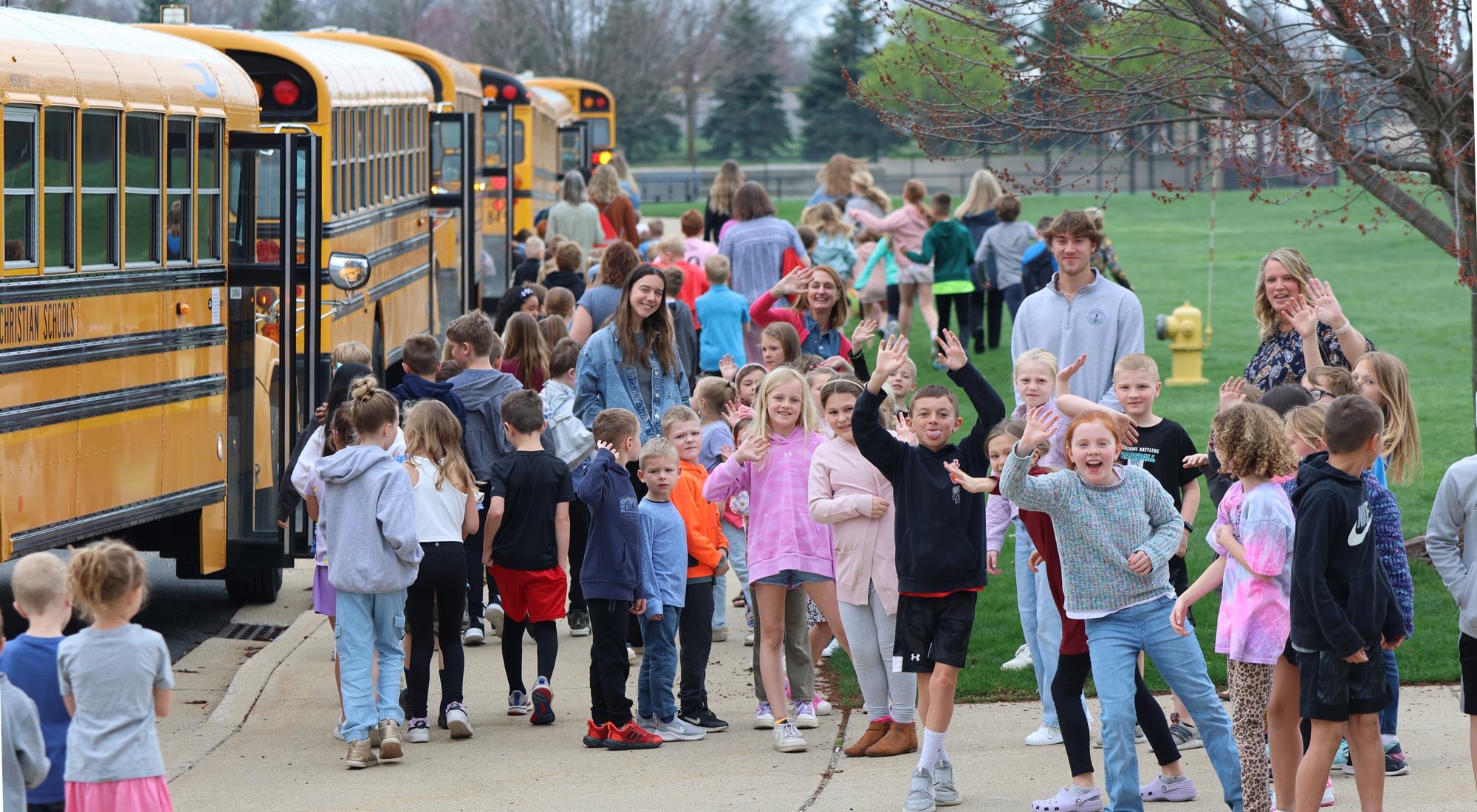
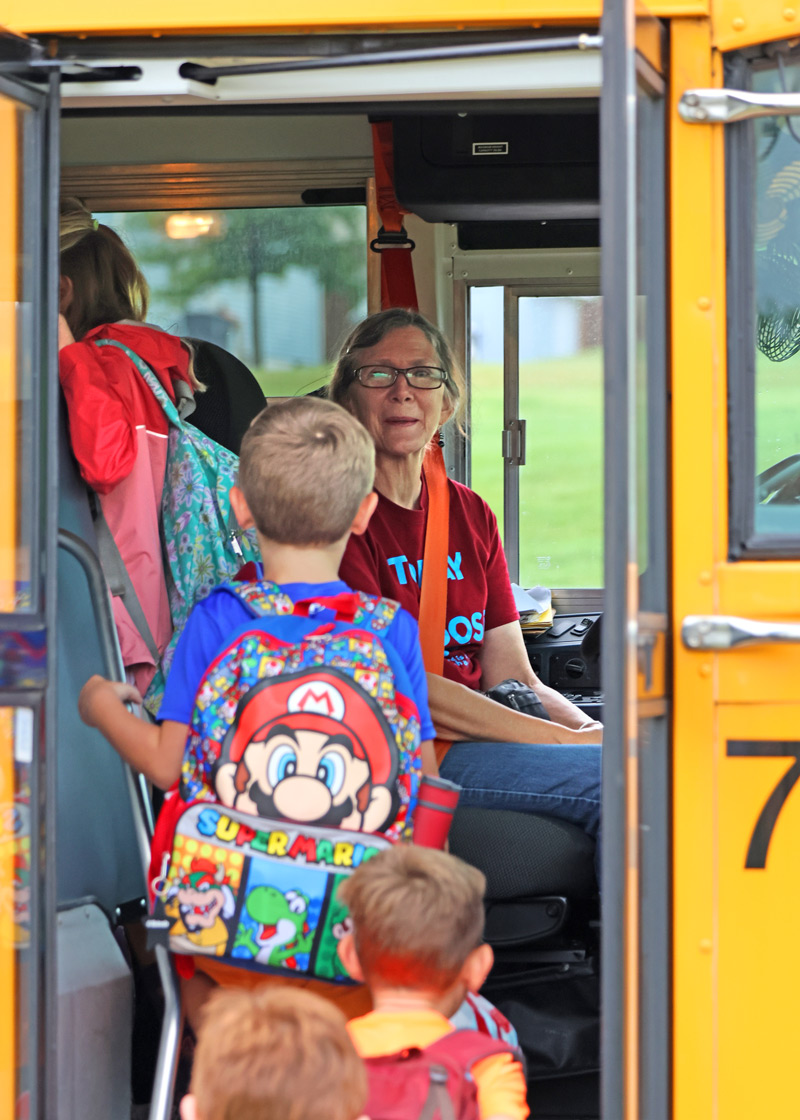
    It’s one of HC Transportation Coordinator Rose Rodriguez’s favorite sights: Eight Holland Christian buses all lined up expertly along the curb of the HCHS stadium. 400 Rose Park pupils and teachers, along with 165 tiny South Side students and their staff pour out of them, parading into the stadium for our all-school Fall Convocation, a time when all six Holland Christian campuses gather to worship and praise the Lord together.

    And this fall’s Convocation day was actually one of the busiest busing days of the year—because on the same day as the eight buses carted kids to and from Convocation, they also brought a busload of Forest School 2nd graders out to their learning space, and drove three regular field trips, four regular bus routes and four shuttle routes, besides eight athletic trips. Thirty-two bus trips in one day!

    Plus the transportation department was down two out of our nine total buses, since they were out for maintenance! In case you can’t tell, busing has changed in this last generation. Yes, we’re still driving regular bus routes to and from school—four regular routes, four regular shuttles between the south side campuses and Rose Park’s north side campus, and serve almost 300 HC families getting to and from school.

    But busing has become a much larger part of the actual school day and learning process, as learning has expanded outside the four walls of a classroom to the great outdoors, and to more on-site learning than ever before. In fact, it’s becoming a growing line item of our yearly budget; HC spent $48,248 just on fuel last school year, not to mention maintenance on our nine buses and six vans, as well as the crucial personnel to drive and organize the buses.

    “One of the greatest barriers any school faces when developing an outdoor education program is, well, getting students offsite and outdoors!” commented Forest School principal Miska Rynsburger ’92. “Our West Michigan community is blessed with so many beautiful natural areas waiting to be enjoyed and studied by children! It is thanks to our dedicated bus drivers and supportive transportation team that we can get our children and teachers into these spaces for learning, playing and worshiping! Our students are able to experience safe and invigorating (and messy) learning experiences thanks to our servant hearted bus drivers and transportation team!”

    “Having a bus and consistent driver has been crucial as we’ve integrated outdoor learning within 6th grade,” added HCMS science teacher Dave Nieuwsma. “Getting almost 120 students off campus at once has its challenges, but getting buses hasn’t ever been a barrier. Kim has been the driver for my weekly Creation Keeping adventures for years now. I’m grateful for her reliability in making these learning opportunities happen!”

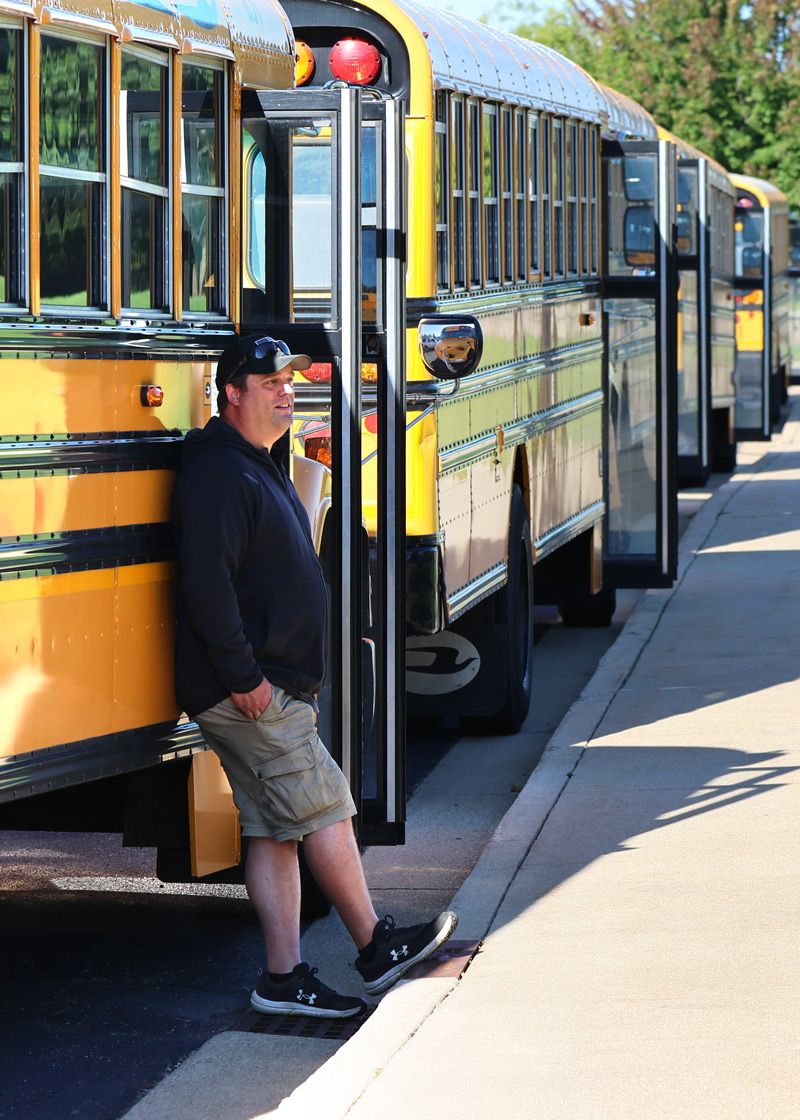
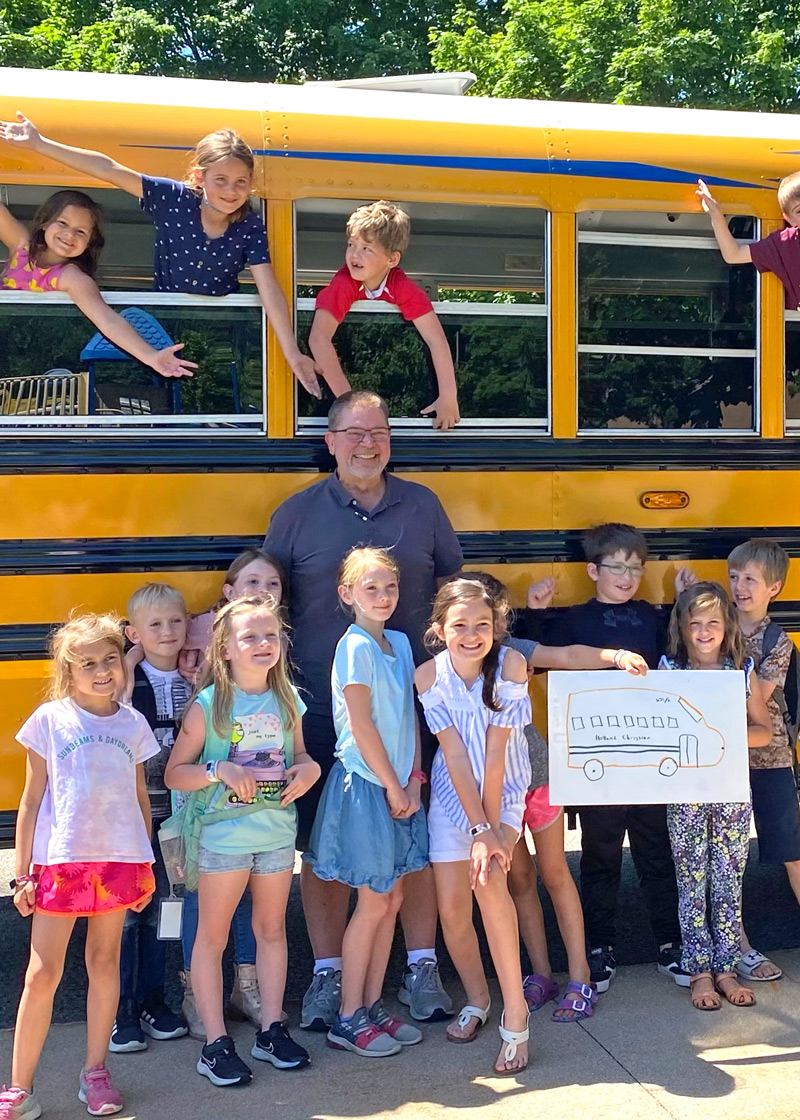
    So along with our terrific Transportation Coordinator Rose Rodriguez, who has been coordinating HC buses for the last four years, and our expert Transportation Director Bill Embil, who has been overseeing and maintaining the bus fleet and drivers for five years, our bus drivers have become ever more crucial in the daily education of our students. They are an additional layer of a caring professional adult who notices and loves and educates HC students. In addition to Rose Rodriguez and Bill Embil, our 18 bus drivers are an invaluable part of the Holland Christian educational team! And we are always looking for more! It’s easy to apply at dev.hollandchristian.org/jobs, and HC covers the costs of training!

    They’re often hidden behind the scenes, so we want to introduce you to a few of our valued bus drivers who make this new way of doing education happen:

    Greg Mulder

    Greg Mulder is a parent of seven HC students (yes, that is currently the most students we have from one family!) and on top of his full time job at Mulder Brothers Brokerage has driven a bus for Holland Christian since December of 2023. Since he already has a full time job, Greg will drive anywhere from zero hours in a week to a max of 14—which he did one week when we desperately needed him to cover a route.

    1. What made you decide to be an HC bus driver initially? 

    Being part of the HC community I could see the need for drivers and I already had my CDL for driving semi trucks. I knew I could pretty easily get my school bus endorsement, so I took the steps to take the test. My basic mindset with driving is to sign up when there are large groups needing to be moved…Tulip Time, Eastertide, etc. I also try to cover the routes when the route drivers are off. The routes are the most difficult to cover.

    2. What do you like about driving a bus for HC? What are some perks of the job?

    I have 7 kids that go to HC, so I am going to be around for a while. It also gives me the opportunity sometimes to drive them to events that I might not already attend. For example the choir festival in Hastings for Middle School. I wouldn’t have taken the day off of work to drive out there, but I saw a need for a driver and signed up. I was able to fill the need and watch my daughter at the same time. It has also been great getting to know more students and teachers through driving buses.

    3. What is the hardest part of bus driving?

    Balancing a full time job with trying to also be available to help out.

    Mike Rotman is in his 5th year driving buses for HC. Mike worked much of his professional career at Trendway, and retired from Central Wesleyan a few years ago. Mike is HC’s regular shuttle driver bringing the northside students every morning from Rose Park to HCHS and HCMS; after dropping those students off at their buildings, he picks up a group of south side Spanish Immersion students from the HCHS parking lot, and drives them to Rose Park. It’s a big loop he drives every morning, and then does the same thing backwards at the end of the day, along with a shuttling Zeeland area high school students back to ZCS, and a few field trips in between as needed.

    1. What made you decide to be an HC bus driver initially? 

    I was retired and enjoying life, when my granddaughter said “Hey, Grandpa, do you want to be my shuttle driver?!” And it just kinda went from there! I didn’t really have a clue what she actually meant until after I talked to Dan Vos, the head of transportation at the time—[and learned] that it involved driving a bus and getting my CDL and all that!

    2. What do you like about driving a bus for HC? What are some perks of the job?

    I’ve invested a lot of myself into these kids, and have gotten to know them from kindergarten through 5th grade, and they know me as “Mr. Mike.” Hopefully I’ve been a blessing to them, but they certainly have been a blessing to me! I just enjoy getting to talk with the kids, and they talk to me.

    During the summer, the favorite part of my summer is when I see them on the street or in stores, and they are just as excited to see me as I am to see them! That’s the best part of my summer!

    3. What is the hardest part of bus driving? 

    The hardest part is when the 5th graders go into Middle School, because quite often I don’t see them anymore. Same thing with the High School. Sometimes they come up to me and say “This is my last day on the bus,” and I say, “Oh! You got your license!” But they promise to come see me, and they always stop in and say hi to me. That’s the hardest part: I get to know them and develop a relationship with them from the youngest to high school and then I don’t see them again—I miss that aspect.

    I love driving for HC, I’m committed to HC, and I’m committed to the kids. I guess my granddaughter did me a favor when she asked me to drive the shuttle—but I would never tell her that! I also do field trips for Forest School four out of five days of the week. Getting to know those kids and those teachers as well has been a fun job!

    Mike Rotman

    Kim Walters

    Kim Walters ’78 has driven HC buses the longest of all our drivers, since she began driving an afternoon bus route in the fall of 1996, making this fall year number 29! As a driver of both a daily route and field trips, Kim averages 30 hours a week during the school year. She has seven grandchildren who attend Holland Christian, all as 5th generation students, and her favorite Bible verse is Nehemiah 8:10, “The Joy of the Lord is my strength.”

    1. What made you decide to be an HC bus driver initially?

    The current driver of the local HC bus route wanted to retire, so she picked me as a possible replacement. My husband said, “No way,” but I thought about it and decided to take up the challenge!

    2. What do you like about driving a bus for HC? What are some perks of the job?

    I am a strong believer in the importance of Christian education. I feel like I am helping promote Christian education in my community and helping Holland Christian out by serving in this way. My perks would be the joy I experience taking my grandchildren, not only to/from school everyday, but also taking them on field trips.

    For some of us, it is not easy to get up in the morning before 6am to drive a bus route, but the perk would be to become a witness of the most awesome sunrises on a regular basis! The song that fills my heart when I see those sunrises is, “When morning guilds the sky, my heart awaking cries, may Jesus Christ be praised!!” It’s an old hymn that pops up in my heart—some of those songs will stick with me forever!

    3. What is the hardest part of bus driving? 

    The hardest part of my job would be the occasional lack of visibility due to a blinding snow storm or heavy fog. But I am very appreciative of the support I feel from my boss, Mr. Bill, and from the parents who have entrusted me to direct and encourage their children while in my care.

    Have Questions?

    We look forward to meeting you and your family and introducing you to the fresh, creative, personalized education at Holland Christian! We are here to help! Get in touch using the contact form linked below or call us at 616.820.2805.

    Get in Touch!
  • “Edventures” in Middle School Education

    “Edventures” in Middle School Education

    Project-based and experiential learning is being infused into Holland Christian Middle School.

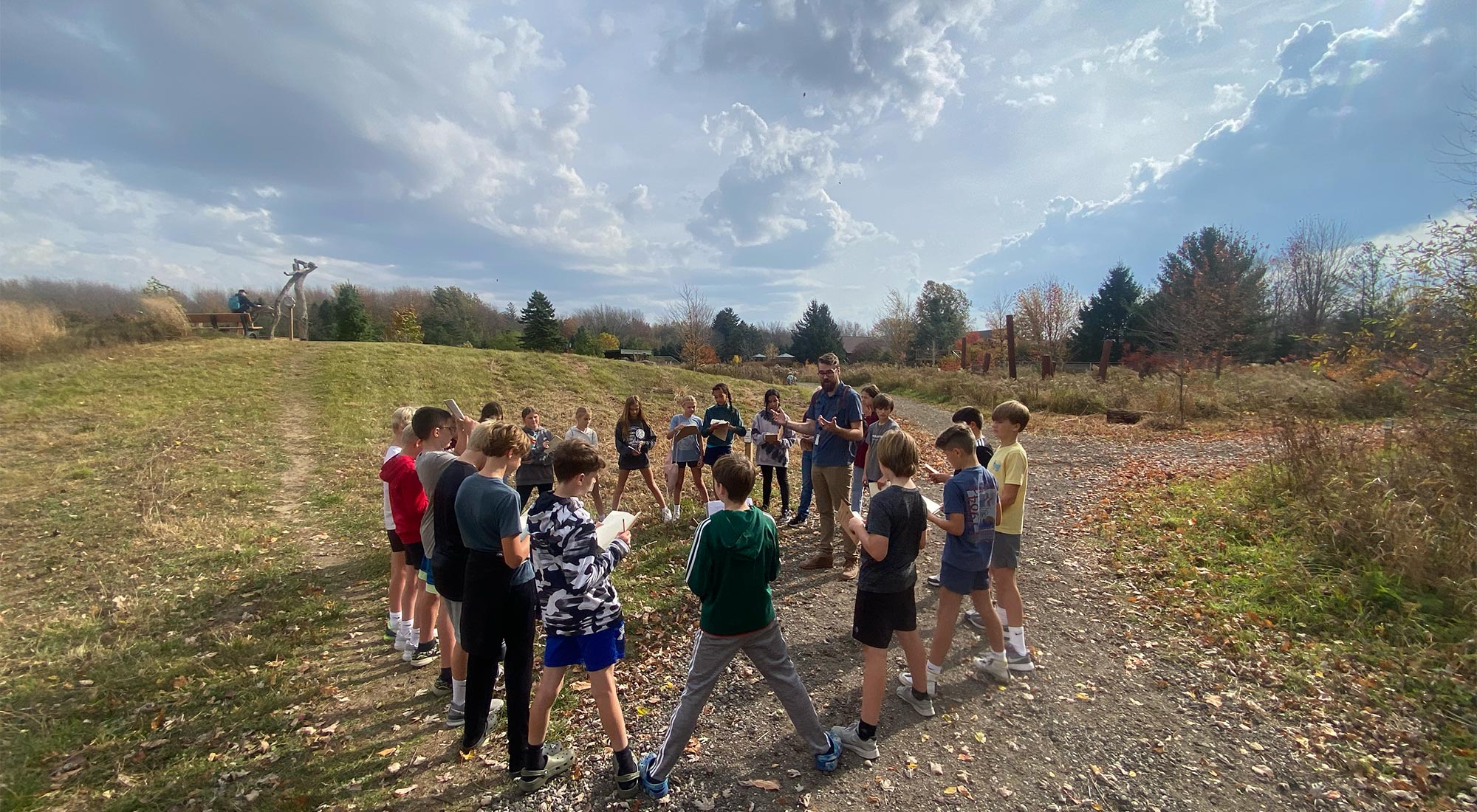
    In contrast to HC’s Spanish Immersion program, Forest School does not extend into Holland Christian Middle School as a distinct program. That is purposeful, and based on research and experience with middle school kids: “What we’re doing is better than having a separate program at this age level,” said Andrew Kleyn, HC’s Director of Learning. “We’re taking what’s best about learning and education in general and infusing it into every grade and subject. And HC is working to include it for all students.”

    Basically HCMS teachers are borrowing the best of “Forest Schoolesque” style of experiential, hands-on, authentic and off-site learning to slowly and intentionally infiltrate middle school learning in general. Not completely, and nothing is set in stone, but more project-based and experiential field-study learning can be found seeping into a class here, a unit there. “The world beyond school isn’t separated into class hours and subjects and this gives kids an opportunity to see that,” Andrew explained.

    It’s been a steadily growing emphasis in the Middle School for a couple of years now, sparked in part by sixth grade science teacher Dave Nieuwsma’s interdisciplinary 9-week course called “Creation Keeping.” In Creation Keeping students “learn a little bit about everything, but the main goal is much more experiential—how do we live out what we’re learning, under the umbrella of creation keeping as a discipleship practice that we say is important,” Dave explained. “It’s super fun—it’s awesome!”

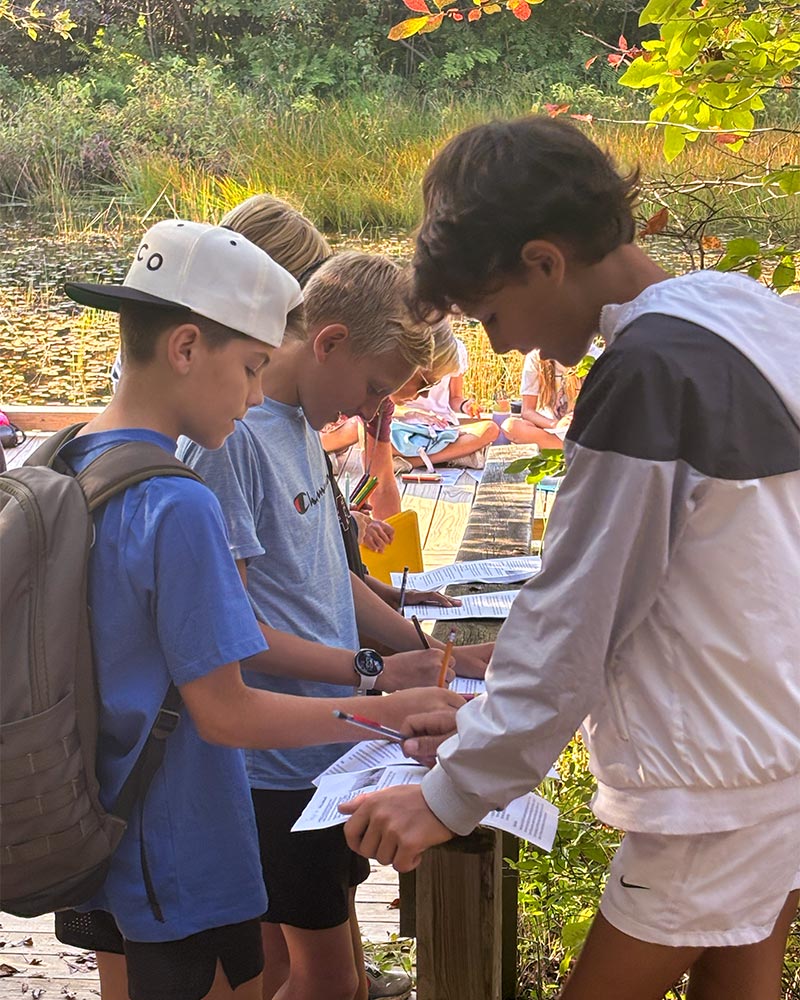
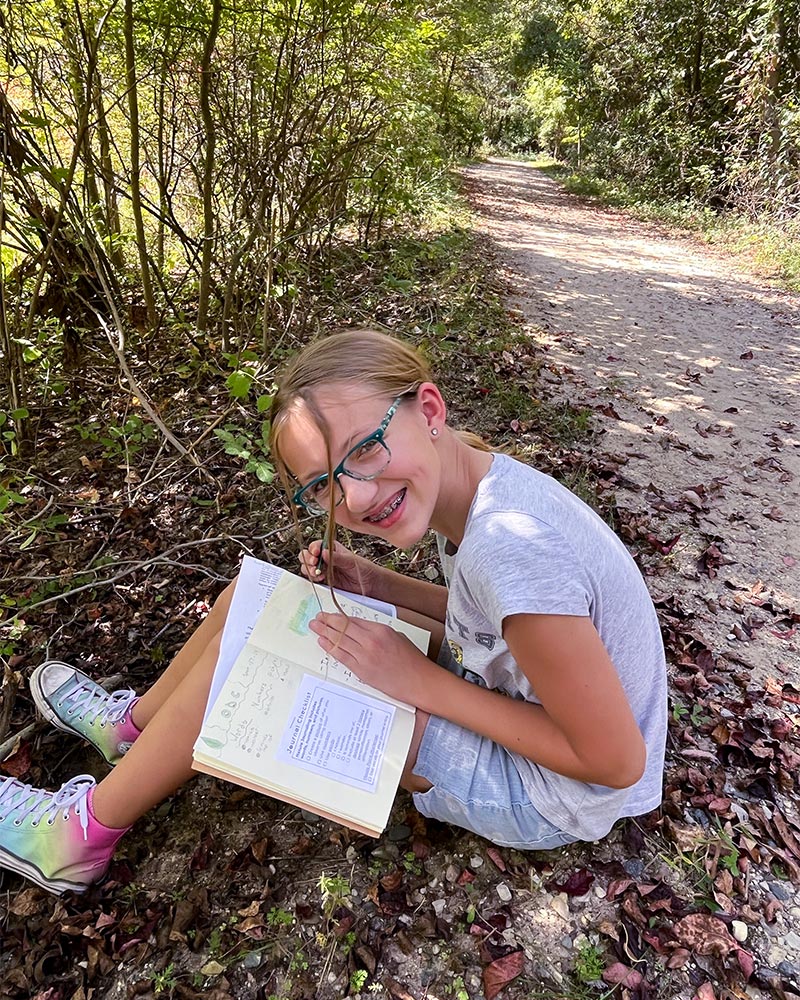
    In the Creation Keeping class, sixth graders learn how they can be more appreciative and observant of this earth, how can they help take care of God’s world from a Christian perspective. They have been taking weekly expeditions to the ODC, Saugatuck Dunes, Eighth Day Farm, or even their own Middle School pond to journal, help, observe, collect data, research, pray. They learn how to compost, build bird nesting boxes, build shelters, tie knots, but also observe, help others, sit still in wonder.

    “That’s hard for kids! It’s giving kids more exposure to how what they learn connects to outside of school,” Dave said. “You learned how to make an angle in math—can you do that on a nest box, put it up, and then see a bird there at the end of the year?”

    Similar learning is happening in core subjects: Katie Boer ’06 enhanced sixth grade math by adding several life-relevant projects like “Ratio Restaurant,” where kids cook a meal based on accurate ratios and fractions, and “Geometrocity” where kids apply shapes and angles to build a miniature city together. Meredith Beukelman ’09 has added multiple excursions and dune studies to seventh grade science, where students gather real life data and compare with past students’ dune and lakeshore findings. Michelle Styf ’99 and her eighth grade science students studied invasive species, then actually ripped them out around the HCMS pond, and presented their findings to the parent community. Lisa Lundy takes her eighth grade English students outside for journaling, reading, and research conversations. Sixth grade English teacher Jamie Dannenberg ’01 and Nieuwsma plan monthly interdisciplinary sixth grade “edventures” at places like Camp Beechwood, VanRaalte Farm, and the Outdoor Discovery Center (ODC).

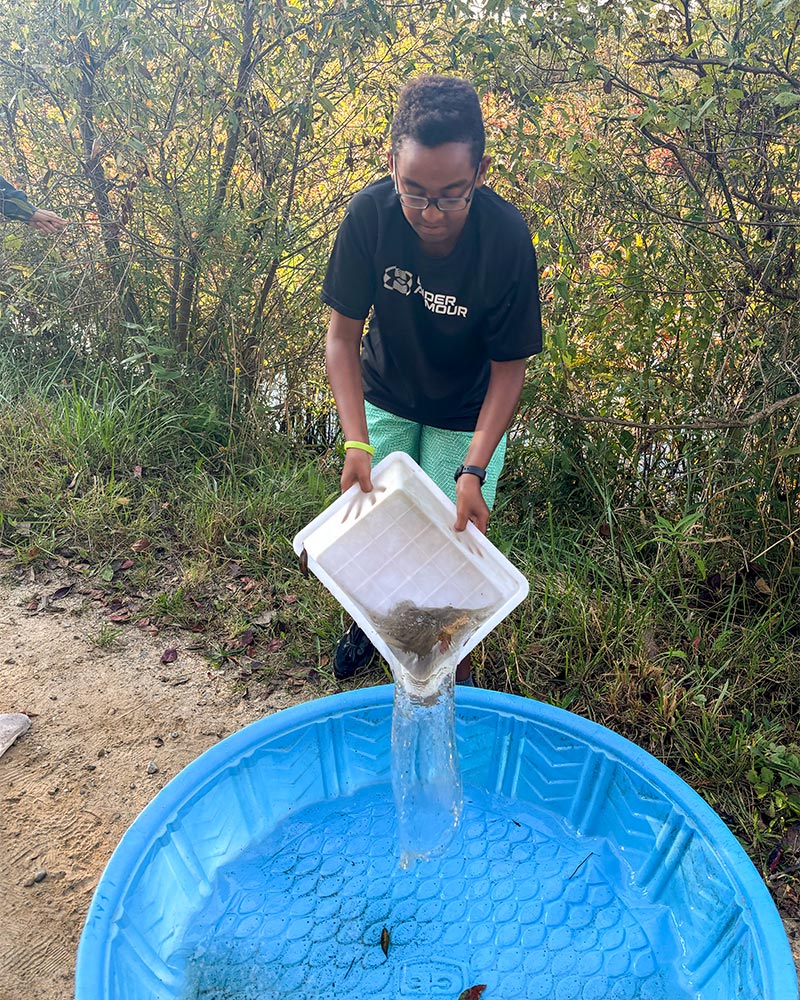
    One of these interdisciplinary excursions was at the ODC in September, where sixth grade science students researched the water’s health, studying macroinvertebrates, then applied their research back in the classroom, sorting through what water health means for them personally and their daily water use. For English, the same sixth grade students practiced reading and decoding informational text, as well as nature journaling—learning that can better fit the attention span of a 12-year-old student outside than inside all day on a block day, the teachers found. Besides, taking vocab quizzes and reading outside in hammocks involve more learning than you may think: Just imagine 40-some sixth graders problem solving how and where to hang hammocks, how to tie them up, how to get them down, how to read comfortably and sustainably in them—a whole learning aspect that doesn’t typically happen inside walled classrooms!

    “There’s a component of all of this that is mental health and emotional health—whole child wellness. There’s a factor of getting outside and doing stuff that is engaging,” Dave explained, describing how much calmer and composed students are on the bus ride back after these “edventures” than on the way out.

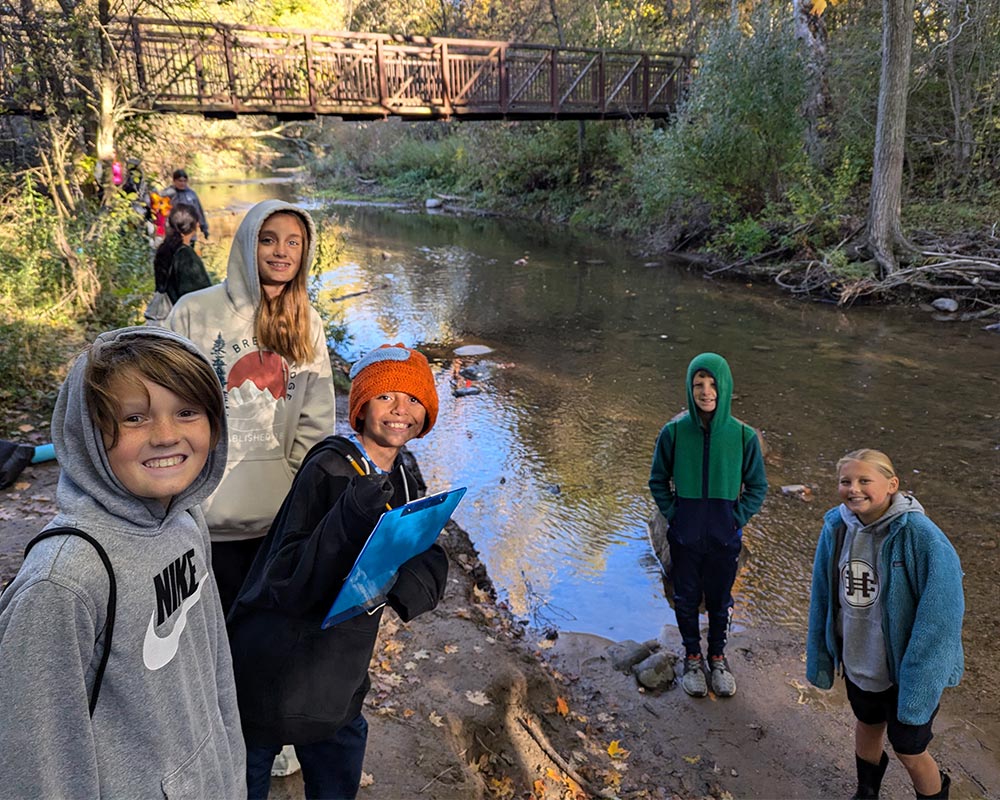
    At VanRaalte Farm, sixth graders assessed stream habitat as part of their water unit—just using real geologist tools and in an authentic setting. “Let’s do real science the real way, not just ‘dumb it down’ for kids,” Dave said. “It also gives exposure to a career connection—if you like this, you can do this for your job. They’re learning collaboration and had to work as a team. They’re practicing non-fiction reading—how do I read non-fiction text to gain understanding?”

    Not only does authentic outdoor learning offer “a meaningful chance to reflect on the beauty and wonder of God’s handiwork…allowing them to engage their senses in a more natural, hands-on environment,” HCMS principal Tom Strikwerda commented, but “both experiential and outdoor learning spark curiosity and excitement as students interact with creation and see relevance in their learning, leading to greater engagement.”

    Ted Malefyt, Education Network Manager at the ODC and former middle school teacher himself, agrees that this version of education is better for middle school kids: “Middle school students need to have these relevant connections to knowledge and skills included in education, and we have this easiest through the outdoors, where it’s readily available,” he said. “And it should not be something that is only for some kids, but for all kids. From a Christian faith, we have these discipleship practices, but it doesn’t mean just Creation Keeping—our responsibility is to infiltrate all of students’ other learning as well, living these core values out outside of just Bible class.”

    Plus “middle school kids are still kids, and need opportunities to play, explore,” Ted added. “That should all be a part of their growing up and becoming the adults that we are wanting them to be.”

    Believe it or not, teaching outside and intentionally experientially does not make teachers’ jobs easier: It’s not just letting kids play outside, but includes hosts of additional details to plan things like busing, make chaperone and weather arrangements, intentionally arrange off-site learning to match with state standards and school discipleship practices, prep kids for authentic research tasks, teach them how to learn outdoors and in public, be able to adapt and adjust on the fly. Teachers are “on” continually and in ways much more difficult than staying inside their four-walled classrooms.

    “Our incredible middle school staff has done an outstanding job of bringing learning to life by incorporating experiential and outdoor learning into their lessons,” Tom added. “Their creativity and dedication to making learning meaningful and engaging for students is truly commendable!”

    “HC is blessed with some really amazing teachers willing to do it, who are willing to do the hard work,” Ted reiterated.

    Have Questions?

    We look forward to meeting you and your family and introducing you to the fresh, creative, personalized education at Holland Christian! We are here to help! Get in touch using the contact form linked below or call us at 616.820.2805.

    Get in Touch!
  • Going Phoneless📱➡📴

    Going Phoneless
    📱➡📴

    What do you think–could you go without your phone every week day, from the start of school at 8am until the last bell at 2:45pm?”

    Research has shown a significant increase in the learning of students who do not have access to their phones during the school day. Based on this research HCHS decided to go phoneless last school year, resulting in a surprisingly positive reception.

    “We LOVE no phones in the school. Our kids would say they see a difference in the way that kids interact with each other in between classes and at lunch,” ​​commented Jamie Langejans, parent of two current HCHS students and one 2024 graduate. “One of my concerns for this next generation is their lack of interpersonal skills due to the escape of pulling out a cell phone. Whatever we can do to combat that is going to give our kids an advantage in the workplace, but more importantly in their communities. To be able to notice others…. not just withdraw into our own devices. Way to go HC on this one!” 

    Overall HCHS teachers appreciated the new rule of no cell phones during the HCHS school day as well, even though they end up the rule’s main enforcers, removing over 272 student phones last school year: “I really enjoyed when kids would enter a room, they would talk to each other and to me instead of retreating into their phones,” HCHS band and orchestra teacher Scott VandenBerg noted. “It led to many interesting conversations and chances to get to know kids and for them to know each other.”

    Looking back to a year ago, when HCHS first implemented its rule of no cell phones during the school day, it seemed a whole lot more controversial than it actually was, or is now. Especially since so many schools, school districts, even whole states, are going the same route—banning cell phones in schools throughout the school day. 

    Two states, Florida and Indiana, have already banned cell phones outright in classrooms. Ohio requires school districts to create cell phone policies minimizing student cell phone use, while other states are currently investigating cell phone bans based on school state funding. Just last month, the nation’s second largest and most diverse school district, Los Angeles Unified, with 429,000 students, became the largest district to adopt a full-fledged ban on phones during the school day. 

    Locally, Unity Christian High School plans to implement Yondr Monitors this school year for all students’ phones—a locking device that students lock their phones into immediately after walking into the school building in the morning, carry around with them all day, and then unlock when they leave at the end of the school day. Other area high schools such as The Potter’s House, Coopersville, Zeeland, and Grand Haven have all banned student cell phones during school hours to varying degrees, while Spring Lake High School is currently debating a ban.

    It’s kind of nice being ahead of the curve on this trend.

    HCHS principal Miles Colago explained that the no phones in school conversation actually started with Deb Feenstra, before Miles came to HC in the 22-23 school year. Miles simply continued the conversation started by Deb and the staff, adding his own research on the growing topic, including stats like how much bullying decreased in Spain and France when students didn’t have phones. How academic performances went up. Researchers even noted the differences in student learning when the phones were left on students’ desks vs. in their backpacks vs. out of the classroom entirely. Guess which option students learned best with?

    Research on schools without phones in students’ hands throughout the day finds students interacting more with each other, building community better, and in general, learning better, Miles added. 

    One of his number one reasons for banning phones in high school, however? 

    “To bring back childhood,” Miles said, explaining that the reasons behind no phones in the high school are “pretty similar to what Miska [Rynsburger] said about why Forest School. This is part of childhood learning—how to pick up on social cues, and learn how to respond to verbal messages on the fly. I’ve noticed over the last few years the effect [cell phones] have on students—technology is not neutral.”

    And Miles can rattle off all the research, including Jonathan Haidt’s extensive research and recent book, The Anxious Generation, on how social media and cellphones can lead to greater anxiety in teens.

    “Once you put something into writing, it’s out there,” Miles said, explaining how he wanted to take the social anxiety off of students at school at least, so they can focus on learning instead. With social media, “kids are thinking how is this one person going to perceive me, and even how are 1000 people who are going to perceive what I’m about to say—which creates a ton of anxiety.”

    Miles adds that the typical argument against the no cell phones in school hours rule is that teens need to learn to handle cell phones at some point, so why not learn to manage them earlier rather than later?

    “It’s an addiction!” Miles said, adding “With that analogy, we should let kids have alcohol or heroin. Developmentally their impulse control is miniscule. Nicotine is less addictive—the effects of social media are way worse than smoking was when it was popular in high school!”

    You might think that most students wouldn’t be huge fans of the rule, but you’d be surprised.

    “I liked it, honestly,” said Kelsey Dokter ’24, who as a member of the student council helped approve the rule when Miles proposed it to the student council. “I had a lot more in person conversations, people were just there. In the past, people were just glued to their phones. I saw a big benefit this year.”

    “I have mixed opinions about it,” Lydia Rodriguez ’24 said. “Obviously it’s not good to be on social media and phones constantly, and limiting that has been very beneficial for me.

    “But on the flipside, we’re supposed to have more independence—especially during our junior and senior years—but without the ability to call work or call my mom, that independence is limited. As a freshman it would have been really easy for me, but as a senior [with a job] it was really hard.”

    However students aren’t always looking at the research and long term stats. Through social media “Children are being told the world is a very dangerous place, and are encouraged to be inside and play video games,” Miles added. “Young boys aren’t breaking bones as much as in previous generations, since they’re not outside roughhousing. Instead male depression and suicide numbers are increasing.

    “If you take the phones out of their hands for seven hours a day, that’s at least seven hours when they don’t have to worry about that pressure,” Miles said.

    “I loved it!,” Spanish teacher Jane (Geerlings) VanderBeek ’90 commented about the rule. “I loved that I saw significantly more face-to-face student-student and student-teacher conversations between classes because people were interacting with each other instead of on their phones. It helped, too, that for the most part the staff was consistent in keeping kids accountable for the new expectations. All in all, definitely two thumbs up from me!”

    “I absolutely feel like kids were more engaged with what was happening in the room and with each other in person in the classroom as a result of not having the phone to worry about all the time,” added business teacher Duane Baker. “I think kids were more engaged with each other outside of the classroom as well. Having a blanket rule made enforcing it very simple and took away the confrontation that always seemed to be potentially be there with phones in past years. 100% the right choice for education and for kids’ mental health and relationships!”

    Have Questions?

    We look forward to meeting you and your family and introducing you to the fresh, creative, personalized education at Holland Christian! We are here to help! Get in touch using the contact form linked below or call us at 616.820.2805.

    Get in Touch!
  • Seek First ⋅ Buscar Primero

    Seek First ⋅ Buscar Primero

    In the very center of the Sermon on the Mount, Jesus’ most famous message, he says: “seek first [God’s] kingdom and righteousness.” In many ways these words are the core of the sermon, a summary of what it means to participate in God’s mission. But what exact is The Kingdom of God, and how does a person “seek” it?

    This year we’re intentionally asking this question in connection with our school’s mission. Practically, Seeking God’s kingdom looks like:

    • Taking stock of our current concerns, pursuits, investments. What am I running after right now?
    • Exploring the Scriptures to better know God’s heart. What do You care about, God?
    • Prioritizing God’s will and way in every situation, decision and relationship. By doing this we will experience the community and purpose he has in store for us. What are you up to in this world, God? In my own life? In my community? How can I join You?

    These questions apply whether you’re a student, a parent, a teacher, or a grandparent. They’re relevant for chemists, artists, engineers, mathematicians, biblical scholars, actors, and athletes. These questions apply whether you know exactly what you want to do with your life or if you haven’t got the foggiest idea.

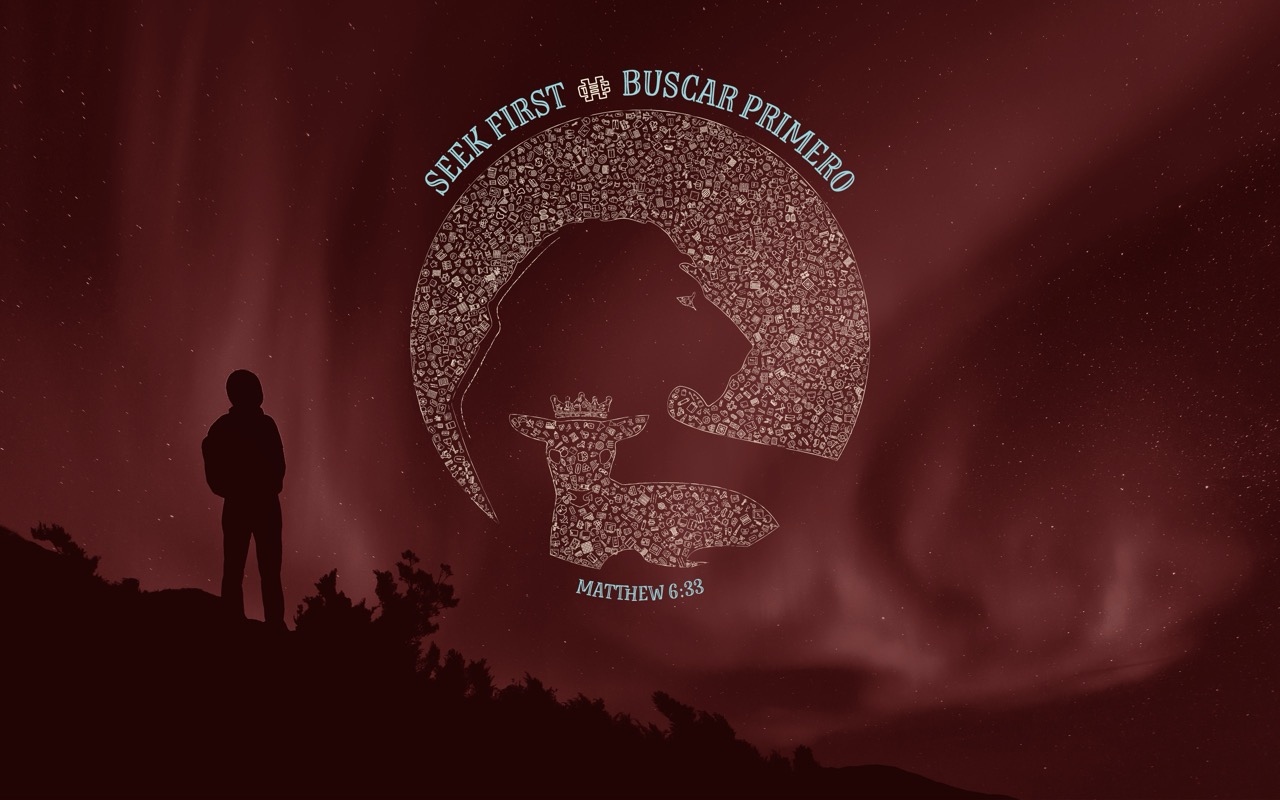
    Seeking God’s Kingdom first doesn’t simply mean prioritizing religious activities in our lives (though these things are important!), but about aligning our hearts to His in everything that we do. Seeking God’s Kingdom is the process through which Christ’s heart enters Christ’s Body (AKA the Church) in a way that overshadows all other allegiances, transforming our love, identity, and mission. These ideas can be seen represented in the theme logo like this:

    Everyday objects

    These images—a pencil, a basketball, an airplane, a pie, etc.—are meant to prompt the question, “What does my “normal,” day-to-day life have to do with God’s story? Henry Zylstra wrote that “nothing matters but the Kingdom of Jesus Christ, but because of the kingdom, everything else matters.” Seeking first means inviting God’s reign and rule into every aspect, every element, every corner of our lives.

    Lamb/Lion

    Halfway through Mark’s gospel, after eight chapters of speculation, Peter declares that Jesus is in fact the king they had been waiting for (Mark 16:13-20). From this point on, the pressing question becomes, “Okay, but how will Jesus king?” How will he take the throne? What kind of Messiah will he be? Will he rule like a lion and challenge Israel’s enemies with the power of the sword?

    Contrary to the common expectations of his followers, Jesus insists that he will become king not by taking power, but by submitting to a cross.In the final book of the Bible, the Apostle John sees a vision of God’s throne. An Elder says to him, “Look, the Lion has triumphed!” But when John looks, he instead sees “a lamb, looking as if it had been slain” (Rev. 5:6).

    The Lion who won is actually a Lamb who lost! This mystery informs the kind of Upside Down Kingdom we’ll discover (and be called into!) as we seek it with all our hearts, intentionally this school year, but also through all our lives.

  • Volunteers: Our Hidden Support System

    Volunteers: Our Hidden Support System

    There is a serious problem with this article…

    In order to fit every single HC volunteer and everything they do into one article, we would need 100 pages, or at least all 32 of this magazine. But we didn’t realize the extent of this problem until we were well into the planning, interviewing, and investigating phase, discovering the sheer number—and high quality—of volunteers who keep Holland Christian alive and well.

    Unfortunately we didn’t plan for 100 pages, or even all 32 pages. So we are left with a paltry bit of space to do justice to so many who give so much to Holland Christian on a daily basis.

    But we also met amazing people and heard wonderful tales about Holland Christian volunteers so it’s worth at least sharing the tip of the iceberg. We have volunteers in almost every aspect of our school—from finances (thank you ditto), to leadership (thank you Board of Trustees), to landscaping (thanks, John Wood), classroom assistants, libraries, athletics, extracurriculars, parent organizations, and high school winter dances. And we were struck not just with the fact that all these people are at Holland Christian regularly giving their time and talents for HC students and staff, but especially with the sheer quality of their giving and talents. People with degrees and experience who could so easily take their time elsewhere to earn both money and greater recognition. But instead donate it to us. We are so amazed—and so grateful!

    There are several programs and opportunities that would be either nonexistent or lower quality without our volunteers. Take our elementary libraries, for example:

    We have almost 20 regular volunteers in the three HC elementary libraries, all keeping the elementary libraries afloat since our one elementary librarian, Mary Hofman, hasn’t figured out yet how to be in three places at once.

    “There are some retired teachers who have been lifesavers,” Mary said. “I can hardly pick one person, but one who is currently saving my sanity and has probably been involved the longest is Mary Harkema ’69, former Pine Ridge 5th grade teacher, who practically runs the South Side library as an unpaid volunteer, and who prepares new books for circulation for all the elementary libraries.”

    There’s also Arlene Dannenberg, who retired from banking, and who has reshelved books in the library at Rose Park for “YEARS!” according to Mary. “This is a big job and Arlene does it faithfully, accurately, and cheerfully.”

    Arlene started working in the Rose Park library when her grandkids were at Rose Park, and she simply kept going and going, reshelving several cartloads of books every Thursday, sometimes into Friday morning, even after her grandkids moved on to HCMS and HCHS.

    “I’m not going to sit home and get old!” Arlene said. “I just tell people to volunteer, find your niche, everybody needs help—and when you don’t need money, you can do it for free! And I didn’t even know books or anything. I’ve just learned so much—the kids are so helpful!”

    Pat Befus, a former teacher and school librarian in Costa Rica and Texas, doesn’t even have any grandkids or previous connections with HC. When she and her husband retired in Holland a few years ago after a lifetime of missions all over South America and in America, she was looking for someplace to plug in.

    “I prayed!” she said. “During my quiet time, this school came up. It’s a mile from my house, and I offered to help with reading because I taught reading before, but my librarian background was what they needed the most.”

    Katie Dryer does help with reading on a volunteer basis at South Side, where her youngest started this year. Their family moved to Holland from Illinois last summer because they wanted to be closer to West Michigan family, but in her previous life before kids and Holland, Katie was an elementary teacher and a reading specialist.

    “I love nothing more than teaching kids how to read—it is my passion in life!” Katie said, adding that not only did she want to see what South Side was like from the inside and be a part of her son’s world there, but also that it was a good way to meet people—the staff at South Side as well as parents. Two mornings a week Katie pulls small groups of mostly second graders to practice reading skills and help them “move up that [reading] mountain. I do the lessons, and I love it!”

    There are other regular volunteers in Holland Christian’s elementary schools, people under the radar, but who fill important niches: Nancy Mulder plays piano at South Side for praise and worship, for chapels and special events. Yvonne Bengelink has volunteered in the junior kindergarten classroom for years working on reading and math skills in small groups with students. Jamie Lanser ’85 reads with students in the library regularly. Sandy Stielstra packs reading level books for South Side first graders twice a week so they can practice reading at home, and then reads it one more time with students back at school. “Students are always excited to get to read their book to Mrs. Stielstra to show off their reading,” South Side principal Christy Haig commented. “It is fun for them to have someone other than their teacher or parent to read to!”

    “And there are so many more that randomly help for lunch breaks, field trips, and all kinds of random things,” added Katie VanFaasen, secretary at Rose Park. “It’s truly a blessing and enables the teachers to do some amazing things!”

    Last fall fifth grade Forest School teacher Chris DeZwaan ’88 needed an extra set of hands to go off site for a water testing outing, and asked at family Sunday dinner if anyone wanted to help. Her dad, Lean Koops ’63 jumped on it: “I think he liked the idea of it being outside, and he just really loves kids, and he likes to do those kinds of service things at Holland Christian. I just love that about him,” Chris said, adding that her dad has also built bookcases for Pine Ridge, and frequently helps out wherever needed at HC. Her students find it especially delightful to see their teacher interacting with her dad: “I tell them that the only person who trumps the teacher [in the classroom] is the teacher’s dad—they get a kick out of that!”

    Then there are all the parents who are on parent boards at each HC campus, groups who meet regularly to plan and organize the Walkathon fundraiser, organize meals at parent-teacher conferences, encourage and support staff with Christmas gifts, classroom supplies, and treats. Even plan school events and outings like Forest School’s night hikes, and Rose Park’s Family Nights.

    “The core of Parent Board is supporting the teachers, and showing them how much we appreciate them,” said Peggy Gorno, who has been on parent boards at South Side, Pine Ridge, HCMS, and is now helping to start one at the high school. “In the younger years it was doing the Walkathon, filling the principal’s needs, celebrating the kids and making sure they have fun activities. In the middle school it was more about leadership and meeting new families, and at the high school we’re focusing on the staff—it’s really about bringing joy. In some small way letting them know how much we appreciate them, honoring what they give.”

    “They’re with our kids more than we are sometimes!” Peggy added. “They have such an impact on their lives, so it’s one small way I can give back!”

    Kerri deVries ’96 joined the HCMS Parent Board when her youngest was in middle school, once she had more time. “What I love about the parent team is you don’t have to do every single thing yourself—you just pick up when the time works in your life,” Kerri said. She also is working to bring the parent board into the high school on a more official basis, cleaning the teachers’ lounge, bringing in snacks more regularly. “The teachers need to be doted on—they’re doting on our kids, so it’s important they get some appreciation!”

    Kerri also helps with the senior graduation party, a committed group of parents that plan, collect prizes, and chaperone the all-night senior party the night after graduation. “That’s just fun,” Kerri said. “The goal of senior night is to keep kids off the road graduation night, and celebrate the kids after 13 years!”

    Basically no high school shows, concerts, trips or programs happen with the high quality they do without the undergirding of (mostly parent) volunteers. Take TAP, or Theatre Arts Parents, for example—a group of nine, frequently doubled by spouses, who promote theatre arts at HCHS. But like most of the HC volunteers when we ask why they even volunteer, they comment how much they are blessed by the experience:

    “I decided to originally join the TAP board as our family was new to Holland Christian HS and theater so I thought it would be a great way to get to know other parents,” commented Ashley Hernandez, now VP of TAP. “It has been wonderful to connect with other theater parents who I now call friends, but more importantly, I have gotten to know all of the theater kids better by being at the performances, and bringing in meals and snacks for rehearsals and practices. We have been able to pray for all of the directors, actors, and crew every week during show seasons.”

    If there would be no HCHS theatre without TAP, there also would be no band or orchestra concerts without Janet Jenosky, the volunteer band and orchestra assistant extraordinaire. We could honestly write this whole article on all that she does—without getting paid, and without any complaints—mostly. And she can tell you a beautiful story of how God led her daughter and her unexpectedly to Holland Christian over 10 years ago.

    “I really love working at HC, and I worked too hard to get [Scott VandenBerg] organized to walk away and let someone else mess it up!” she laughed. “And I don’t want to get paid—then I can’t tell them what I don’t want to do!”

    Janet starts coming in July to file and find music out of the over 2500 pieces HCHS owns, make copies, and organize music folders for all 139 HCHS band and orchestra students. She sorts their various uniforms, answers emails, plans and organizes the Disney trip every other year including who needs what meds, who is rooming with whom, and who is on which bus. Fortunately, Janet is a spreadsheet queen—you should see the colored tabs on the bottom of her screen—a good use of her finance degree, she laughs.

    “I’m thrilled I have a spot, and am very grateful the Lord has given me gifts and grateful to use them!” she said. “I’m doing this unto the Lord—He gave me this place, I love what I do here, I love watching kids do what they do, watch them grow up!”

    “Janet Jenosky has a servant’s heart,” added HCHS band and orchestra director Scott VandenBerg. “She loves to see others flourish and grow and for 10 years now she has been giving of her time so that HCHS band, orchestra, and choir students can do just that. The music department is thriving here at HCS and Janet has played a key role in this.”

    Similarly, Holland Christian could not run our largest fundraisers without volunteers—the moms on the TGF Auction committee who meet regularly throughout the year to plan and organize the Tuition Grant Fund Auction, invite guests to their tables, then work the long busy evening as well. The volunteers who organize huge piles of paraphernalia at the Kids’ Stuff Resale, or the professionals who give the last Wednesday morning of October—almost always in torrents of rain—to visit local businesses asking for donations to our Business & Industry drive.

    Using SS Services’ equipment, five Holland Christian grandparents, Dale Scholten ’68, Leon Koops ’63, Glenn Brink ’68, Keith Hulst ’68, and Dave Smits mow the HCHS, HCMS, and Pine Ridge lawns on a volunteer basis every Tuesday for a combined weekly 10-12 hours.

    “We all are retired, know how to run the equipment, and have a passion for the school,” Dale said. “The flexibility makes it doable, and it’s a generational passion and support,” he said, adding that the five retired men sent their 16 children and now many of their grandchildren to Holland Christian.

    HCHS athletics would not be what they are without so many dedicated volunteers—from ticket takers to even coaches. Sally Swets, who first worked for years as a professional tennis coach in Grand Rapids and Florida, then with the US Tennis Association, started volunteering back in 2008 as an assistant tennis coach at HCHS when her nieces were on the high school tennis team, and her own kids were in elementary school. Her nieces didn’t have anyone to hit with, she said, so she would hit with them an hour before practice.

    But that was 16-17 years ago. And since then, Chuck Brower joined her when his son played on the boys tennis team, and now both assist both boys and girls teams.

    “”The beauty of it is that the kids are what bring you back,” Sally said. “I’m blessed to have great relationships with all the players—boys and girls. They keep asking me to come back—this is my wheelhouse that God gave me!”

    Like Janet, Sally also relishes being a volunteer rather than a paid coach: “The head coaches do all the detail work—it’s a blessing to go down on the court and just be with the kids!” she said. “I’m not the nice coach—go ahead and fire me!” she laughs.

    And then the line we’ve heard from so many HC volunteers: “Both Chuck and I would say that we don’t need to be recognized—we do it because it’s just a joy!” Sally said.

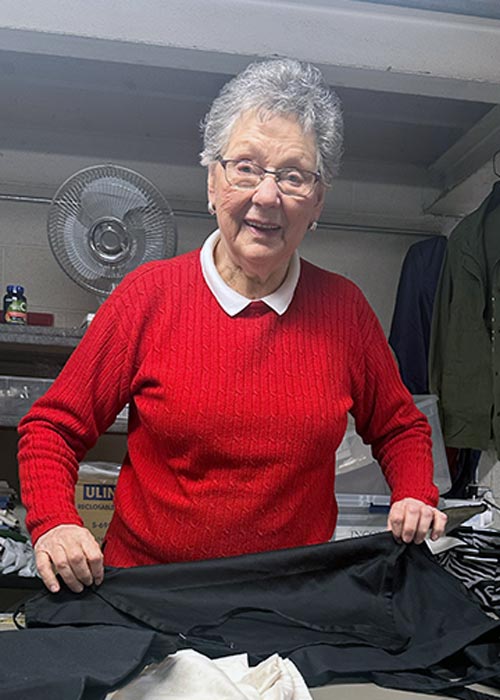
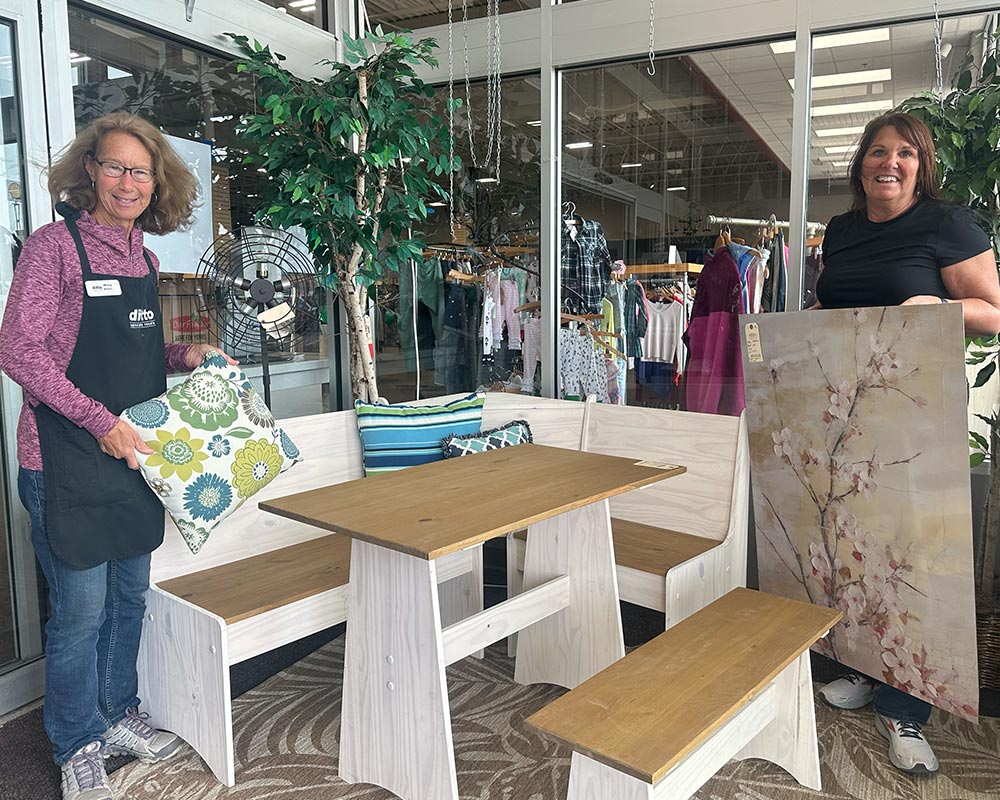
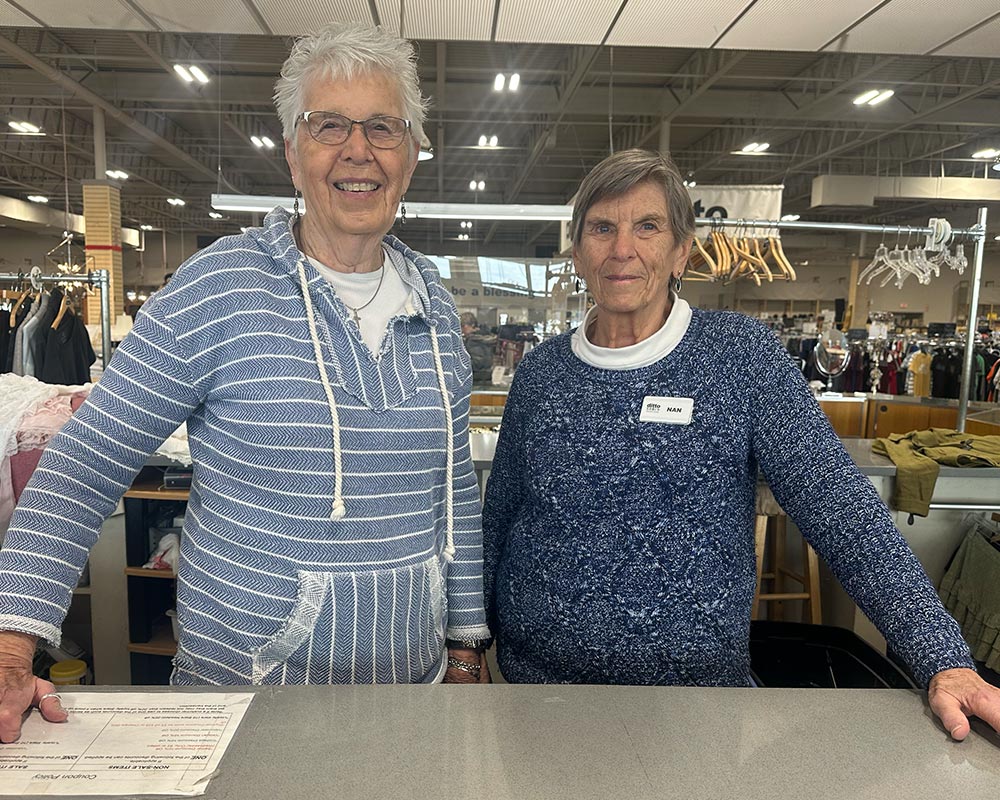
    Another program that couldn’t exist without volunteers, ditto, the nonprofit resale shop that helps make Christian education more affordable at both HC and Zeeland Christian School, lists over 120 volunteers. Cora Dykema ’45 is one of those, ever since 2004 when she started volunteering when her husband, Henry, was hired as the first ditto director. “They got two for the price of one!” Cora laughed, “I went along with him to do everything a pastor’s wife is supposed to do.”

    Her husband quit a number of years ago due to Alzheimers, but Cora keeps coming back, even though she is 86, “Because ditto is more like family!” she said. “The first half an hour we just have therapy around these [breakroom] tables!”

    But also because “Christian education is very important,” she added. “My kids didn’t have Christian education except through me,” Cora explains since the family were missionaries in Guam for 12 years, and her oldest was 16 when they came back to the States.

    Cora used to work up front at ditto at the cash registers, but now “I like it better in the back,” she said. “We let our hair down—we have more fun in the back if we want to goof off!”

    Jan Jonker ’66 and her husband, Jim ’67, both volunteer at ditto regularly—but not together. “I just feel ditto is an excellent way to give to the schools,” Jan said. “Plus it provides a wonderful service to the community that goes beyond just selling them stuff. The relationships you form with customers, with people! They strike up conversations, share needs, ask you to pray for them!”

    Where do we even begin to thank all these volunteers? And there are so many more that go unnamed here, but are known and loved in their own niches throughout our various campuses. This whole article feels a little like a Hebrews 11 list of God’s faithful—ways that God’s people show up and give, “unto the Lord” by giving to all of us at Holland Christian, improving our learning, making our work more effective. Words don’t seem enough, but we are supremely grateful to them all—for their time, their talents, their joy and energy, their example to not just our students, but to us as staff and teachers as well: Thank you for being the hands and feet of Christ in our community!

  • The (Holy) Art of Teaching Art

    The (Holy) Art of Teaching Art

    “It’s the very first thing you learn about God back in Genesis—that He is a creator, an artist who finds His creation, His artistry, and handiwork good, even “very good.”

    So it would follow that a Christian school would also highly value art classes and teaching the visual arts, if we are learning to live and walk in His image? To imitate all that He is?

    “Art is…an important part of our faith because it serves as a protest to modern pragmatism, which is an alluring trait of the cultural pool that we swim in today,” adds HCHS principal Miles Colago. “Art is and has been essential to Christian life for the last two millennia because it speaks to the image-bearer’s experience no matter the circumstance, serving as a testament of not what is, but what ought to be in light of the Kingdom of God.”

    We are grateful here at Holland Christian for the amazing visual art teachers we get to work with—five people particularly blessed with God’s ability to create, and to coax that godly imitation out of a classroom full of kindergartners, or teenagers—and every age between.

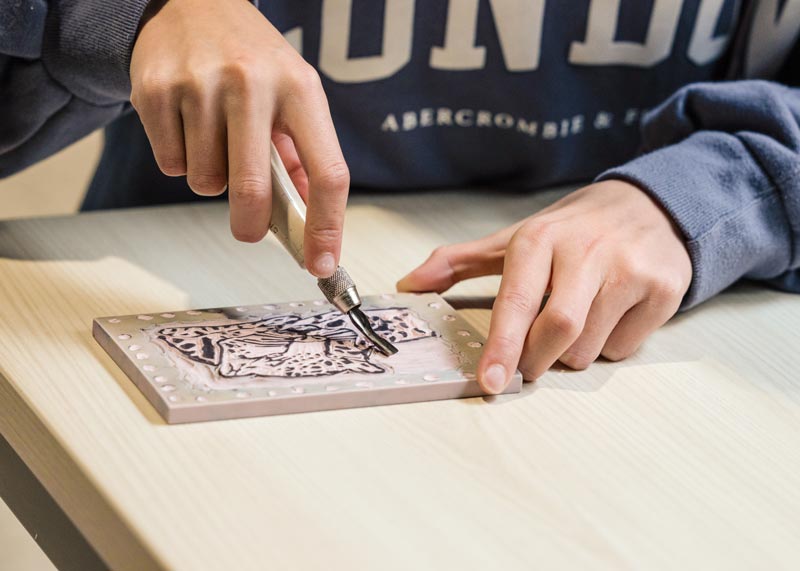
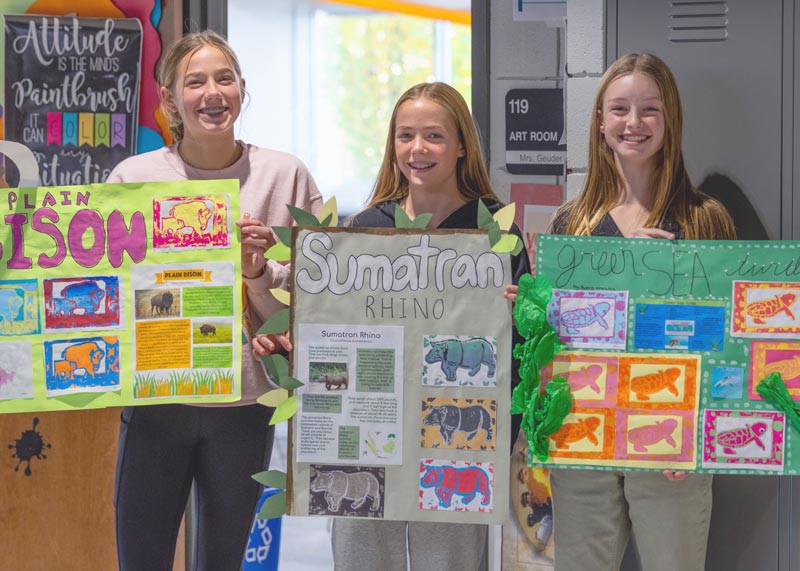
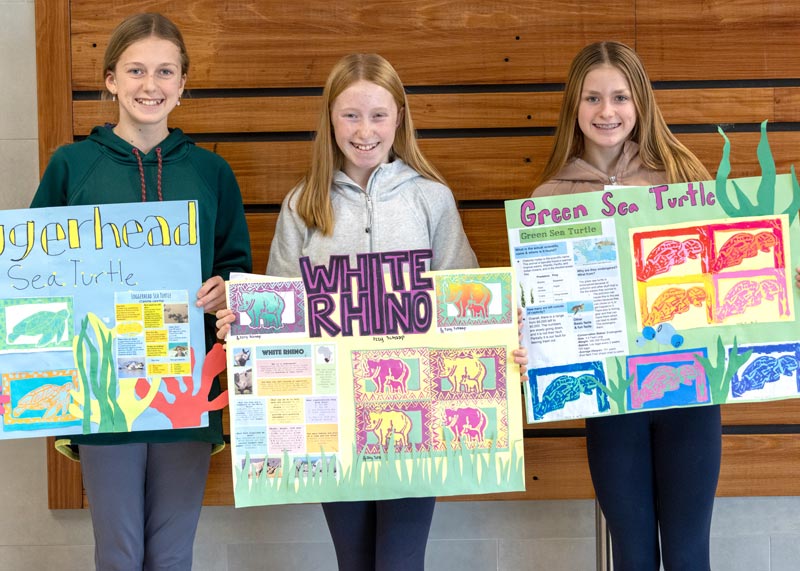
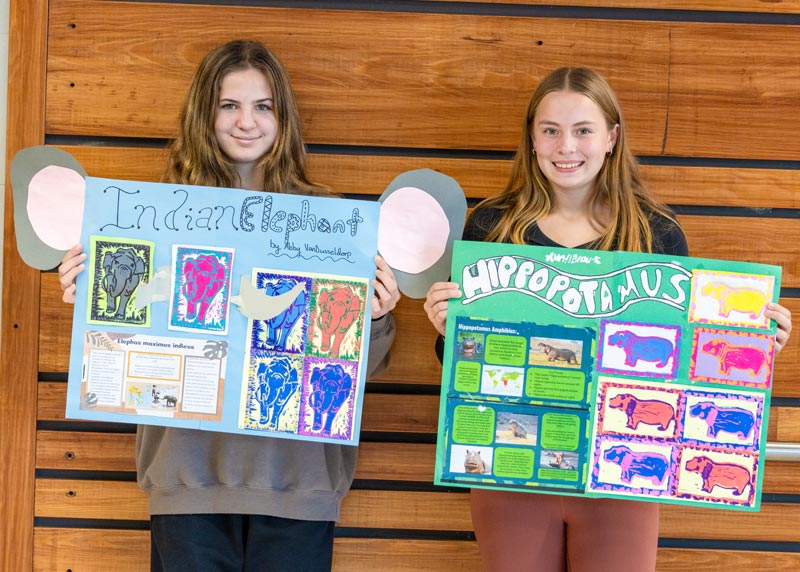
    Jenny Geuder smiling at the cameraHCMS art teacher Jenny Gueder enjoys teaching all middle school students, but particularly relishes the 8th grade printmaking project, where students research an endangered species, carve out a stamp of the animal, and then play with colors in stamping the animal image—think Andy Warhol style.

    “Printmaking in 8th grade is one of those few projects I do that has them look outside themselves. They get to make lots of personal choices and it checks off all the boxes of fun, right? Because it’s bright colors, it’s messy, colorful,” Jenny explained. “They get to carve a stamp, which is a subtractive method, which is really fun and different than normal. But more than that the project is about caring and bringing awareness to this endangered species. You learn about the history of printmaking—we look at art from Japan,  printmaking there…some of the early printmakers here in America, pop art from Andy Warhol.”

    Students learn about a particular project by Andy Warhol when he was asked to partner with the World Wildlife Foundation on an endangered species project, and the sales from those posters went toward conservation. “It was this really cool intersection of art and conservation and care,” Jenny said. “Some [students] have never even heard of these species—some of them are shocked—and I think that’s a powerful part of this project…God made our system like a web and it’s so perfectly put together that if something is removed, what is our responsibility in a broken world? So that is what this project is about—nudging that needle toward awareness. In the end, what is the role of Christian artist, and how can one teenager make any difference? It’s just a beautiful project—it’s fun!”

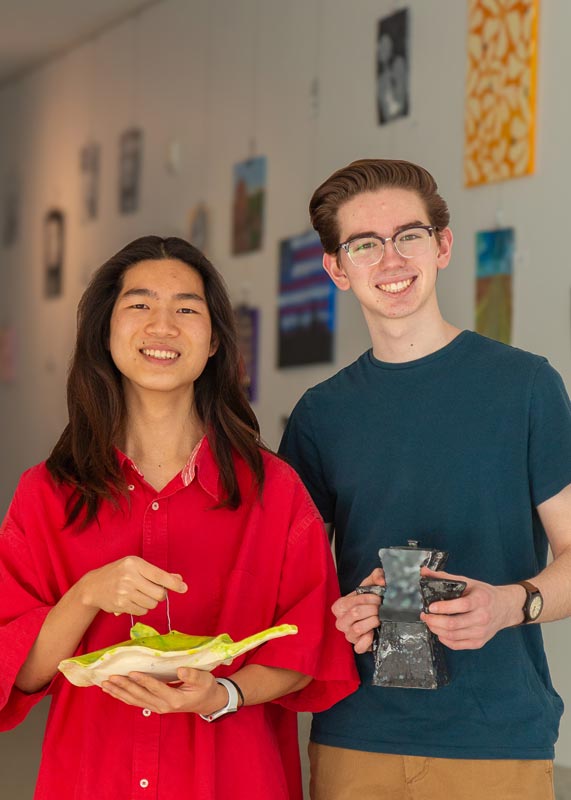
    Heidi Camp smiling at the cameraOne of HCHS art teacher Heidi Camp‘s favorite lessons to teach in high school art is the creation of ceramic teapots. “The technical functions were quite simple: the teapot had to use slab construction, incorporate texture in some way. It needed to have a handle, lid, and spout without using all right angles,” she said. But “their artistic challenge was a bit more complex: How can you invite the viewer to see the form of the teapot in a new way? What do you do with these requirements to create a vessel form that moves beyond our typical sense of teapot?  How is negative space an integral part of your piece?” And they were also asked to think about hospitality with this teapot: “What makes a space inviting and warm? A vessel holds things.  What are you filling your life with? What are you feeling called to hold? What is the Spirit asking you to fill in your life? What is God asking you to hold onto and then offer to others?”

    The variety of teapot student creations are truly amazing, especially Eden McGee ’24‘s and James Appledorn ’24‘s, where you see the intense design and thought process that go into them: “I originally drew my design with the intent of a sort of ‘tree’ theme,” Eden shared. “I knew that I wanted birds somewhere on it and chose the White Breasted NutHatch to build the colors off of. In my choice of main glaze I ended up with a deeper blue than I thought it would turn out to be, but it gave it more of a bold look in the end.”

    Camp points out that she really is teaching problem solving through art. “What do you do when you don’t like something, when it doesn’t turn out? How do you fix that?” as well as “grit. I’m really trying to teach grit to these students,” she said, pointing out how that can be displayed in students with an attention to detail—like James VanAppledorn in his willingness to sand his teapot again and again—and again: “He used a bowl to mold the clay he rolled into a slab. He then meticulously smoothed and sanded the artwork both prior to it being fired and afterward,” Camp said. “His careful craftsmanship is evidenced in shape, glazing, sturdiness (evidence of score & slip), and aesthetic design.”

    Eliot Slenk smiling at cameraElliot Slenk ’04 has taught graphic design at HCHS for 13 years, and one of his favorite assignments to teach is the “Walk for Warmth” poster competition that his students enter every year, and have won seven times: “The project itself is good because it is for an authentic audience and students get the chance to use what they have learned in class to help bring attention to a population in need,” Elliott shared.

    His students agree: “The project that had the most meaning behind it this year was the Walk for Warmth Poster,” Gavin VanderZwaag ’24 wrote. “It was very cool knowing that my work that I was doing was for a good cause. It was a great feeling knowing that I was making a project that could help raise money for people who cannot afford to pay their utility bills. This relates directly towards God’s calling as a Christians because we are called to bless others and spread God’s love through the world. This drove me to do the best work that I could do,” he finished.

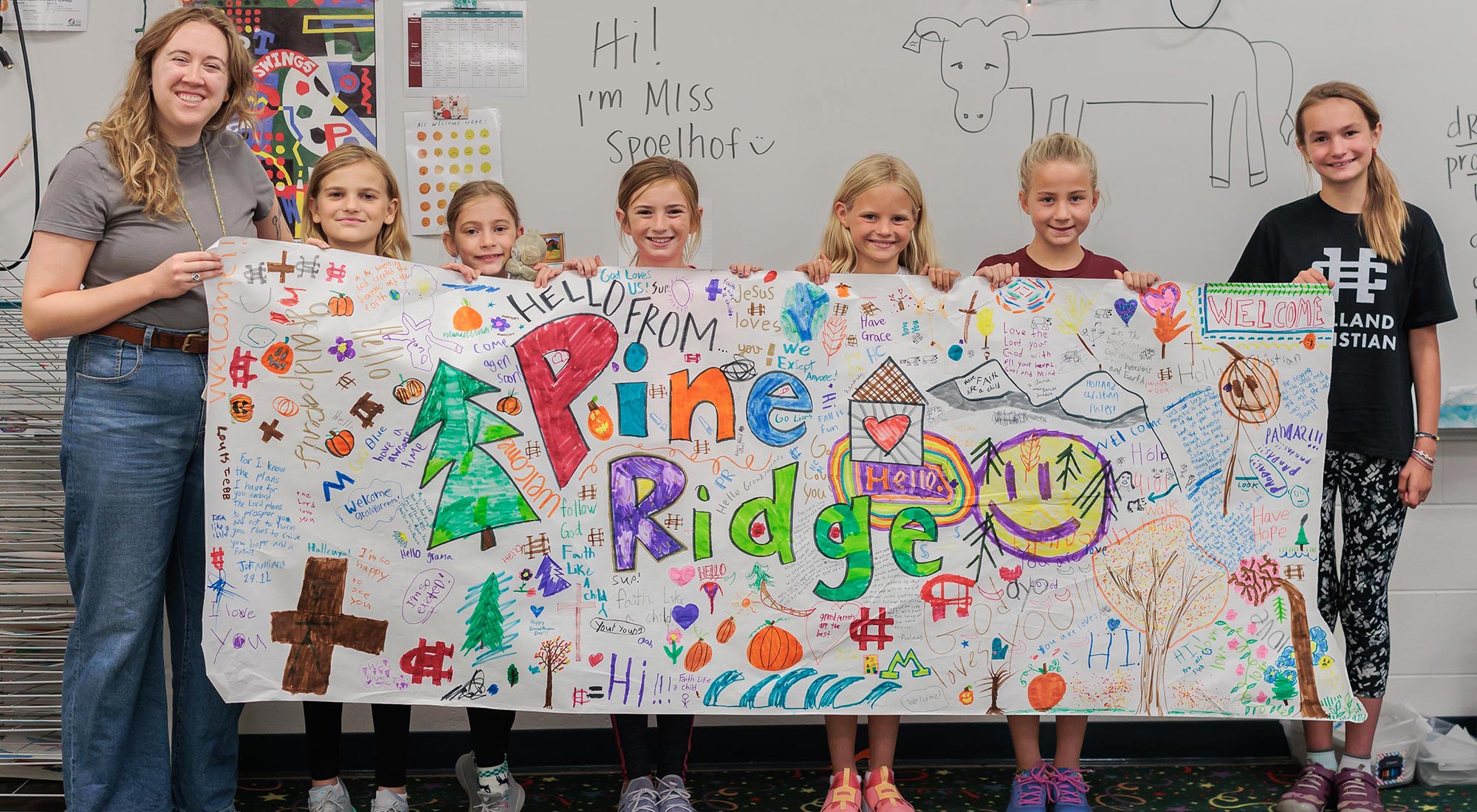
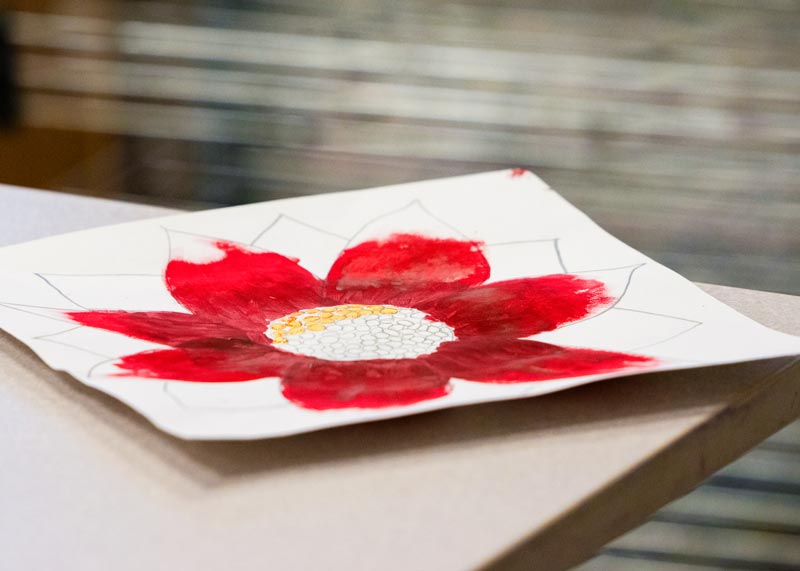
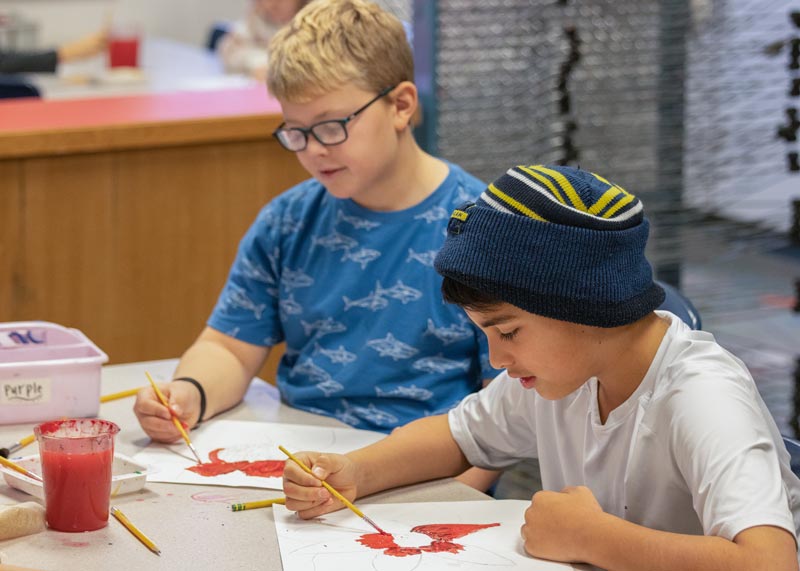
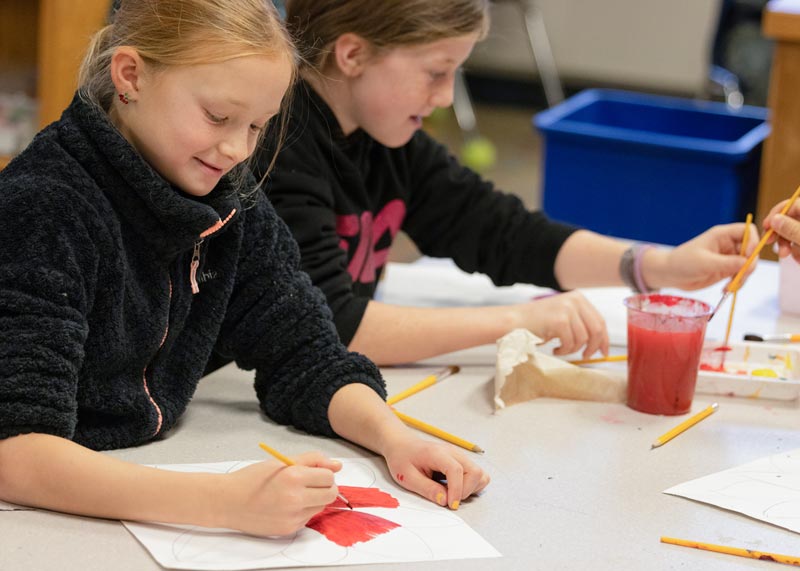
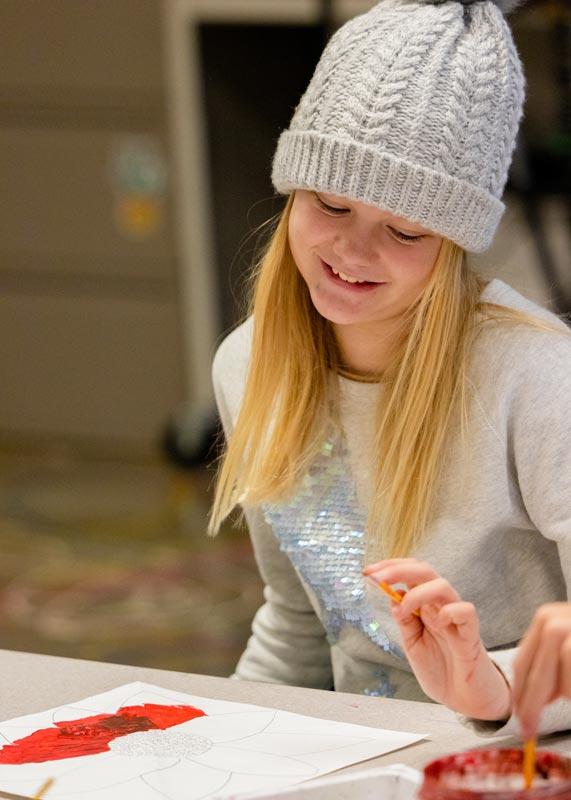
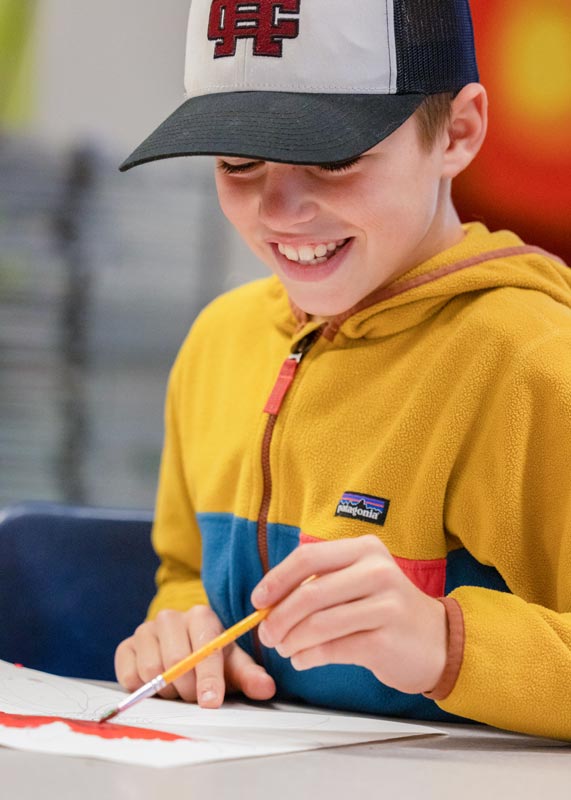
    Alison Spoelhof smiling at cameraAllison Spoelhof, in her second year of teaching elementary art at Pine Ridge, South Side, and Forest School, teaches not only one of the largest age differences as an HC art teacher—from 5-12 year olds, but also moves between campuses! One of her favorite art assignments to teach is painting poinsettias at the beginning of December, when 4th grade students learn about Georgia O’Keefe and her nature closeups, like her Red Poppy VI, 1928 that students’ artwork is patterned after, but also the history of the poinsettia, its use and its poignant symbolism at Christmas—how this native Mexican bush came to be sold in American grocery stores at Christmas time.Through the poinsettia assignment, fifth graders learn to paint with a variety of paintbrushes for more varied strokes, how to mix colors and then shade with varied color combinations from the center of the red leaves to the outer edges.

    “I’m more of a process gal than product, personally,” Allison said, explaining how she emphasizes that students learn and grow by investing in the process, rather than end with a perfect looking poinsettia. “And we learn about good blending—and talk about how that’s a good life skill—blending in the right direction!”

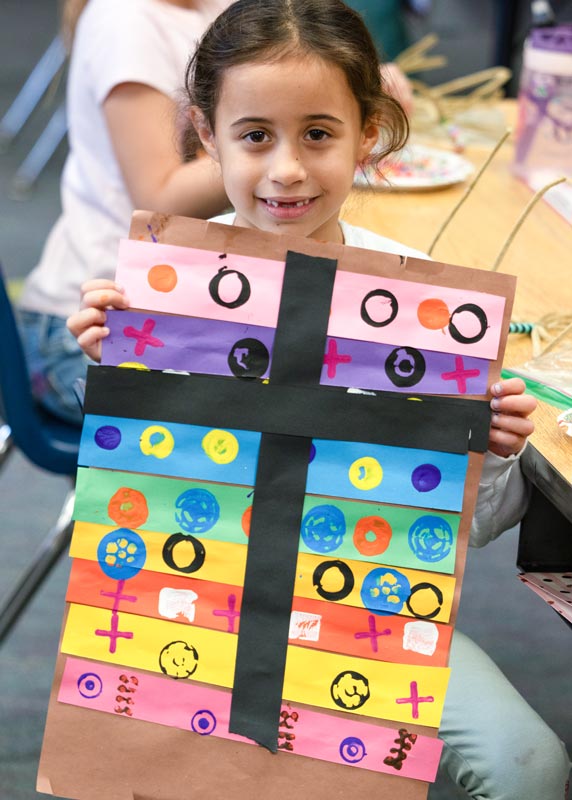
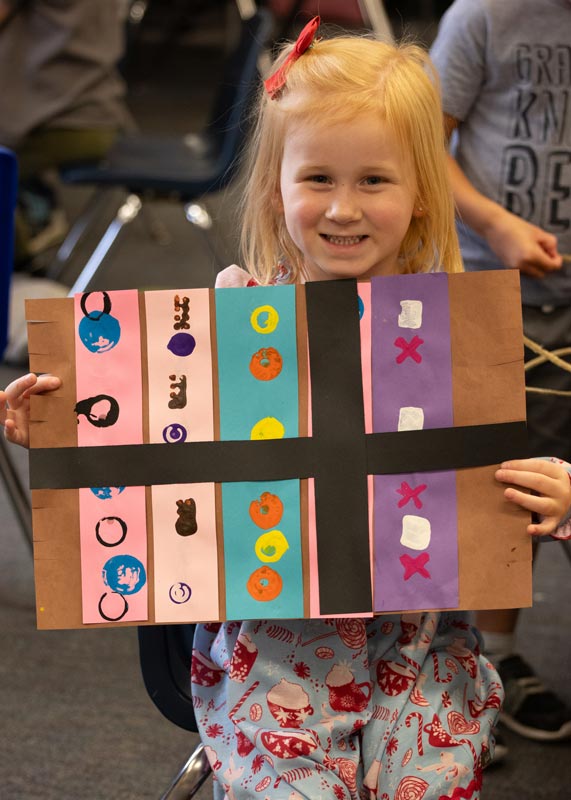
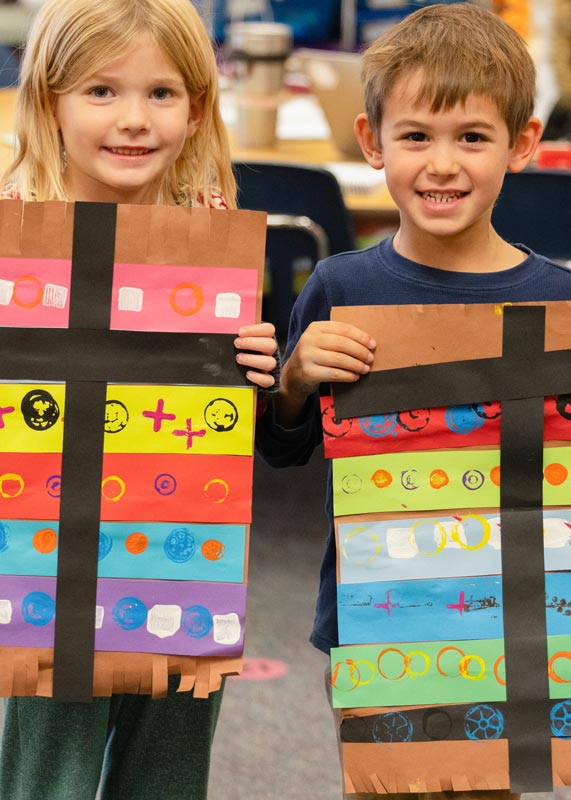
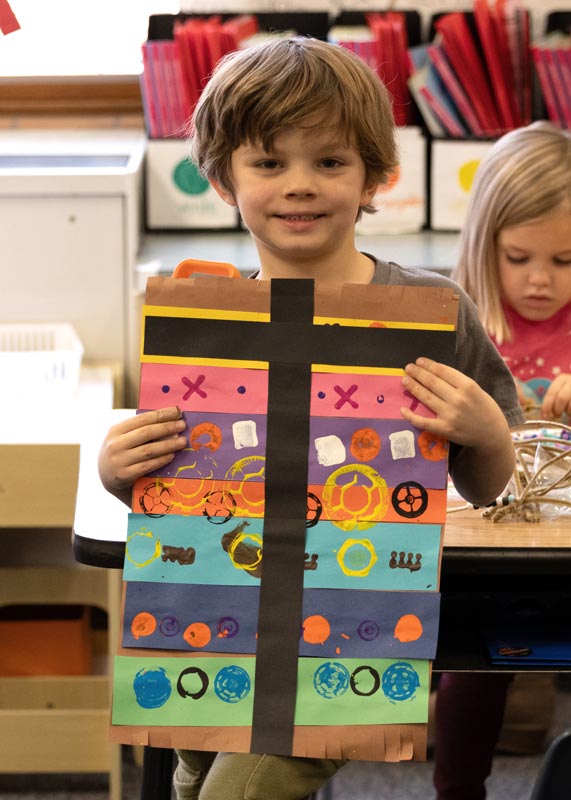
    Amy Luce smiling at the camera.One of Rose Park/HC2 art teacher Amy Luce’s favorite assignments to teach is a kindergarten rendition of Navajo rug weaving using cutting, gluing, and pattern making with strips of construction paper. Amy explains who Navajos are, and then “introduces” them to Christian Navajo artist Elmer Yazzie, while also teaching them pattern making, and how Elmer uses his art to tell his people about Jesus. Kindergartners learn about the process of raising and shearing sheep, then carding and hand spinning wool.

    “Today it’s pretty rare to see the entire process in one community, and the kids enjoy learning about it,” Amy said, explaining that students then look closely at the designs of traditional Navajo rugs, and then create their own on paper. “They print with found objects such as old spools of thread and legos on paper.” After students look for Christian symbols in Elmer Yazzie’s art, they ponder “‘How could you use art to tell others about Jesus?’ The last thing we do is glue a cross on top of our weaving to help us remember how art gives us an opportunity to share God’s story with others,” Amy said.

    Have Questions?

    We look forward to meeting you and your family and introducing you to the fresh, creative, personalized education at Holland Christian! We are here to help! Get in touch using the contact form linked below or call us at 616.820.2805.

    Get in Touch!
  • Top TRIP Tips

    Top TRIP Tips

    Fall 2023 Connections

    Our best estimate is that out of over 1000 HC families, only about 20% use TRIP as a way to put extra money into their tuition accounts. TRIP, an acronym for “Tuition Reduction Incentive Program,” is a fundraising program that uses gift cards, whether purchased online or via a paper order form through Holland Christian Schools to shop at major food, retail, and online stores. A variety of stores sell HC their gift cards at a discount, and then HC sells the cards at face value to participants, crediting their tuition account with the difference; sometimes that difference could be 3%, and sometimes it could be all the way up to 20%, like Biggby’s gift cards are, with everything in between.

    ”TRIP has changed so much, and has gotten a lot more user-friendly. TRIP is magic—it’s just magic!

    The thing is, anyone in the community can participate, and not just current HC families: we’ve got grandparents, relatives, friends, and potential HC families, or couples with no children yet—all who use TRIP to make regular purchases, then send their TRIP earnings to the account of a presently enrolled family of their choice, save it for their own future family, or even donate it to Holland Christian’s Tuition Grant Fund. And if it’s been a few years since you attempted to use TRIP, you might want to give it another go—it’s gotten so much more convenient.

    “TRIP has changed so much, and has gotten a lot more user-friendly,” said Kim Hekman ‘02, HC’s TRIP Coordinator. “It’s become so much more available instantly and on a phone that it takes a lot of planning out of it. And Raise Right is continuing to make the user experience much better. TRIP is magic—it’s just magic!”

    The biggest complaint we hear from parents is that TRIP is too complicated to use. And to be honest, a few of us thought so at first too. But we’re here to show how easy it can be to use if you break it down into regular life activities. So we’re giving you four easy ways to use TRIP in your everyday life right here:

    Number 1: Trash

    Kim Hekman recommends starting small, with one easily managed purchase, like maybe your trash pick up (if you don’t live in the City of Holland). The bonus is that you need to think about it only every third month or so, and it’s for a worthwhile amount: Arrowaste offers 12% towards your tuition, while Republic offers 11%.

    After you receive your trash/recycling bill in the mail, purchase the TRIP certificates for that trash company through the Wednesday morning TRIP tables that are at Rose Park or the High School, or by using the blue weekly order form (also online at hollandchristian. org/admissions/financial-aid/trip/), then pay your full bill by mailing in the TRIP certificates instead of a personal check. If you—or a grandparent, for example— happen to pay a business’s trash through HC TRIP as well, you can really increase your monthly TRIP income.

    The next easiest category is probably gas, since we all need gas, right? Whether you pump gas most frequently at Quality, BP, Speedway, Meijer, Mobil, or even Sam’s Club, you can earn TRIP money from each gas fill-up by purchasing gas gift cards at the TRIP table. If you want, you can reload some of the gas gift cards online right before you get gas, like with Walmart’s gift cards to pump gas at Sam’s Club.

    Or, if you have teenage drivers, physical gas gift cards are an easy way to provide gas for your teens, and you can keep the denominations smaller if they’re likely to lose the cards. If you like to make road trips, Kim recommends looking ahead at the national chain gas stations likely to be on your route, and purchasing a variety of those national chain gas cards ahead of time.

    Number 2: Gas pump
    Number 3: Groceries

    A third easy category for using TRIP is food, since we all need to grocery shop, so why not do it while also saving a percentage off of your tuition?

    How you use TRIP for groceries depends on where you like to grocery shop: There are physical Family Fare and Meijer gift cards available each week, some reloadable online, as well as Walmart and Amazon. If you’re a committed Aldi shopper, you can use the Instacart app, and have your groceries either delivered to your house, or gathered and waiting for you to pick up at Aldi. You can even purchase the annual Aldi Instacart fee through TRIP by using the Raise Right app, or use a prepaid Visa card that has no activation fee. In order to use TRIP through the very easy Raise Right app, you’ll need a school code from the TRIP coordinators that we are not allowed to publish online (too many robots out there!) Just email them at trip@hollandchristian.org for this code, and they’ll get it to you ASAP, though it’s helpful if you can give it a day or two.

    Your best next TRIP step is to get yourself to a Wednesday morning TRIP table at either Rose Park or HCHS, between 7:30-9am, and ask for help from either Kristi Lokker or Kim Hekman. Often the other moms (or dads or grandparents) who are also purchasing TRIP certificates will have great suggestions for how they use it as well. You can also visit our TRIP page at dev.hollandchristian.org/trip or email trip@hollandchristian.org.

    Stay tuned to our HCS social media—we plan to post TRIP suggestions on our Facebook and Instagram pages, and we’d love to hear back from you on the ways your family is using TRIP!

    Number 4: lightbulb
  • HCHS Spanish Immersion Internships

    HCHS Spanish Immersion Internships

    Spring 2023 Connections

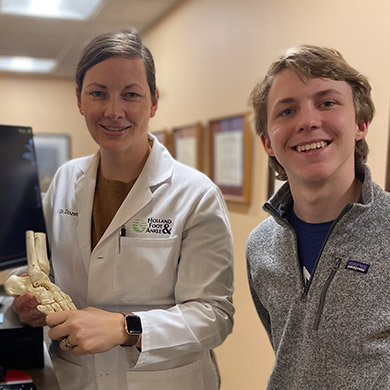
    HCHS Spanish Immersion student Aidan Delcalzo ’23 never anticipated that his Spanish speaking skills would allow him to watch foot surgery in person.

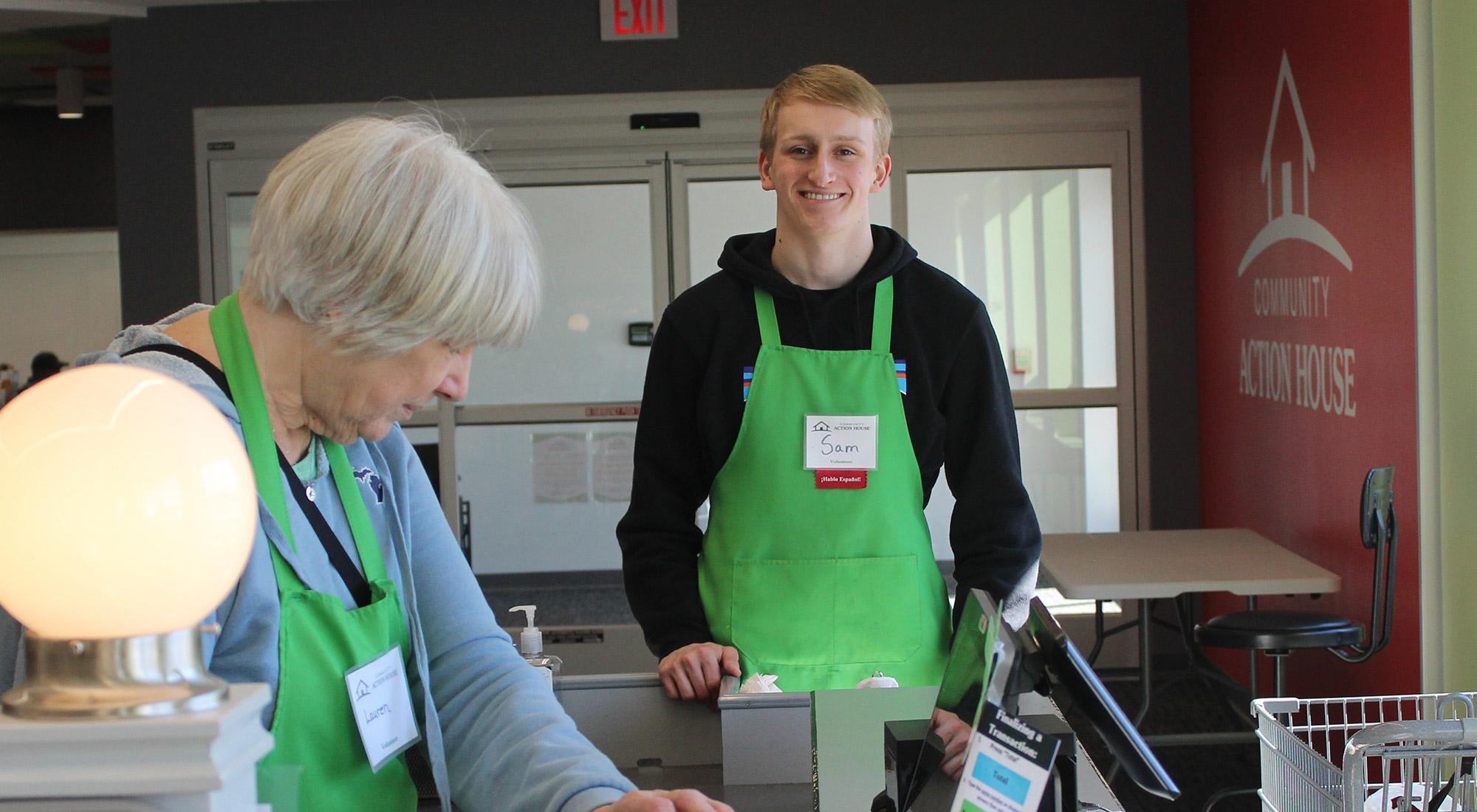
    And Sam DeBoer ’23 really never planned on bagging groceries at Community Action House, but found while doing it this spring that his Spanish was actually quite helpful.

    Kate Schemper ’23 used her Spanish a little while interning this spring at Winning at Home, but she used it a lot at Zeeland Christian School, where she interned with Jodi Pierce, working with 3rd grade Spanish Immersion students there.

    This is the second year of the HCHS Spanish Immersion (SI) Senior Internship Class as the senior capstone class that placed HC students in a variety of work locations throughout Holland and Zeeland to try out their Spanish in a work setting.

    And most learned a new vocabulary.

    “They’re not at all similar!” Aidan exclaimed about Spanish vs English names for foot bones. “There’s all different parts of the foot—like 80 of them, and the English and Spanish are not at all similar.”

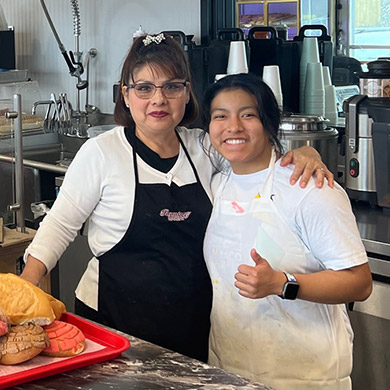
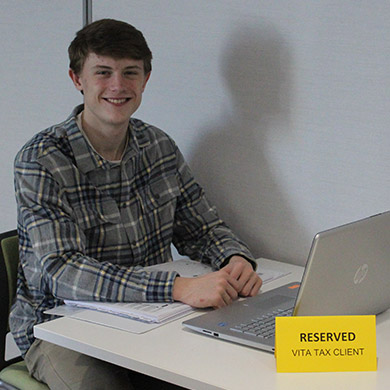
    Izzy Leys ’23 learned the nuances of Mexican pastries and baking terminology through Ramirez and Colin’s Bakeries. Kyle Cannon ’23 studied tax terms to help with filing taxes through the Community Action House. Students learned a few unexpected things as well.

    “It was helpful learning a lot about what a doctor does in day-to-day terms, and gave me insight into what I need to learn in college,” Aidan said, adding that he’s not sure if he wants to go into planes, feet, or business after college.

    “Being able to speak both English and Spanish and translate is a blessing to those [who] need [it],” Sam DeBoer emailed, “and doing what I’m doing can really have an impact on your life and the lives of others.”

    HCHS Spanish Immersion intern smiling at the camera with the podiatrist holding a foot skeleton.

    ”We’re getting [students] into a more authentic context of speaking Spanish.

    “I learned how different workplaces in the community of Holland and Zeeland use Spanish,” Kate Schemper added. “There are many workplaces in our community that work really hard to provide equal supplies to people in both Spanish and English (as well as other languages). This class has helped me see where my interests lie and what careers I could see myself in.”

    “Because I haven’t used my Spanish much outside of school, the language always seemed kind of far away, but being in this class I realized that there’s a whole community of Spanish-speaking people right here in Holland,” Isabelle Leys emailed. “The bakery business does not really fit the field I want to go into; however, the social aspect of the job helps me learn more about culture and how in different parts of the world, people just have different patterns of behavior…and the biggest bonus is that I get a LOT of free dessert!”

    Before her internship with Rose Park SI kindergarten teacher Hillary Klipp Lopez, Kayla Cannon ’23 was thinking about possibly going into education: “It’s been really fun!” Kayla said. “Before I was thinking 5th grade, but I do really like kindergarten, and I would probably consider teaching in Spanish Immersion,” she added.

    “We’re getting [students] into a more authentic context of speaking Spanish,” explained Anna Slenk ’02, HCHS’s SI coordinator, who helped create the class along with the class teacher, Noelle Solis. “Our students have [rarely] been in spaces where they are the minority. Plus there are so few chances for our students to work alongside and learn from more people, versus feeling like they need to serve someone.”

    “Having a second language is so much more than trying to get a leg up, or a better job,” Anna added—as beneficial as that might be. But it’s also “the ability to communicate, and understanding the cross-cultural community in order to do that well.”

    Once a week the internship students gather in class to read and discuss and compare notes, to assess the use of language, both English and Spanish, in the context of their internship location. At the end of the internships, students present to their friends and family at a banquet what they learned.

    We “want to understand how the Hispanic community is shaping Holland, look at how you can use [Spanish] now that you’re done [with high school], show them that you don’t need to go far to use your Spanish,” Noelle said.

    Anna says that too frequently students think they will reach a point when they know all the Spanish they need to know. Instead, she wants them to “understand what it’s like to be a lifelong language learner, that the language used in school is different than the medical profession, that every field has unique languages—that you never really arrive. It’s a reminder that maybe I still have a lot to learn, and … there’s a lot of new to be discovered!”

    HCHS’s SI program is in its eighth year, and has developed into an amazing program—one that other secondary SI programs have asked to copy. Despite some initial difficulties settling into which college program we could attach ourselves to for advanced/college Spanish credits, things have settled into place. We are able to offer a rotating variety of classes so that students and families have flexibility and choices, as well as a wealth of experiences.

    HCHS Spanish Intern Kyle smiling at the camera from his Vita Tax help desk, study materials in front of him.
    HCHS SPanish Immersion intern student reading with a 3rd grade ZCS Spanish Immersion female student

    “We went on tons of field trips, from churches to bakeries,” said Kayla. “We did service days—[Solis] found ways to apply our Spanish skills so much in the real world, rather than just in class.”

    Of course we are grateful for the plethora of community businesses and organizations willing to take in our SI students as interns, so our students not only use their second language in community, but can explore future careers:

    “Allowing high school students to experience a medical career firsthand is a special way for them to gain insight on understanding their own gifts and talents, and learn how God may lead them in the future,” emailed Dr. Allison Dozeman, DPM about Aidan’s internship with her at the Holland Foot & Ankle Center. “It is especially interesting for me to work with a Spanish Immersion student from Holland Christian. I studied Spanish as a high school and undergraduate student, and I am thankful to be able to use these skills in a practical sense in a medical setting.”

    HCHS Spanish Intern Kayla teaching a group of Spanish Immersion kindergartners.

    “The kids absolutely LOVE [Kayla] and are always asking if it is a day when ‘Maestra Kayla’ is coming to see them,” Hillary said. “They think it is so cool that she was once a Spanish Immersion kindergarten student just like them! It is also fun for me to work with Kayla as an aspiring future teacher, give her tips, show her what has worked or not worked for me in the classroom, and seeing her joy and enthusiasm with my students. It is truly a blessing to have this kind of full-circle partnership with our high school immersion students!”

    Plus the idea of our SI students in community internships fits in so beautifully with HC’s whole reason for existence: “The Spanish Immersion program at HCHS is an invaluable opportunity for our students not only because of the clear academic and professional benefits, such as higher critical thinking and problem-solving skills, but more importantly because immersion encourages students to see more intimately the image of God in people who speak the language around the world,” wrote HCHS principal Miles Colago. “Our students are learning Spanish in order to deepen their love of their neighbor and, in so doing, transform the world distinctively for Jesus Christ.”

    To read more about HCHS’ Spanish Immersion program, visit the HCHS Spanish Immersion page.